Sts. Cyril and Methodius: Apostles to the Slavs
Quick answer
Sts. Cyril (about 826–869) and Methodius (about 815–885) were brothers from Thessalonica, in Greece, who were sent in 863 to preach to the Slavs of Great Moravia. Cyril created an alphabet, Glagolitic, to write the Slavonic language, and the brothers translated the Scriptures and the liturgy. Supported by the popes, they faced strong opposition. They are called the Apostles to the Slavs, and Pope St. John Paul II named them co-patrons of Europe in 1980. Their feast is February 14.
Key takeaways
- They grew up in Thessalonica, where many Slavs lived, and knew their language.
- Cyril, originally named Constantine, was a brilliant scholar in Constantinople.
- They translated the Gospels and the liturgy into Old Church Slavonic.
- Pope Adrian II approved the Slavonic liturgy, and Cyril died in Rome in 869.
Long before the modern missions, two brothers from Greece understood that people need to hear the Gospel in their own tongue. Their work shaped the faith and culture of Eastern Europe for more than a thousand years.
Two Brothers from Thessalonica
Methodius and his younger brother Constantine, who later took the name Cyril, were born in Thessalonica, a Byzantine city with many Slavic neighbors. They grew up speaking the Slavic language of the area.
Methodius served as a governor, then became a monk. Constantine studied in Constantinople, became a priest and taught philosophy, earning the nickname “the Philosopher.” He went on a diplomatic and missionary journey to the Khazars, near the Black Sea.
The Mission to Moravia
In 862 Prince Rastislav of Great Moravia, in present-day Czech Republic and Slovakia, asked the Byzantine emperor for teachers who could explain the faith to his people in their own language. The emperor sent the two brothers in 863.
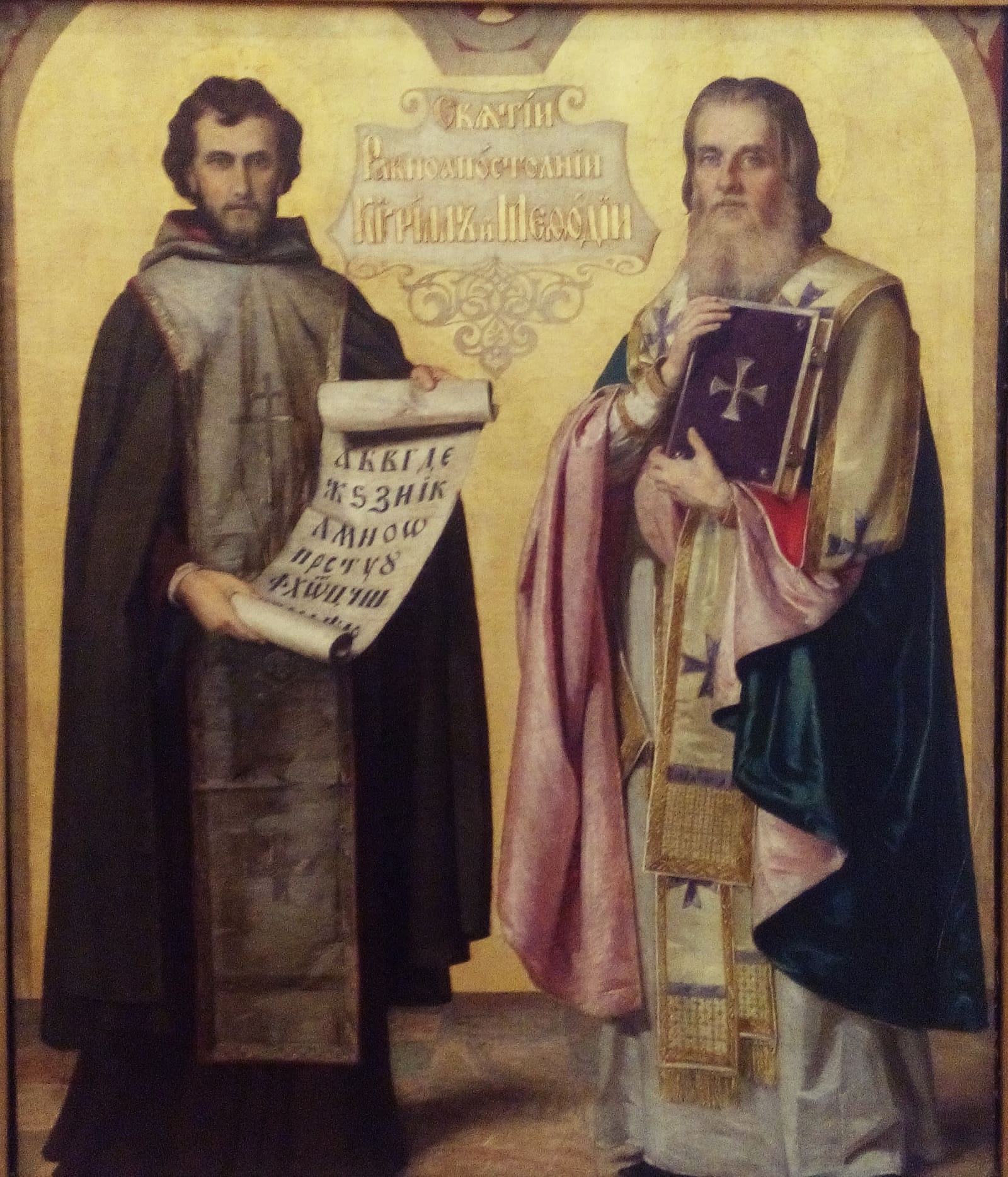
To write the Slavic language, Constantine created a new alphabet, now called Glagolitic. The brothers translated the Gospels, the Psalms and the liturgy into the language now called Old Church Slavonic. They trained Slavic disciples to be priests.
Opposition and Rome
German clergy in the region opposed them, insisting that the liturgy could only be in Latin, Greek or Hebrew. The brothers went to Rome. In 868 Pope Adrian II received them warmly, approved their Slavonic books and had them placed on the altar of a Roman church. Some of their disciples were ordained.
Constantine became a monk in Rome, taking the name Cyril. He fell ill and died there on February 14, 869. He is buried in the Basilica of San Clemente.
Methodius Carries On
The pope made Methodius archbishop of Sirmium, with authority over the Slavic lands. Opponents had him imprisoned for over two years in Germany until Pope John VIII secured his release. Methodius continued the work, completing a translation of most of the Bible, until his death in 885.
After his death, his disciples were driven out of Moravia, but they took the Slavonic liturgy and letters to Bulgaria, Serbia and Kievan Rus’, where they flourished.
Patrons of Europe
In 1980 Pope St. John Paul II, the first Slavic pope, named Cyril and Methodius co-patrons of Europe, with St. Benedict. He praised them for proclaiming the Gospel in a way that respected the culture of each people while keeping unity with the universal Church.
A Prayer for Christian Unity (Original Prayer)
Sts. Cyril and Methodius, you brought the Gospel to the Slavs in their own language. Pray for the unity of Christians in East and West, and help me share the faith in words others can understand. Amen.
Continue Reading
Read about St. Boniface, apostle of Germany, St. Patrick, or St. Andrew, patron of the Christian East.
Frequently asked questions
When is the feast of Sts. Cyril and Methodius?
February 14 in the Roman calendar. Many Eastern Churches honor them on May 11.
Did St. Cyril invent the Cyrillic alphabet?
Cyril created the Glagolitic alphabet. The Cyrillic alphabet, named in his honor, was developed a little later by their disciples, probably in Bulgaria.
Why are they patrons of Europe?
Because they united the Christian East and West in their mission, bringing the faith to the Slavic peoples in their own language while remaining in communion with Rome. St. John Paul II named them co-patrons of Europe with St. Benedict.
Sources
- Vita Constantini and Vita Methodii (ninth century)
- Pope St. John Paul II, Encyclical Slavorum Apostoli (1985)
- Pope St. John Paul II, Apostolic Letter Egregiae Virtutis (1980)