St. Andrew the Apostle: The First Called
Quick answer
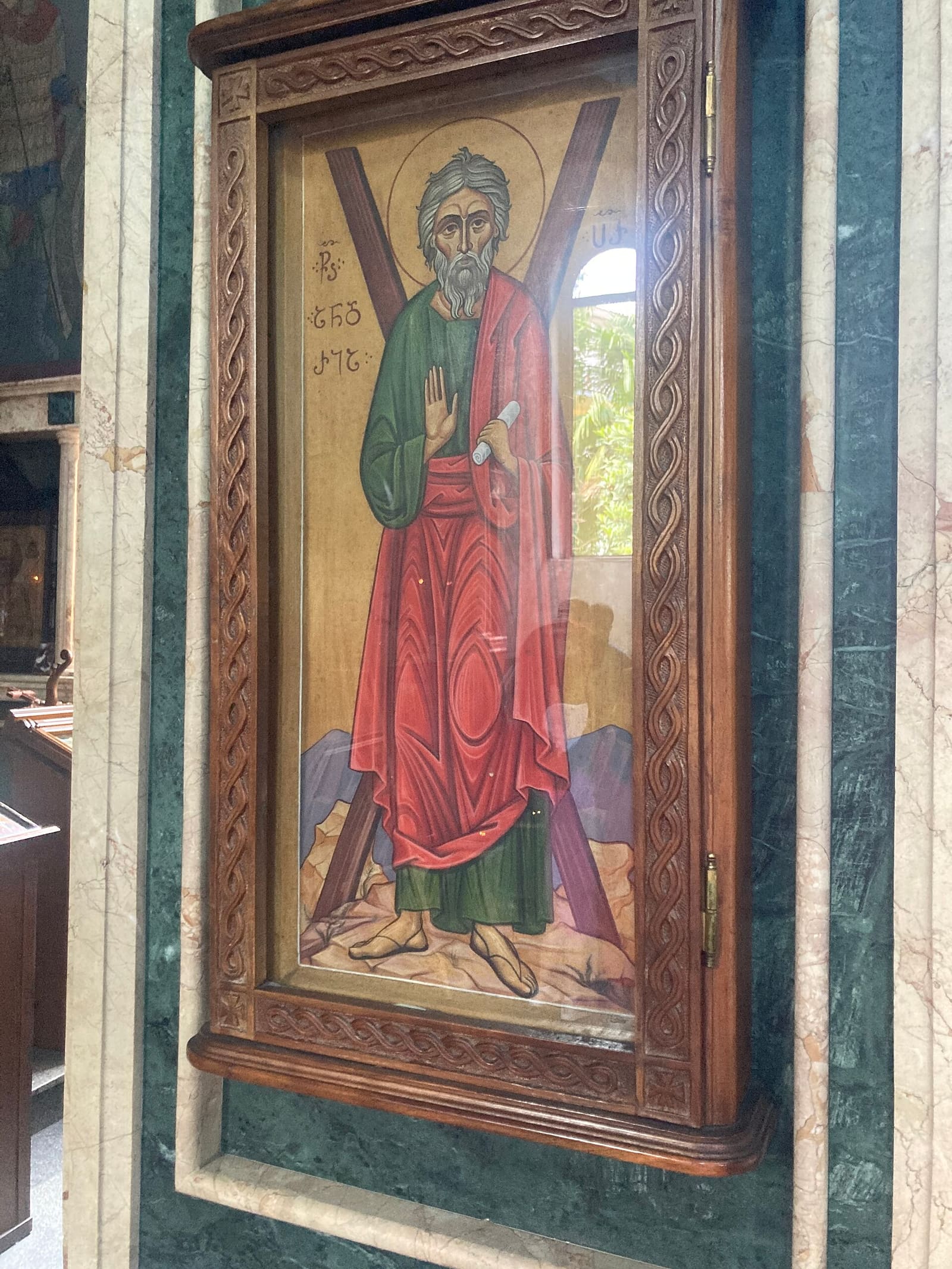
St. Andrew was a fisherman from Bethsaida, the brother of Simon Peter, and a disciple of John the Baptist before he followed Jesus. He brought his brother to the Lord. Tradition says he preached in Greece and the lands around the Black Sea and was crucified at Patras on an X-shaped cross. He is patron of Scotland, Greece and Russia, and of the Ecumenical Patriarchate of Constantinople. His feast is November 30.
Key takeaways
- He was the first disciple named in John's Gospel to follow Jesus (John 1:35-40).
- He brought Peter to Jesus, saying, "We have found the Messias."
- He pointed out the boy with five loaves and two fish (John 6:8-9).
- His feast on November 30 begins the traditional St. Andrew Christmas Novena.
St. Andrew’s whole role in the Gospels can be summed up in one phrase: he brought people to Jesus. First his brother, then a boy with a basket of bread, then a group of curious Greeks.
The First Called
Andrew was a fisherman from Bethsaida in Galilee, the brother of Simon. He was a disciple of John the Baptist. One day, as Jesus walked by, John said, “Behold the Lamb of God.” Andrew and another disciple followed Jesus, who turned and asked what they were seeking. They spent the day with Him (John 1:35-40).
For this reason the Eastern Churches call Andrew the Protokletos, the “First Called.”
Bringing Others
The first thing Andrew did was find his brother:
He findeth first his brother Simon, and saith to him: We have found the Messias, which is, being interpreted, the Christ. And he brought him to Jesus. (John 1:41-42, Douay-Rheims)
Later, when five thousand people were hungry, it was Andrew who noticed the boy with five barley loaves and two fish (John 6:8-9). When some Greeks wanted to see Jesus, they asked Philip, and Philip and Andrew brought them to Him (John 12:20-22). Andrew was one of the four, with Peter, James and John, who asked Jesus on the Mount of Olives about the end of the age (Mark 13:3).
His Mission and Martyrdom
After Pentecost, early tradition recorded by Eusebius says Andrew preached in Scythia, the region north of the Black Sea. Other traditions place him in Greece. He is said to have been crucified at Patras, Greece, on an X-shaped cross, and to have hung there for two days, preaching to the people.
His relics were later brought to Constantinople, then to Amalfi in Italy. A portion is venerated in Patras, returned by Pope St. Paul VI in 1964 as a gesture of friendship with the Orthodox.
Patron of Many Nations
Andrew is patron of Scotland, whose flag bears his cross, and of Greece, Russia, Ukraine and Romania. He is the patron of the Ecumenical Patriarchate of Constantinople, as Peter is of Rome. Every year on November 30 the pope sends a delegation to the patriarch, and the patriarch sends one to Rome on June 29, a sign of hope for Christian unity.
The St. Andrew Christmas Novena
Many Catholics begin a beloved prayer on his feast, repeating it fifteen times a day until Christmas:
Hail and blessed be the hour and moment in which the Son of God was born of the most pure Virgin Mary, at midnight, in Bethlehem, in piercing cold. In that hour vouchsafe, O my God, to hear my prayer and grant my desires, through the merits of our Savior Jesus Christ, and of His blessed Mother. Amen.
A Prayer to St. Andrew (Original Prayer)
St. Andrew, you brought your brother to Jesus. Help me bring my family and friends to Him, and pray for the unity of all Christians. Amen.
Continue Reading
Read about his brother St. Peter, St. John the Baptist, or when Advent starts.
Frequently asked questions
When is the feast of St. Andrew?
November 30.
What is the St. Andrew Christmas Novena?
A short prayer traditionally said fifteen times a day from November 30 until Christmas, beginning "Hail and blessed be the hour and moment in which the Son of God was born of the most pure Virgin Mary."
Why is the St. Andrew's cross shaped like an X?
Tradition says he was crucified on an X-shaped cross, called a saltire. It appears on the flag of Scotland.
Sources
- Gospel of John 1:35-42; 6:8-9; 12:20-22; Mark 1:16-18 (Douay-Rheims)
- Eusebius, Church History III.1
- Pope Benedict XVI, General Audience on St. Andrew (June 14, 2006)