St. Thomas the Apostle: From Doubt to "My Lord and My God"
Quick answer
St. Thomas, called Didymus or "the Twin," was one of the Twelve. He was ready to die with Jesus, asked the question that led to "I am the way, the truth and the life," and doubted the Resurrection until he saw the risen Lord, then cried out, "My Lord and my God." Ancient tradition holds that he preached in India and was martyred near Chennai. His feast is July 3.
Key takeaways
- When Jesus went to Bethany, Thomas said, "Let us also go, that we may die with him" (John 11:16).
- His question at the Last Supper drew Jesus' words "I am the way, and the truth, and the life."
- Seeing the risen Christ, he made the clearest confession of Jesus' divinity in the Gospels.
- The St. Thomas Christians of India trace their faith to his preaching.
We tend to remember St. Thomas for one bad week. But the Gospel tells us much more about him, and his doubts ended in the greatest profession of faith in the New Testament.
A Brave and Honest Apostle
Thomas was called Didymus, which means “twin.” The Gospels never tell us who his twin was.
When Jesus decided to return to Judea, where His enemies wanted to stone Him, to raise Lazarus, Thomas said to the others, “Let us also go, that we may die with him” (John 11:16). He was loyal and brave.
At the Last Supper, when Jesus spoke of going to prepare a place for them, Thomas admitted he did not understand: “Lord, we know not whither thou goest; and how can we know the way?” Jesus answered with some of His most famous words: “I am the way, and the truth, and the life” (John 14:5-6).
Doubt and Faith
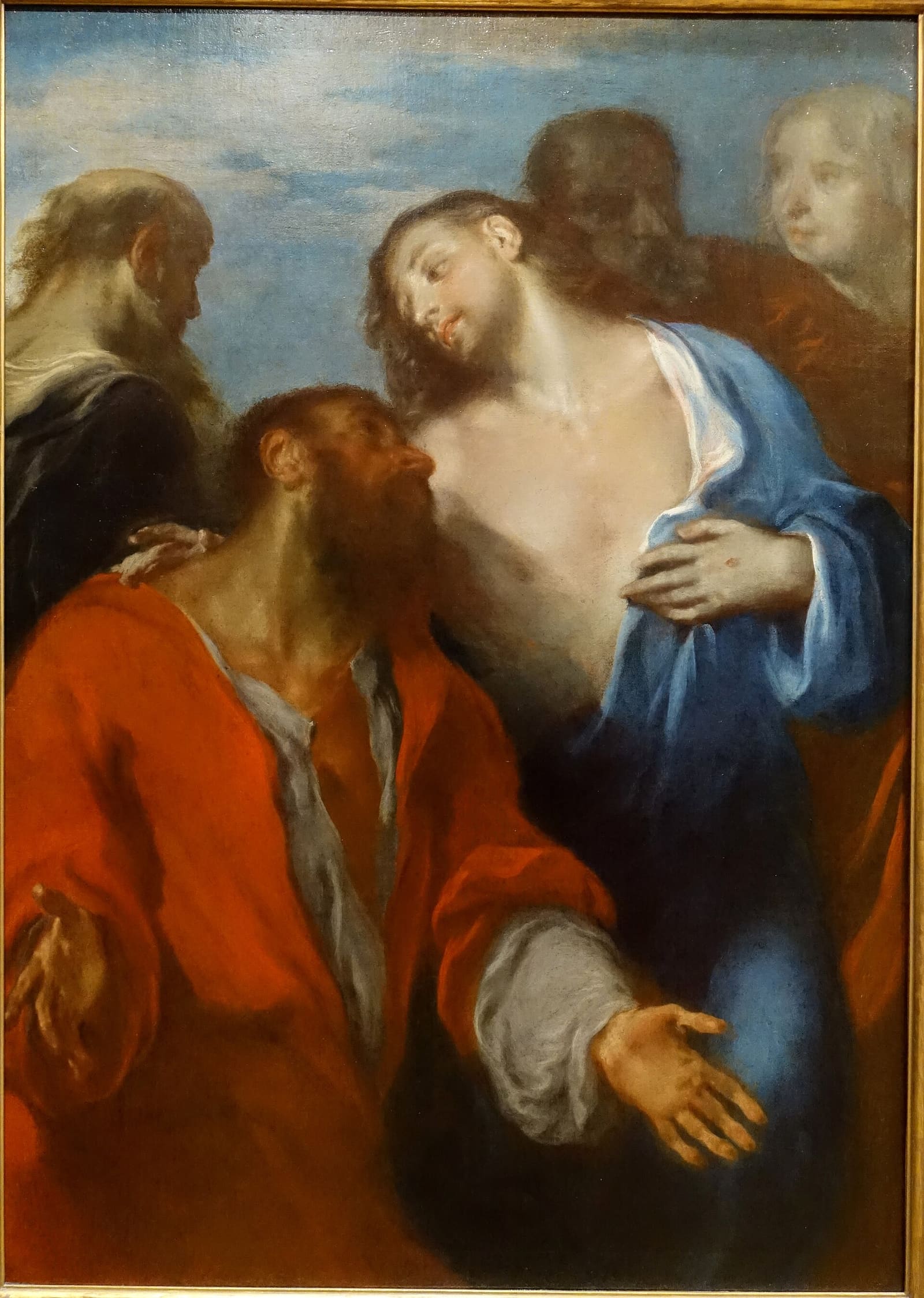
Thomas was not with the others when the risen Jesus first appeared to them. When they told him, he said he would not believe unless he put his finger into the nail marks and his hand into Jesus’ side. A week later Jesus came again and invited him to do just that.
Thomas answered, and said to him: My Lord, and my God. Jesus saith to him: Because thou hast seen me, Thomas, thou hast believed: blessed are they that have not seen, and have believed. (John 20:28-29, Douay-Rheims)
Pope St. Gregory the Great observed that Thomas’s doubt did more for our faith than the faith of the believing disciples, because when he touched the wounds, our doubts were healed too.
Apostle of India
Early Christian tradition says that Thomas carried the Gospel east, to Parthia and to India. The ancient St. Thomas Christians of Kerala, in southwest India, trace their Church to his preaching around the year 52. Tradition says he was martyred by a spear near Mylapore, today part of Chennai, where the Basilica of San Thome stands.
What He Teaches
Thomas shows that honest questions are not the enemy of faith. He brought his doubts to the community, stayed with them, and met Jesus there. And Jesus’ words to him are meant for us: blessed are those who have not seen and yet believe.
A Prayer in Times of Doubt (Original Prayer)
St. Thomas, you doubted, then believed. When my faith is weak, stay with me. Help me meet the risen Jesus in His Church, and say with you, “My Lord and my God.” Amen.
Continue Reading
Read about St. Peter, St. Bartholomew, or what Catholics believe about Jesus.
Frequently asked questions
When is the feast of St. Thomas the Apostle?
July 3. Before 1970 it was kept on December 21, and some traditional calendars still use that date.
Why is he called doubting Thomas?
Because he said he would not believe in the Resurrection unless he saw and touched Jesus' wounds (John 20:25).
Where is St. Thomas buried?
Tradition places his tomb at San Thome in Chennai, India. Most of his relics were later taken to Ortona, Italy.
Sources
- Gospel of John 11:16; 14:5-6; 20:24-29; 21:2 (Douay-Rheims)
- Pope Benedict XVI, General Audience on St. Thomas (September 27, 2006)
- Acts of Thomas (third century)