St. Catherine of Siena: Mystic, Peacemaker and Doctor of the Church
Quick answer
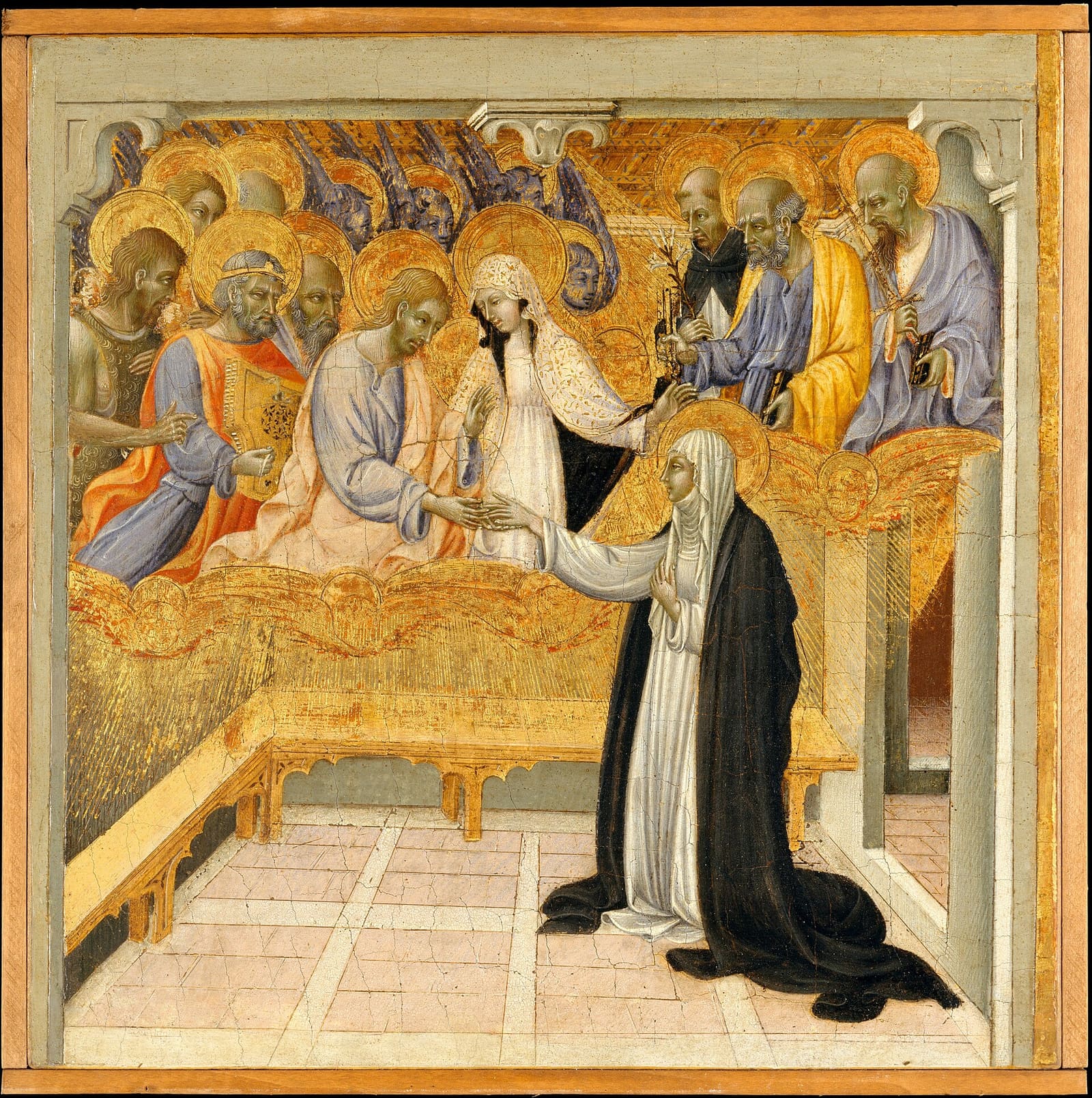
St. Catherine of Siena (1347–1380) was a Dominican tertiary, a laywoman who lived a life of prayer at home, served the sick and the poor, and worked tirelessly for peace and for the reform of the Church. She urged Pope Gregory XI to return from Avignon to Rome. She is a Doctor of the Church and a patron of Italy and of Europe. Her feast is April 29.
Key takeaways
- She was the 24th or 25th child of a family of dyers in Siena.
- She joined the Dominican laywomen known as the Mantellate and lived in prayer, then in service to the sick.
- She encouraged Pope Gregory XI to return the papacy from Avignon to Rome, which he did in 1377.
- Her book The Dialogue records conversations between God and the soul.
She never learned to write until late in life, never held an office in the Church, and died at thirty-three. Yet St. Catherine of Siena spoke with popes and princes, and the Church counts her among her greatest teachers.
A Child of Siena
Catherine Benincasa was born in 1347 in Siena, Italy, one of the youngest of many children of a wool dyer. As a little girl she had a vision of Christ blessing her, and at about seven she privately promised her life to God.
Her parents hoped she would marry. Catherine cut off her hair in protest, and for a time her family made her do the household chores as a servant. She turned even this into prayer, imagining that she was serving the Holy Family.
Prayer, Then Service
At around sixteen she joined the Mantellate, Dominican laywomen who wore the habit but lived at home. For three years she lived almost in silence in a small room, praying and fasting. Then she understood that Christ was sending her out to serve others.
She nursed the sick in Siena’s hospitals, including people with leprosy and the plague, cared for the poor and visited prisoners. A group of followers, priests and lay people, gathered around her.
A Voice for the Church
In Catherine’s time the popes lived in Avignon, in France, not in Rome. Catherine wrote to Pope Gregory XI with great respect and great frankness, calling him “sweet Christ on earth” and urging him to return to Rome. In 1376 she traveled to Avignon herself. The pope returned to Rome in 1377.
She also worked for peace between Italian cities. Nearly four hundred of her letters survive, dictated to her secretaries.
The Dialogue
Her great book, The Dialogue, records conversations between the Eternal Father and a soul. It speaks of God’s mercy, the dignity of the soul, and Christ as the bridge between heaven and earth. One of the lines most often attributed to her teaching is that if we are what we should be, we will set the whole world on fire.
Her Death
When a schism divided the Church after 1378, Catherine went to Rome to support Pope Urban VI and offered her sufferings for the Church. She died there on April 29, 1380. She was canonized in 1461, declared a Doctor of the Church in 1970, and named a patron of Europe in 1999.
A Prayer for the Church (Original Prayer)
St. Catherine, you loved the Church as your mother. Pray for our Holy Father, our bishops and our priests. Give me your courage to speak the truth with love, and your tenderness toward the sick and the poor. Amen.
Continue Reading
Read about St. Teresa of Ávila, another woman Doctor of the Church, St. Dominic, or our guide to the popes.
Frequently asked questions
When is the feast of St. Catherine of Siena?
April 29.
Was St. Catherine of Siena a nun?
No. She was a laywoman, a member of the Dominican Third Order, who lived at home rather than in a convent.
What is she the patron saint of?
She is a patron of Italy and of Europe, and is invoked by nurses and the sick.
Sources
- Blessed Raymond of Capua, The Life of St. Catherine of Siena
- St. Catherine of Siena, The Dialogue and Letters
- Pope St. Paul VI, Proclamation as Doctor of the Church (October 4, 1970)
- Pope St. John Paul II, Spes Aedificandi (1999)