St. Catherine of Alexandria: Feast Day (November 25), Patron and Prayer
Quick answer
St. Catherine of Alexandria is a virgin martyr traditionally said to have died around 305 in Alexandria, Egypt, after defending the faith before the emperor and converting pagan philosophers. Her feast is November 25. She is patron of philosophers, students, young women and preachers, though much of her story is legend.
Key takeaways
- St. Catherine of Alexandria's feast is November 25, an optional memorial in the Roman calendar.
- Tradition says she was a learned young Christian of Alexandria martyred around 305, but most details of her story cannot be verified.
- Her feast was removed from the general calendar in 1969 and restored in the 2002 Roman Missal.
- She is patron of philosophers, students, teachers, preachers, young women and those who work with wheels.
St. Catherine of Alexandria is a virgin martyr honored by the Church on November 25. According to ancient tradition she was a learned young Christian woman of Alexandria in Egypt who defended the faith before the emperor, out-argued pagan philosophers, and was put to death around the year 305. She is the patron saint of philosophers, students, young women and preachers.
Her story is one of the most loved of the Middle Ages, and also one of the hardest to verify. Below we look at what tradition tells us, what the Church says about it, and why her example still speaks to us.
Who Was St. Catherine of Alexandria?
Alexandria, on the Mediterranean coast of Egypt, was one of the great cities of the Roman Empire and a famous center of learning. Tradition says Catherine was born there to a noble family, received an excellent education, and became a Christian as a young woman.
When the emperor (usually named as Maxentius) persecuted the Christians, Catherine is said to have gone to him in person to protest. The emperor called in some fifty pagan philosophers to argue her out of her faith. Instead, the story goes, she won them over, and they became Christians and were martyred themselves.
She was then condemned to be torn apart on a spiked wheel. When she touched it, the wheel broke. In the end she was beheaded. A later tradition adds that angels carried her body to Mount Sinai.
What Can We Know for Certain?
Honesty matters here. The written accounts of Catherine’s life come from several centuries after the events they describe, and historians have found little that can be confirmed. Many details, like the debate and the breaking wheel, belong to legend rather than history.
For this reason, when the Roman calendar was revised in 1969, her feast was removed from the general calendar. It was restored as an optional memorial in the 2002 edition of the Roman Missal under Pope St. John Paul II. The Church continues to honor her, while recognizing that we know her story mainly through ancient devotion. The old Catholic Encyclopedia article on St. Catherine gives a careful account of the sources.
What is certain is that Christians in East and West have prayed to her for well over a thousand years. The famous monastery at the foot of Mount Sinai, founded in the sixth century, came to bear her name and is still a place of pilgrimage today.
Why Does the Church Honor St. Catherine?
The Church honors saints because their lives show the grace of Christ at work, and because they pray for us in the communion of saints (CCC 828, 956). Catherine’s story, whatever its exact details, holds up several things the Church has always prized:
- Courage under persecution. Like St. Agnes and St. Cecilia, she is remembered as a young woman who chose Christ over safety.
- Faith and reason together. She used her mind in the service of the Gospel. The Church teaches that faith and reason are not enemies, since the same God gives both (CCC 159).
- Bold witness. She spoke the truth to the most powerful man in the empire.
She was also counted among the Fourteen Holy Helpers, a group of saints much invoked in the Middle Ages. And she was one of the saints whose voices St. Joan of Arc said guided her, together with St. Michael and St. Margaret.
What Is St. Catherine of Alexandria the Patron Saint Of?
Because of her learning and her debate with the philosophers, St. Catherine is patron of:
| Patronage | Reason |
|---|---|
| Philosophers and scholars | She defended the faith with reason |
| Students and teachers | Her learning; many medieval schools took her as patron |
| Preachers and apologists | She persuaded the philosophers |
| Young unmarried women | She consecrated her virginity to Christ |
| Librarians | Her love of books and learning |
| Wheelwrights and those who work with wheels | The wheel of her martyrdom |
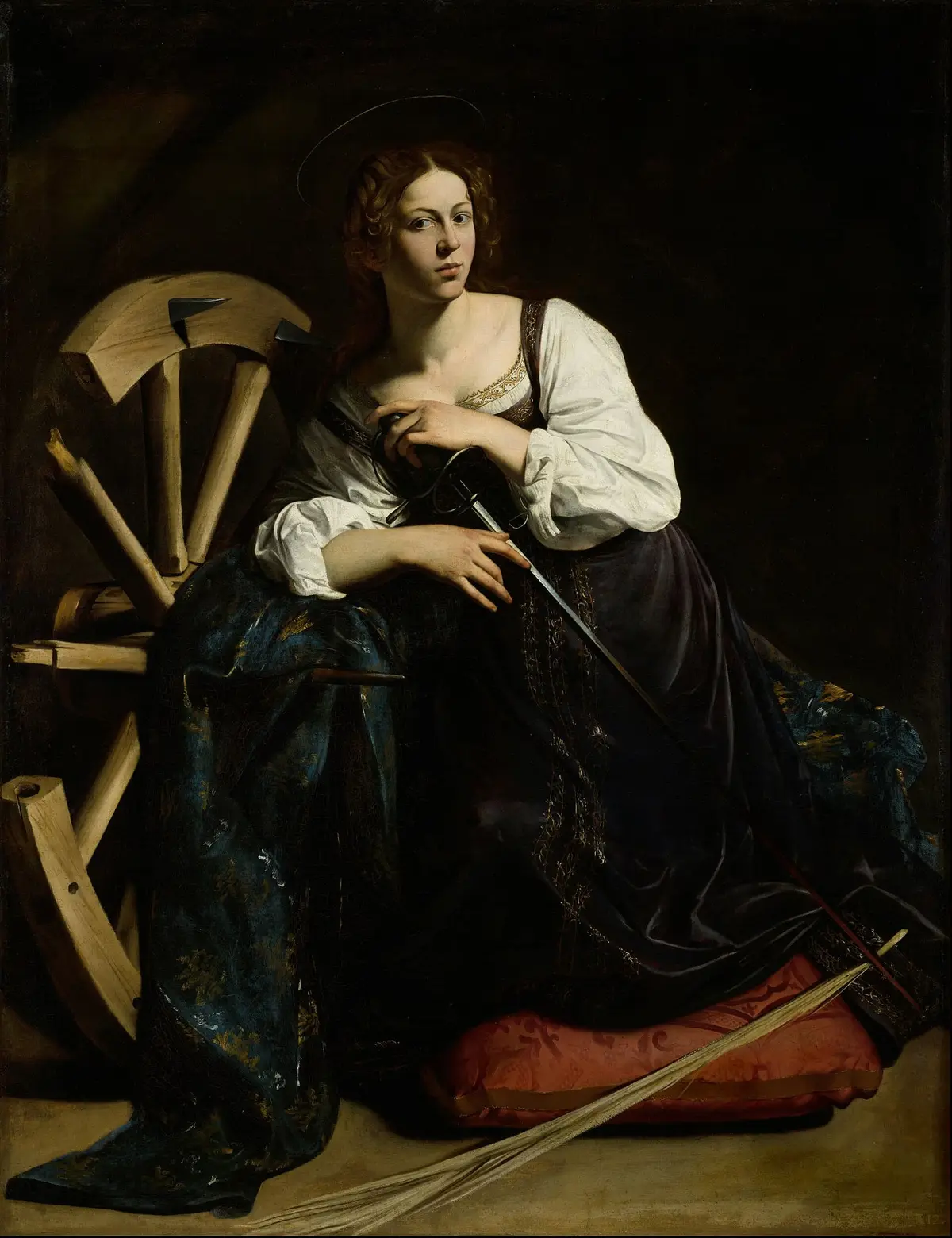
The spinning “Catherine wheel” firework is named after her, and in art she is usually shown with a broken wheel, a sword, a book and a crown.
St. Catherine of Alexandria Feast Day: November 25
Her feast is kept on November 25, as an optional memorial in the Roman calendar. In 2026 it falls on a Wednesday, just before the First Sunday of Advent.
Simple ways to celebrate:
- Go to Mass if you can, and ask her intercession for students and teachers you know.
- Pray for those who teach the faith: catechists, Catholic school teachers, priests and parents.
- Read something worthwhile. Catherine loved learning; spend a little time with Scripture or a good Catholic book.
- Pray for persecuted Christians today, who still face prison and death for their faith.
Don’t confuse her with two other great Catherines: St. Catherine of Siena, the fourteenth-century mystic and Doctor of the Church (April 29), and St. Catherine Labouré of the Miraculous Medal (November 28).
A Prayer to St. Catherine of Alexandria
Prayer to St. Catherine of Alexandria for Wisdom and Courage (Original Prayer)
St. Catherine of Alexandria,
bride of Christ and faithful witness,
you used the gifts of your mind
to give glory to God.
Pray for all students and teachers,
for those who study and those who seek the truth.
Obtain for me the wisdom to understand my faith,
the courage to speak of it with gentleness,
and the grace to stay true to Jesus when it is hard.
Through Christ our Lord.
Amen.
What Can We Learn from St. Catherine Today?
St. Peter wrote, “Always be ready to give an explanation to anyone who asks you for a reason for your hope, but do it with gentleness and reverence” (1 Peter 3:15-16). Catherine’s story is that verse lived out.
Few of us will debate philosophers before an emperor. But many of us are asked by a grandchild, a neighbor or a coworker why we still go to Mass or why we believe. Catherine reminds us that our faith is reasonable, worth knowing well, and worth sharing with love.
She also reminds us that the Church tells the truth about her saints. Where history is uncertain, the Church says so, and still invites us to pray with those who have gone before us. To understand this better, read why Catholics pray to the saints.
St. Catherine of Alexandria, pray for us.
Frequently asked questions
When is the feast day of St. Catherine of Alexandria?
The feast of St. Catherine of Alexandria is November 25. It is an optional memorial in the General Roman Calendar, which means parishes and priests may celebrate it at Mass that day. In 2026, November 25 falls on a Wednesday, a few days before the First Sunday of Advent on November 29.
Was St. Catherine of Alexandria a real person?
Christians have honored her for well over a thousand years, but the written accounts of her life come from centuries after her death, and historians can confirm very little. Details such as the debate with fifty philosophers and the breaking wheel are best read as legend. The Church still honors her as a martyr and restored her feast in 2002.
What is St. Catherine of Alexandria the patron saint of?
Because of her learning and her defense of the faith, she is patron of philosophers, scholars, students, teachers, preachers and librarians. She is also patron of young unmarried women, and of wheelwrights and others who work with wheels, because of the wheel of her martyrdom. She was one of the Fourteen Holy Helpers.
What is the difference between St. Catherine of Alexandria and St. Catherine of Siena?
St. Catherine of Alexandria was an early virgin martyr traditionally said to have died around 305 in Egypt, honored on November 25. St. Catherine of Siena was an Italian Dominican mystic who died in 1380, worked for peace in the Church, and is a Doctor of the Church, honored on April 29.
Sources
- Catechism of the Catholic Church, 159, 828, 956
- Roman Missal (2002), Optional Memorial of St. Catherine of Alexandria, November 25
- Catholic Encyclopedia (1908), St. Catherine of Alexandria
- Scripture: 1 Peter 3:15-16