St. Martin of Tours: Life, Feast Day (November 11) & Prayer
Quick answer
St. Martin of Tours (c. 316-397) was a Roman soldier who shared his cloak with a freezing beggar at Amiens, then saw Christ wearing it in a dream. He left the army, founded the first known monastery in Gaul, and served as Bishop of Tours from 371 until his death. His feast is November 11, and he is patron of soldiers and the poor.
Key takeaways
- St. Martin was born around 316 in Pannonia (today Szombathely, Hungary), the son of a Roman army officer, and served as a soldier himself as a young man.
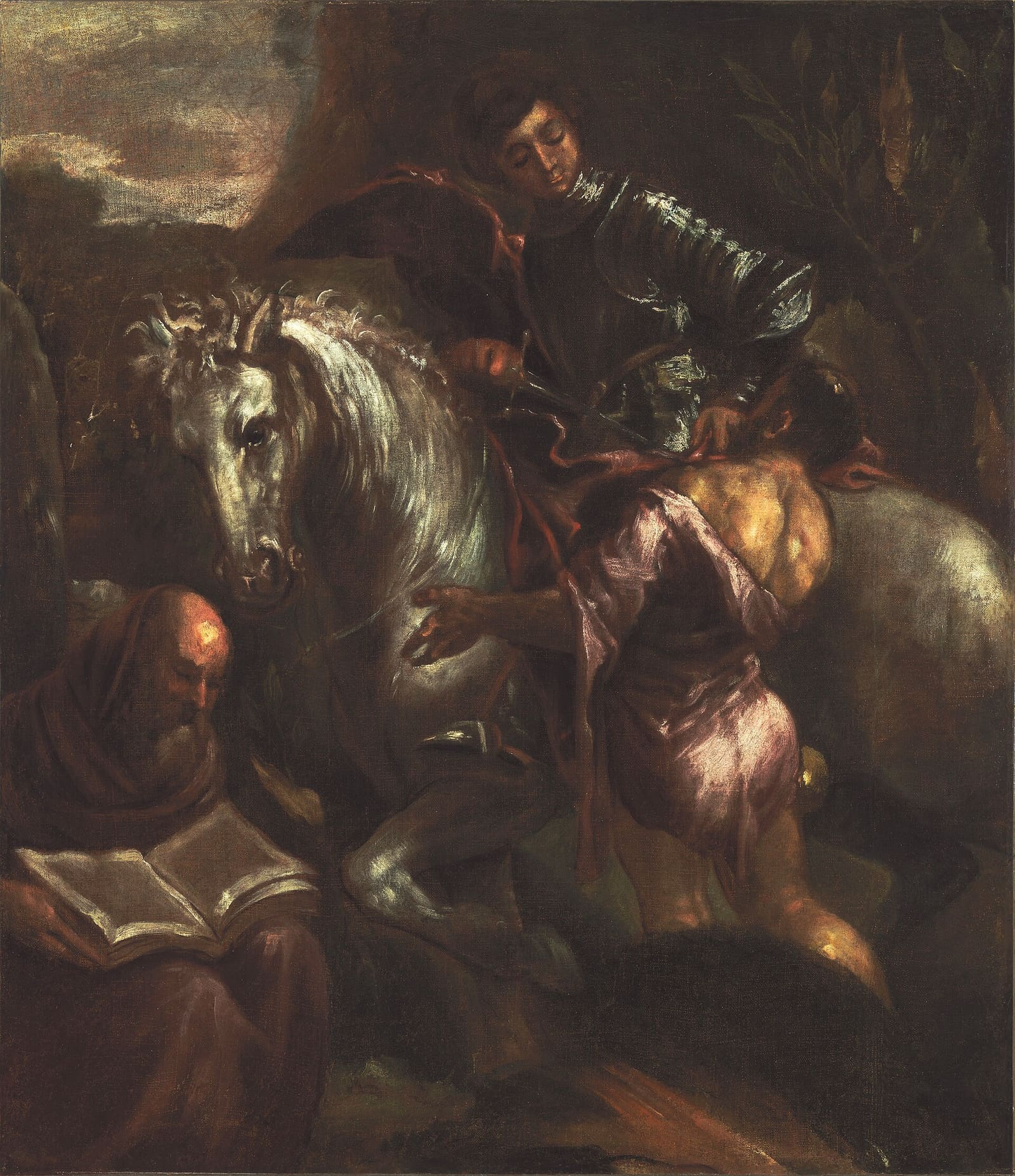
- At Amiens he cut his military cloak in two to clothe a beggar; that night, his biographer says, he saw Christ wearing the half-cloak.
- After leaving the army he became a disciple of St. Hilary of Poitiers and founded the monastery of Ligugé, the earliest known in Gaul.
- He was Bishop of Tours from 371, died on November 8, 397, and was buried on November 11, which became his feast day.
- He is one of the first saints honored in the West who was not a martyr, and he is patron of soldiers, the poor and France.
St. Martin of Tours was a Roman soldier who became a monk and then Bishop of Tours, in what is now France. He is remembered above all for cutting his military cloak in half to clothe a freezing beggar. He died in 397, and the Church keeps his feast on November 11. He is the patron saint of soldiers, of the poor and of France.
Few saints were as loved in the Middle Ages as St. Martin. Thousands of churches, villages and families took his name. His story is simple enough to tell a child, yet it carries the whole Gospel: Christ is found in the poor, and a soldier can become a servant of peace.
Who Was St. Martin of Tours?
Martin was born around the year 316 in Sabaria, in the Roman province of Pannonia. The town is now Szombathely, in western Hungary. Some historians prefer a later date, around 336, because the ancient sources do not agree perfectly. His father was an officer in the Roman army, and he named his son after Mars, the Roman god of war.
The family moved to Pavia (ancient Ticinum), in northern Italy, where Martin grew up. His parents were pagans. Yet as a boy of about ten, against their wishes, Martin went to the church and asked to become a catechumen, someone preparing for Baptism. He was drawn early to prayer and even dreamed of living as a hermit.
Roman law required the sons of veterans to serve in the army. So at about fifteen Martin was enrolled as a soldier, and he served in a cavalry unit stationed in Gaul. His biographer says that even as a soldier he lived simply, treated his servant as an equal, and was known for kindness to the sick and the poor.
We know Martin’s life well because a friend of his, Sulpicius Severus, wrote a Life of St. Martin while Martin was still alive. It is one of the earliest biographies of a saint in the Western Church. Some of its wonder stories are hard to check, but the main outline of Martin’s life is solid history.
Key Dates in the Life of St. Martin
| Year | Event |
|---|---|
| c. 316 | Born in Sabaria, Pannonia (modern Szombathely, Hungary) |
| c. 326 | Becomes a catechumen in Pavia, Italy |
| c. 331 | Enrolled in the Roman cavalry at about age 15 |
| c. 334 | Shares his cloak with a beggar at Amiens; baptized soon after |
| c. 356 | Leaves the army; becomes a disciple of St. Hilary of Poitiers |
| c. 361 | Founds a monastery at Ligugé, near Poitiers |
| 371 | Chosen Bishop of Tours |
| c. 372 | Founds the monastery of Marmoutier, outside Tours |
| 385 | Pleads with the emperor not to execute the heretic Priscillian |
| November 8, 397 | Dies at Candes, in his diocese |
| November 11, 397 | Buried at Tours |
The early dates are approximate, because the ancient sources give only a general picture.
The Cloak at Amiens: Martin and the Beggar
The story that made Martin famous took place at the gate of Amiens, in northern Gaul, during a winter so cold that people were dying of it. Martin, still a young soldier and not yet baptized, met a poor man at the city gate with almost nothing to cover him. Others passed by. Martin had already given away most of his money, and he had only his weapons and his soldier’s cloak.
So he drew his sword, cut the cloak in two, and gave one half to the beggar, wrapping himself in what was left. Some onlookers laughed at the strange, half-cloaked soldier. Others, Sulpicius tells us, were ashamed that they had given nothing.
That night Martin had a dream. He saw Christ clothed in the half of the cloak he had given away, and he heard Jesus say to the angels around Him: “Martin, who is still a catechumen, has clothed me with this robe.” It was the Gospel come to life:
“For I was hungry and you gave me food, I was thirsty and you gave me drink, a stranger and you welcomed me, naked and you clothed me.” (Matthew 25:35-36)
After this, Sulpicius says, Martin did not wait any longer. He was baptized, probably at about eighteen.
Pope Benedict XVI chose this very story in his first encyclical, Deus Caritas Est. He called Martin “almost like an icon” of the irreplaceable value of personal charity (Deus Caritas Est 40).
Why “chapel” comes from Martin’s cloak
The half-cloak that Martin kept was later honored as a relic by the Frankish kings, who carried it with them. The Latin word for a short cloak was cappa, and the priests who guarded it were called cappellani. The small shrine where it was kept came to be called a cappella. From these words come our English “chaplain” and “chapel.”
From Soldier to Servant of Peace
Martin stayed in the army for some time after his Baptism, but his heart was elsewhere. Sulpicius tells that around 356, before a battle near Worms on the Rhine, the soldiers were called before the future emperor Julian to receive a bonus. Martin refused it. “I am a soldier of Christ,” he said; “it is not lawful for me to fight.”
Accused of cowardice, he offered to stand in front of the battle line the next day with no weapon but the sign of the cross. According to the account, the enemy sent envoys to ask for peace before any fighting began, and Martin was released from service soon afterward.
Martin’s refusal did not condemn every soldier. The Church has always honored those who serve their country with justice, and Martin is still a patron of soldiers. His story shows that a Christian’s first loyalty belongs to Christ, and that the courage of a soldier can become the courage of a saint.
Disciple of St. Hilary and Founder of Monks
After leaving the army, Martin went to Poitiers to learn from its bishop, St. Hilary, a great defender of the faith against Arianism, the heresy that denied that Christ is truly God. Hilary wanted to ordain him a deacon, but Martin in his humility would accept only the minor order of exorcist.
Martin then traveled back to Pannonia to visit his parents. His mother became a Christian, though his father did not. In the regions he passed through he spoke against the Arians, and he was publicly beaten and driven out for it. For a time he lived as a hermit on Gallinara, a small island off the coast of northern Italy.
When Hilary returned from exile around 360, Martin rejoined him. Around 361 he founded a community of monks at Ligugé, near Poitiers. It is the earliest monastery known in Gaul, and monks still live at Ligugé today. Martin brought to the West some of the spirit of the monks of Egypt and Syria (see our guide to the Desert Fathers).
Bishop of Tours (371-397)
In 371 the bishop of Tours died, and the Christians of the city wanted Martin to replace him. Martin did not want the office. According to Sulpicius, the people brought him to Tours by a trick, telling him a sick woman needed his help, and then acclaimed him bishop. A later legend, not found in the earliest sources, says he hid in a barn and was given away by the noisy geese. It is a charming story, and the reason geese are part of his feast in many countries.
Martin did not change his way of life when he became bishop. He wore rough clothes, lived simply, and soon founded the monastery of Marmoutier outside Tours, where he lived with his monks in caves and huts along the Loire. Many of those monks later became bishops themselves.
As bishop he worked tirelessly to bring the Gospel to the countryside, where most people were still pagan. He traveled on foot, by donkey and by boat, preached in villages, and founded some of the first rural parishes in Gaul. He also tore down pagan shrines, which made him enemies, though Sulpicius records that he often won over the very people who had opposed him.
Martin and the Priscillian affair
In 385, a Spanish teacher named Priscillian was accused of heresy and brought before the emperor Magnus Maximus at Trier. Some bishops wanted him put to death. Martin went to Trier and pleaded that the case be left to the bishops, and that no one be executed over a matter of faith. Priscillian was executed anyway, and Martin grieved deeply over it. His stand is remembered as an early Christian protest against using the sword in questions of belief.
His Death and Burial
In the autumn of 397, though old and weak, Martin traveled to Candes, a village in his diocese, to make peace among the clergy there. He fell ill and knew he was dying. His disciples begged him not to leave them.
Sulpicius records his prayer: “Lord, if I am still needed by your people, I do not refuse the work. Your will be done.” He asked to lie on ashes, as a sign of penance, and died on November 8, 397. His body was carried by boat down the river to Tours, and he was buried there on November 11.
His tomb at Tours became one of the great pilgrimage shrines of Europe. Kings, bishops and ordinary pilgrims came to pray there for centuries. St. Martin is also one of the first saints in the West to be honored who was not a martyr, a sign that a life given wholly to God is itself a witness to Christ.
What Is St. Martin of Tours the Patron Saint Of?
St. Martin’s patronages grew naturally out of his life:
- Soldiers, because he served in the Roman army.
- The poor and beggars, because of the cloak at Amiens.
- France, where he was among the most beloved saints of the Middle Ages.
- Horsemen and cavalry, since he was a cavalry soldier, and is usually painted on horseback.
- Tailors, by association with the divided cloak.
- Winemakers and innkeepers in some regions, because his feast falls after the grape harvest.
Most of these are popular patronages that grew over the centuries, not formal decrees. They are a way for Christians to ask Martin’s prayers in the parts of life he knew well. (If you wonder why Catholics ask saints to pray for them at all, see why Catholics pray to saints.)
St. Martin of Tours Feast Day: How to Celebrate November 11
November 11 is an obligatory memorial in the General Roman Calendar. In much of Europe the day is known as Martinmas, and it was long one of the most important feasts of the year. Here are some ways to keep it:
- Go to Mass if you can, or pray the collect for the day (below).
- Give a coat or warm clothing to the poor. Many parishes and shelters collect winter clothing in November. This is the most fitting way to honor Martin.
- Hold a lantern walk with children. In Germany, the Netherlands and other countries, children carry paper lanterns through the streets on St. Martin’s evening and sing songs about the saint.
- Share a family meal. A roast goose is the traditional Martinmas dish in many lands, a nod to the legend of the geese.
- Pray for soldiers and veterans. November 11 is also Veterans Day in the United States and Remembrance Day in many countries, because the armistice of 1918 was signed on that date. It is a natural day to pray for those who serve and for peace.
- Look toward Advent. In parts of early medieval Gaul, a season of fasting known as “St. Martin’s Lent” began on his feast and lasted until Christmas, one of the roots of our Advent. You can use the day to plan how you will keep Advent, which begins on November 29 this year.
Prayers to St. Martin of Tours
Collect for the Memorial of St. Martin of Tours (Roman Missal)
O God, who are glorified in the Bishop Saint Martin
both by his life and death,
make new, we pray, the wonders of your grace in our hearts,
that neither death nor life may separate us from your love.
Through our Lord Jesus Christ, your Son,
who lives and reigns with you in the unity of the Holy Spirit,
God, for ever and ever.
Amen.
Prayer to St. Martin of Tours for a Generous Heart (Original Prayer)
St. Martin of Tours,
you saw a poor man shivering at the gate
and gave him half of your own cloak.
Pray for me, that I may see Christ in those in need
and not pass them by.
Help me to share what I have, even when it is little,
and to give it with a glad and humble heart.
Ask the Lord to give me your courage, your simplicity
and your love for the poor.
Amen.
Prayer to St. Martin for Soldiers and Veterans (Original Prayer)
St. Martin, soldier of Christ,
you knew the hardships of a soldier’s life
and the call to serve the Prince of Peace.
Pray for all who serve in the armed forces,
for veterans who carry wounds of body and soul,
and for their families who wait and worry.
Protect them in danger, keep them honest and merciful,
and bring them home safely.
Ask God to grant our world a just and lasting peace.
Amen.
What Can We Learn from St. Martin of Tours Today?
Charity is personal. Martin did not solve poverty in Gaul. He clothed one man on one cold day. The Catechism reminds us that love for the poor is part of the Church’s constant tradition (CCC 2444), and Martin shows that it starts with the person in front of us.
Christ hides in the poor. Martin’s dream is a picture of Matthew 25: “Whatever you did for one of these least brothers of mine, you did for me” (Matthew 25:40). When we serve someone in need, we serve the Lord Himself.
Holiness can grow anywhere. Martin began his journey in the barracks, not the cloister. Whatever our work or age, God can call us to deeper faith.
Leadership means service. As bishop, Martin kept the simple habits of a monk and spent himself for his people. Like other great pastors, such as Pope St. Leo the Great and St. Charles Borromeo, he shows that authority in the Church is meant for service.
Accept God’s will to the end. His last prayer, “I do not refuse the work,” is a beautiful prayer for anyone growing older. As long as God wants us here, there is still good to do.
St. Martin, pray for us, and help us to share our cloak with Christ in the poor.
Frequently asked questions
When is the feast day of St. Martin of Tours?
His feast is November 11, an obligatory memorial in the General Roman Calendar. Martin died on November 8, 397, at Candes, and was buried at Tours on November 11; the day of his burial became his feast. In many European countries the day is called Martinmas and is kept with lantern processions, a shared meal and gifts to the poor.
What is St. Martin of Tours the patron saint of?
St. Martin is best known as a patron of soldiers, because he served in the Roman army, and of the poor and beggars, because of the cloak he shared at Amiens. He is also a patron of France, where he was one of the most loved saints of the Middle Ages, and of horsemen. Many parishes, towns and churches across Europe and the Americas bear his name.
Why did St. Martin cut his cloak in half?
According to his biographer Sulpicius Severus, Martin met a nearly naked beggar at the gate of Amiens on a bitterly cold winter day. He had already given away most of what he had, so he cut his military cloak in two with his sword and gave half to the man. Part of the cloak was issued by the army, so he gave what was his to give.
Was St. Martin of Tours a martyr?
No. St. Martin died peacefully of old age in 397, after more than twenty-five years as a bishop. He is one of the first saints honored in the Western Church who was not a martyr. Christians recognized that his life of prayer, poverty, preaching and service to the poor was a witness as complete as the shedding of blood.
Sources
- Sulpicius Severus, Life of St. Martin (written c. 396-397)
- Matthew 25:31-46
- Pope Benedict XVI, Deus Caritas Est (2005), 40
- Roman Missal, Memorial of St. Martin of Tours, November 11
- Catechism of the Catholic Church 2443-2449 (love for the poor)