St. Jerome: Translator of the Bible and Doctor of the Church
Quick answer
St. Jerome (about 347–420) was a scholar, priest and monk who translated most of the Bible into Latin. His translation, the Vulgate, was the Bible of the Western Church for over a thousand years. Brilliant and often sharp-tongued, he spent his last thirty-four years in Bethlehem, studying, writing and guiding a community of monks and nuns. He is the patron of Scripture scholars and translators. His feast is September 30.
Key takeaways
- He was born in Stridon, on the border of Dalmatia, and studied in Rome.
- Pope St. Damasus asked him to revise the Latin translation of the Gospels.
- He learned Hebrew in order to translate the Old Testament from the original.
- He wrote, "Ignorance of the Scriptures is ignorance of Christ."
If you have ever read a Douay-Rheims Bible, you have read St. Jerome. His Latin translation shaped the Church’s prayer, preaching and art for over a millennium.
A Student in Rome
Jerome was born around 347 in Stridon, a town near the border of present-day Croatia and Slovenia. He studied in Rome, where he became an expert in Latin literature and was baptized. He later admitted that, as a student, he lived carelessly, but on Sundays he would visit the tombs of the martyrs in the catacombs.
A Scholar in the Desert
Seeking a life of penance, Jerome lived for a time as a hermit in the Syrian desert. There he began learning Hebrew from a Jewish convert, a hard task he took on to understand Scripture better. He later wrote of a dream in which he was accused of being a follower of Cicero rather than a Christian, because he loved pagan literature more than the Bible. He resolved to give his best to God’s word.
The Bible in Latin
In 382 Jerome went to Rome as secretary to Pope St. Damasus, who asked him to revise the existing Latin translations of the Gospels, which were full of errors. Jerome went on to translate most of the Old Testament directly from the Hebrew, a great labor that took many years. This translation, together with some older texts, became known as the Vulgate, the “common” version.
In Rome he also taught a circle of devout women, including St. Paula and her daughter St. Eustochium, who studied Scripture with him.
Bethlehem
In 386 Jerome settled in Bethlehem, near the cave of the Nativity. Paula founded monasteries for men and women there, and Jerome spent the rest of his life translating, writing commentaries and letters, and defending the faith.
He was not easy to get along with. He wrote fiercely against those he disagreed with and admitted his quick temper. A story says that a pope, looking at a painting of Jerome beating his breast with a stone, remarked that he was right to do so, for without that penance the Church would never have made him a saint.
He died in Bethlehem on September 30, 420.
“Ignorance of the Scriptures Is Ignorance of Christ”
Jerome’s most famous line comes from his commentary on Isaiah. The Catechism quotes it, urging all the faithful to read the Bible often (CCC 133). For Jerome, reading Scripture was a way of meeting Christ Himself.
A Prayer Before Reading Scripture (Original Prayer)
St. Jerome, you gave your life to God’s word. Pray that I may open the Bible each day, understand what I read, and meet Jesus in its pages. Amen.
Continue Reading
Read our guide to the Catholic Bible, how to read the Bible in chronological order, or about St. Augustine, Jerome’s friend and correspondent.
Frequently asked questions
When is the feast of St. Jerome?
September 30, the day he died in Bethlehem in 420.
What is the Vulgate?
The Latin translation of the Bible made mostly by St. Jerome. The Council of Trent declared it the authentic Latin text for the Church's use. The Douay-Rheims English Bible was translated from it.
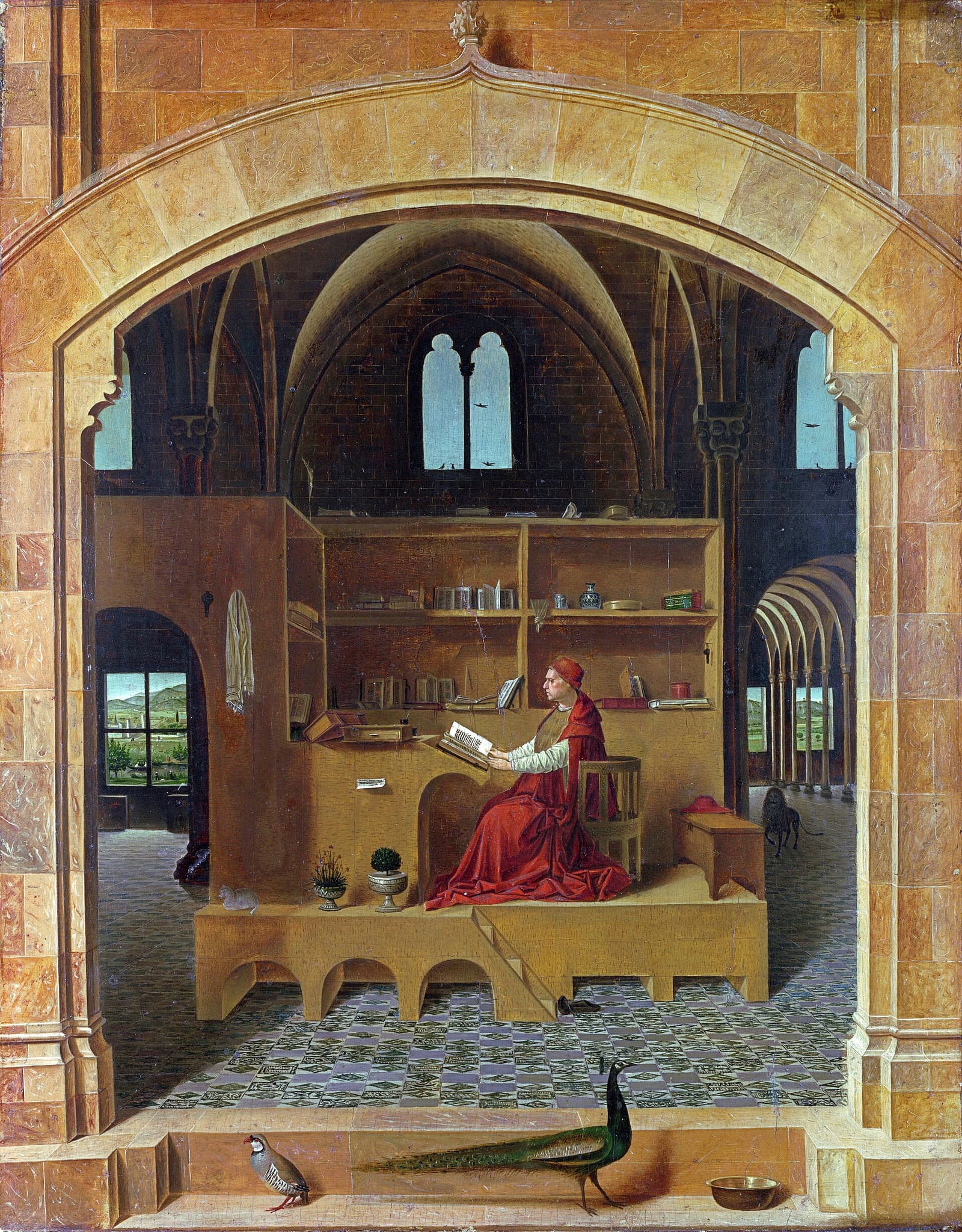
Why is St. Jerome shown with a lion?
A legend tells that he removed a thorn from a lion's paw, and the grateful lion stayed with him at his monastery.
Sources
- St. Jerome, Commentary on Isaiah, Prologue
- St. Jerome, Letters
- Pope Benedict XV, Encyclical Spiritus Paraclitus (1920)
- Catechism of the Catholic Church, no. 133