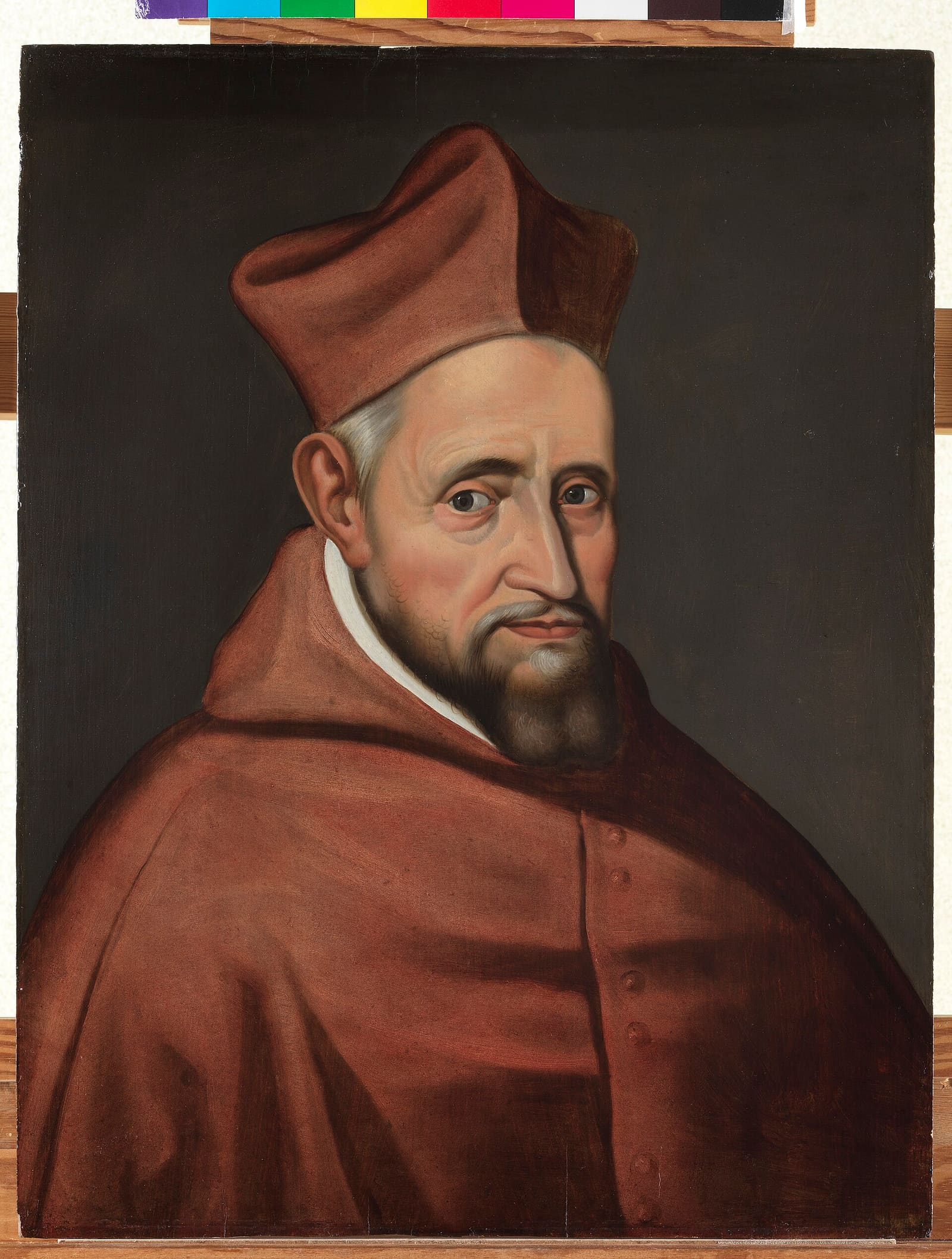
St. Robert Bellarmine: Jesuit Cardinal, Catechist and Doctor of the Church
Quick answer
St. Robert Bellarmine (1542–1621) was an Italian Jesuit priest, theologian and cardinal. He taught at Louvain and Rome, wrote the Controversies explaining Catholic teaching during the Reformation, and composed catechisms used for centuries. He was the spiritual director of St. Aloysius Gonzaga. Though a cardinal, he lived simply and gave to the poor. He is a Doctor of the Church. His feast is September 17.
Key takeaways
- He was a nephew of Pope Marcellus II.
- His Controversies were a respectful, thorough defense of Catholic doctrine.
- His short catechisms were translated into dozens of languages.
- He died in Rome in 1621 and is buried near St. Aloysius.
St. Robert Bellarmine was one of the most brilliant theologians of his age. He also wrote a little catechism for children so simple that it was used for three hundred years.
Early Life
Roberto Bellarmino was born on October 4, 1542, in Montepulciano, in Tuscany. His mother was the sister of Cardinal Marcello Cervini, who briefly became Pope Marcellus II. Robert entered the Society of Jesus in 1560.
He was small and often in poor health, but a gifted preacher. He was ordained in 1570 at Louvain, in present-day Belgium, where he taught and preached during the upheavals of the Reformation.
The Controversies
In 1576 he was called to Rome to teach at the Roman College. His lectures became the Controversies, a massive work explaining Catholic teaching on the points disputed by Protestants. He took the trouble to quote his opponents accurately and answer them with Scripture, the Fathers and reason. The work was widely respected, even by those who disagreed.
Catechist
Bellarmine thought that the faithful needed simple, clear instruction. He wrote two catechisms, a short one for children and a longer one for teachers. They were translated into many languages and used for centuries.
Spiritual Father
As spiritual director at the Roman College, he guided the young St. Aloysius Gonzaga, who died in 1591 after nursing plague victims. Bellarmine was with him at his death and later asked to be buried near him.
A Humble Cardinal
Pope Clement VIII made him a cardinal in 1599. Bellarmine lived simply, ate plain food, gave most of his income to the poor and once used the tapestries of his rooms to clothe the needy, saying the walls would not catch cold.
He took part in the debates of his time, including the early questions over Galileo’s teaching in 1616. He wrote that if a true demonstration were found that the earth moves around the sun, Scripture would have to be understood more carefully.
In his last years he wrote short books of devotion, including The Art of Dying Well. He died on September 17, 1621. He was canonized in 1930 and declared a Doctor of the Church in 1931.
A Prayer for Teachers of the Faith (Original Prayer)
St. Robert Bellarmine, you taught the faith with clarity and charity. Pray for catechists, parents and grandparents who pass on the faith to children. Help me to know my faith and to explain it with love. Amen.
Continue Reading
Read about St. Aloysius Gonzaga, St. Ignatius of Loyola, or St. Charles Borromeo.
Frequently asked questions
When is the feast of St. Robert Bellarmine?
September 17.
What was St. Robert Bellarmine's role in the Galileo affair?
In 1616 he delivered to Galileo the Church's instruction not to hold or defend heliocentrism as proven. He wrote that if real proof were found, Scripture would need to be interpreted more carefully. He died years before Galileo's trial in 1633.
When was he made a Doctor of the Church?
In 1931, by Pope Pius XI, a year after his canonization.
Sources
- St. Robert Bellarmine, Disputationes de Controversiis; Dottrina cristiana breve
- St. Robert Bellarmine, Letter to Paolo Antonio Foscarini (1615)
- Pope Benedict XVI, General Audience on St. Robert Bellarmine (February 23, 2011)