St. Anastasia of Sirmium: The Martyr Remembered at Christmas
Quick answer
St. Anastasia was a Christian martyr who died at Sirmium, in present-day Serbia, during the persecution of Diocletian around 304. Her relics were brought to Constantinople, and her cult spread to Rome, where the church of Sant'Anastasia stood near the Palatine Hill. Her name is in the Roman Canon. Because her feast falls on December 25, she is remembered at the Mass at Dawn on Christmas Day. Her name means "resurrection."
Key takeaways
- She was martyred at Sirmium around 304.
- Her relics were taken to Constantinople in the fifth century.
- The popes once celebrated the Christmas Mass at Dawn in her Roman church.
- Legends call her a noblewoman who cared for imprisoned Christians.
Every time a priest prays the Roman Canon, he names St. Anastasia among the martyrs. And for centuries, on Christmas morning, the pope went to her church to celebrate Mass. She is a quiet companion of the Nativity.
What We Know
Anastasia was a Christian martyred at Sirmium, a major Roman city in present-day Serbia, during the persecution of Emperor Diocletian, around 304. In the fifth century her relics were brought to Constantinople and placed in the church of the Anastasis, the “Resurrection.”
Her name means resurrection in Greek, a fitting name for a martyr who was born into eternal life.
Her Church in Rome
In Rome, an ancient church near the Palatine Hill, close to the imperial palace, came to bear her name. Because her feast fell on December 25, the pope, after celebrating the Mass at midnight at St. Mary Major, went to Sant’Anastasia to celebrate the Mass at Dawn, perhaps as a courtesy to the Byzantine officials who lived nearby and honored her. He then celebrated the Mass of the Day at St. Peter’s. That is why the Roman Missal still notes that St. Anastasia may be commemorated at the Mass at Dawn.
Her Legend
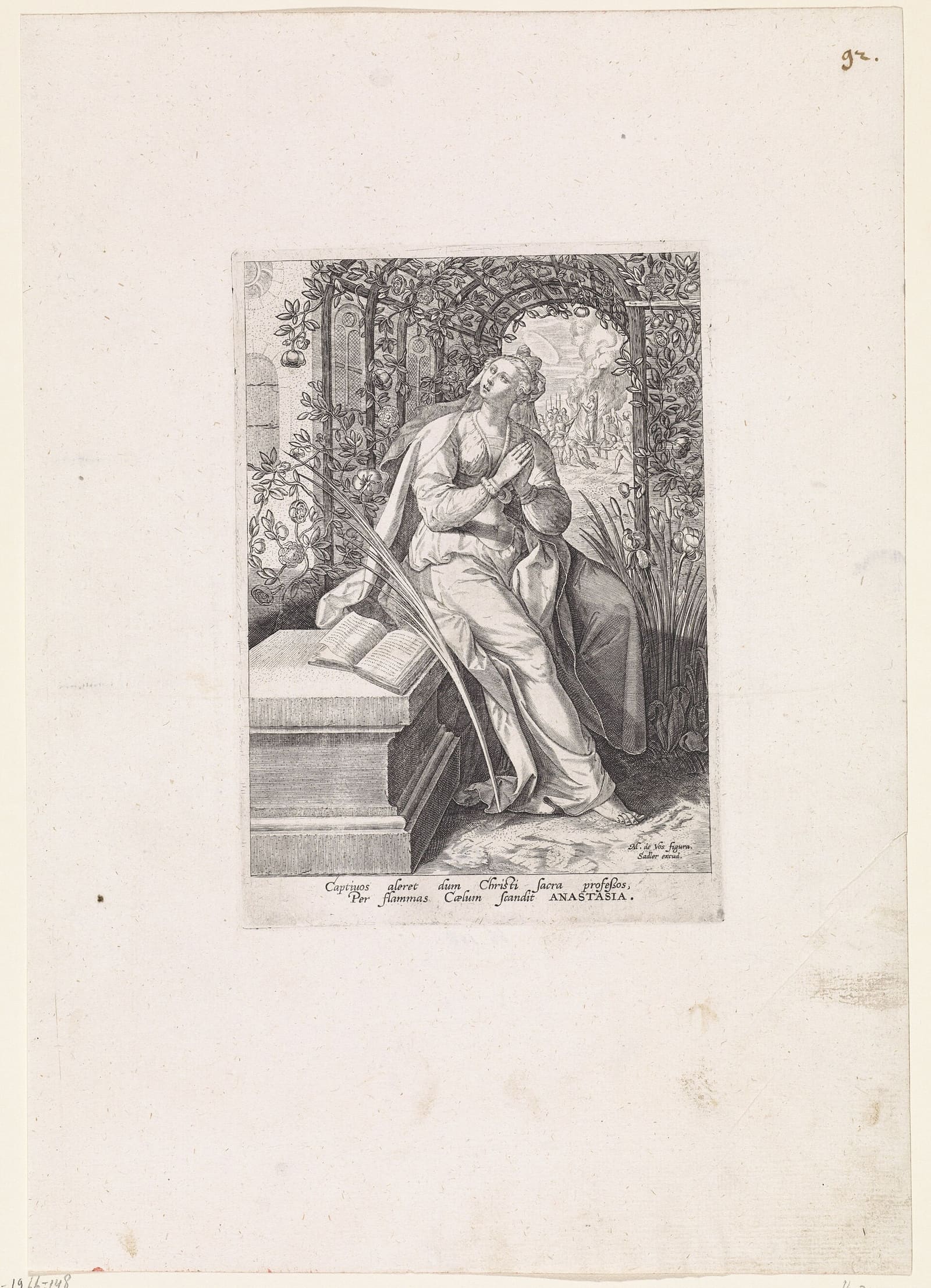
Later accounts, written in the fifth century, tell a fuller story. They say Anastasia was a Roman noblewoman, married against her will to a pagan, who used her wealth to care for Christians in prison. She was taught by a holy man, St. Chrysogonus, who was himself martyred. After her husband’s death, she went on caring for prisoners until she was arrested and burned at the stake. Historians treat these stories with caution, but they show how deeply she was loved.
Martyrs in the Roman Canon
Anastasia is one of seven women martyrs named in the Roman Canon, along with Felicity, Perpetua, Agatha, Lucy, Agnes and Cecilia. Their names remind us at every Mass that the Church is built on the witness of those who gave their lives for Christ.
A Prayer on Christmas Morning (Original Prayer)
Lord Jesus, born for us in Bethlehem, St. Anastasia gave her life for You. Help me welcome You with faith this Christmas and share in Your resurrection. Amen.
Continue Reading
Read about St. Agnes, St. Cecilia, and St. Eugenia, another martyr remembered on Christmas Day.
Frequently asked questions
When is the feast of St. Anastasia?
December 25. Because it is Christmas Day, she is commemorated at the Mass at Dawn where local custom allows. The Eastern Churches honor her on December 22.
Is she the same as Grand Duchess Anastasia of Russia?
No. St. Anastasia lived in the fourth century. The Russian grand duchess was named after her.
What is St. Anastasia the patron saint of?
She is invoked by the Eastern Churches as "Deliverer from Potions," a protector against poison, and is a patron of martyrs and weavers.
Sources
- Roman Missal, Eucharistic Prayer I (Roman Canon)
- Roman Martyrology, December 25
- Passio Sanctae Anastasiae (fifth century)