St. Timothy: St. Paul's Beloved Son in the Faith
Quick answer
St. Timothy was a young man from Lystra, in present-day Turkey, son of a Greek father and a Jewish Christian mother, Eunice. His mother and grandmother, Lois, taught him the Scriptures. He became St. Paul's companion and helper, and Paul left him to guide the Church at Ephesus, writing him two letters in the New Testament. Tradition says he was martyred there. His feast, shared with St. Titus, is January 26.
Key takeaways
- Paul praised the faith of his grandmother Lois and mother Eunice (2 Timothy 1:5).
- He joined Paul on his second missionary journey (Acts 16:1-3).
- Paul called him "my dearly beloved son" and sent him on important missions.
- Paul's two letters to Timothy guide pastors to this day.
St. Timothy is a saint for every grandparent who has quietly passed on the faith. Before he was Paul’s helper, he was a boy learning the Scriptures from his mother and grandmother.
A Faith Handed Down
Timothy came from Lystra, in the region of Lycaonia, in present-day Turkey. His father was Greek, and his mother, Eunice, was a Jewish believer. Paul later wrote to him:
Calling to mind that faith which is in thee unfeigned, which also dwelt first in thy grandmother Lois, and in thy mother Eunice, and I am certain that in thee also. (2 Timothy 1:5, Douay-Rheims)
From childhood, Timothy had known the Holy Scriptures (2 Timothy 3:15). When Paul preached in Lystra, Timothy’s family probably came to faith in Christ.
Paul’s Companion
When Paul returned to Lystra on his second journey, the believers spoke well of Timothy. Paul took him along (Acts 16:1-3). For years Timothy traveled with Paul through Macedonia and Greece. Paul sent him to Thessalonica, Corinth and Philippi to strengthen the churches. Timothy’s name appears with Paul’s at the beginning of several letters.
Paul loved him like a son. He wrote to the Philippians that he had no one else so like-minded, who cared for them so sincerely (Philippians 2:20).
Bishop of Ephesus
Paul left Timothy to guide the Church at Ephesus, a large and difficult city. Timothy seems to have been young, perhaps shy, and often unwell. Paul encouraged him.
Let no man despise thy youth: but be thou an example of the faithful in word, in conversation, in charity, in faith, in chastity. (1 Timothy 4:12, Douay-Rheims)
In his two letters Paul told Timothy how to choose good leaders, care for widows, guard sound teaching and pray for all people. He told him to “stir up the grace of God” given by the laying on of hands (2 Timothy 1:6). At the end of his life, in prison, Paul asked Timothy to come quickly and bring his cloak and books.
His Death
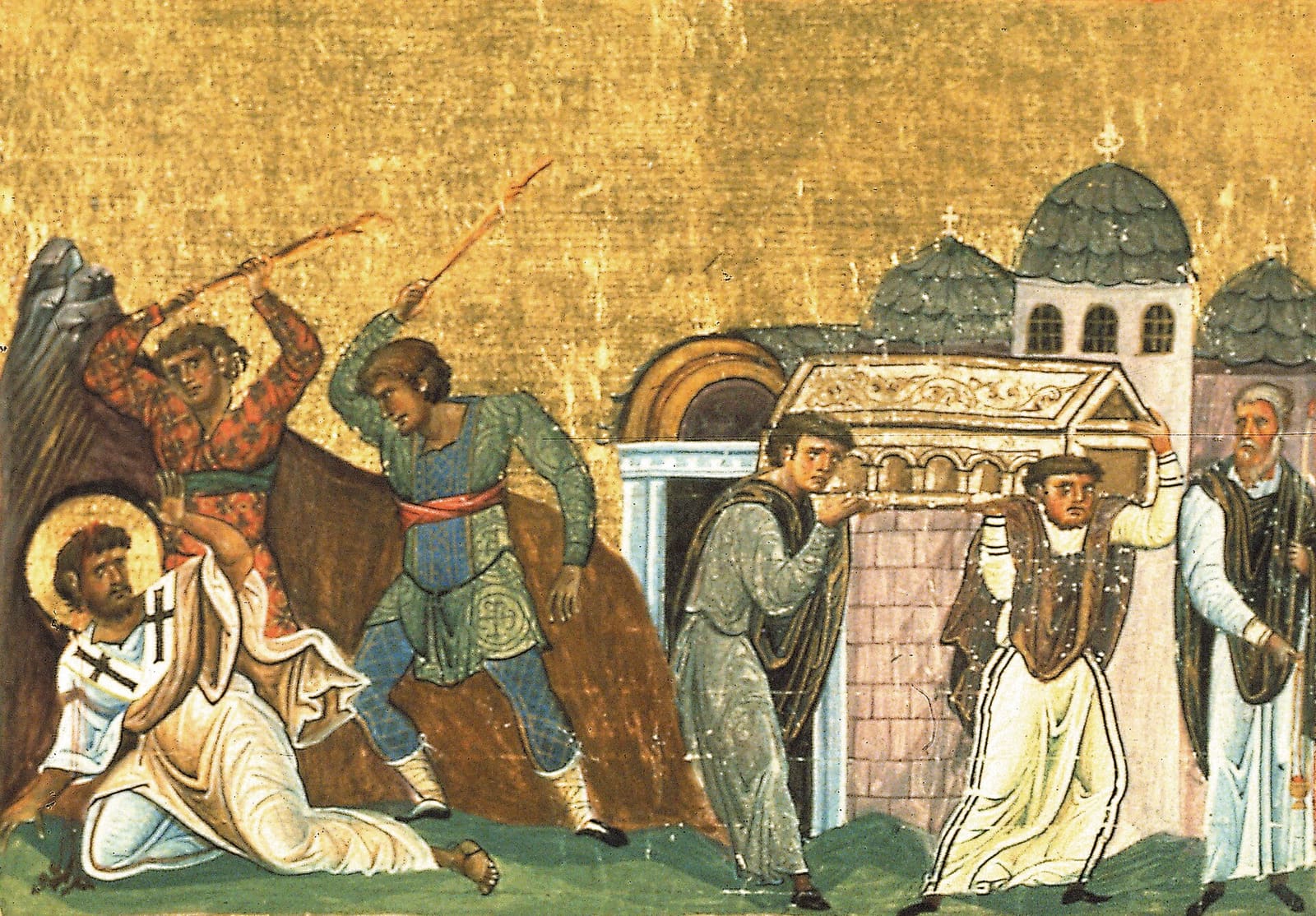
Tradition says Timothy led the Church in Ephesus for many years and was killed around 97 by a mob after he spoke out against a pagan festival.
A Prayer for Passing on the Faith (Original Prayer)
St. Timothy, you learned the faith from your mother and grandmother. Bless all parents and grandparents who teach children to pray. Help me pass on the faith with love, and be an example to the young. Amen.
Continue Reading
Read about St. Paul, St. Barnabas, or St. Anne, patroness of grandmothers.
Frequently asked questions
When is the feast of St. Timothy?
January 26, together with St. Titus, the day after the Conversion of St. Paul.
What is St. Timothy the patron saint of?
He is invoked against stomach ailments, because Paul told him to take a little wine for his stomach (1 Timothy 5:23).
How did St. Timothy die?
Tradition says he was stoned and beaten by a crowd in Ephesus for opposing a pagan festival, around the year 97.
Sources
- Acts of the Apostles 16:1-3; 17:14-15; 19:22; 20:4 (Douay-Rheims)
- 1 and 2 Timothy; 1 Corinthians 4:17; Philippians 2:19-22 (Douay-Rheims)
- Eusebius, Church History III.4