St. Remigius: The Bishop Who Baptized Clovis
Quick answer
St. Remigius, or Remi (about 437–533), was made bishop of Reims at twenty-two and served for more than seventy years. He is best known for baptizing Clovis, king of the Franks, together with thousands of his warriors, around 496. Clovis's conversion to Catholic Christianity, rather than to Arianism, shaped the future of France and Western Europe. His feast is October 1.
Key takeaways
- He was chosen bishop of Reims as a layman of twenty-two.
- Clovis's Catholic wife, St. Clotilde, prayed for her husband's conversion.
- Clovis was baptized at Reims around 496, perhaps on Christmas Day.
- The kings of France were later crowned at Reims in memory of this baptism.
The cathedral of Reims, where French kings were crowned for centuries, stands on the site where a bishop poured the waters of baptism over a pagan king. That bishop was St. Remigius.
A Young Bishop
Remigius, called Remi in French, was born around 437 near Laon, in northern Gaul, to a noble Gallo-Roman family. He was so well known for his learning and holiness that, when the bishop of Reims died, the people chose him as their bishop, even though he was a layman of only twenty-two. He accepted, was ordained, and served for over seventy years.
At the time, the Roman Empire in the West was collapsing. Many of the Germanic peoples who had settled in its lands had become Arian Christians, believing that Christ was not fully God. The Franks, in the north, were still pagan.
Clotilde and Clovis
Clovis, the young king of the Franks, married Clotilde, a Catholic princess from Burgundy. She prayed for him and urged him to accept Christ. He allowed their children to be baptized, but would not convert himself.
According to St. Gregory of Tours, during a battle against the Alamanni at Tolbiac, Clovis’s army was close to defeat. He cried out to “the God of Clotilde,” promising to be baptized if he won. His army was victorious.
The Baptism at Reims
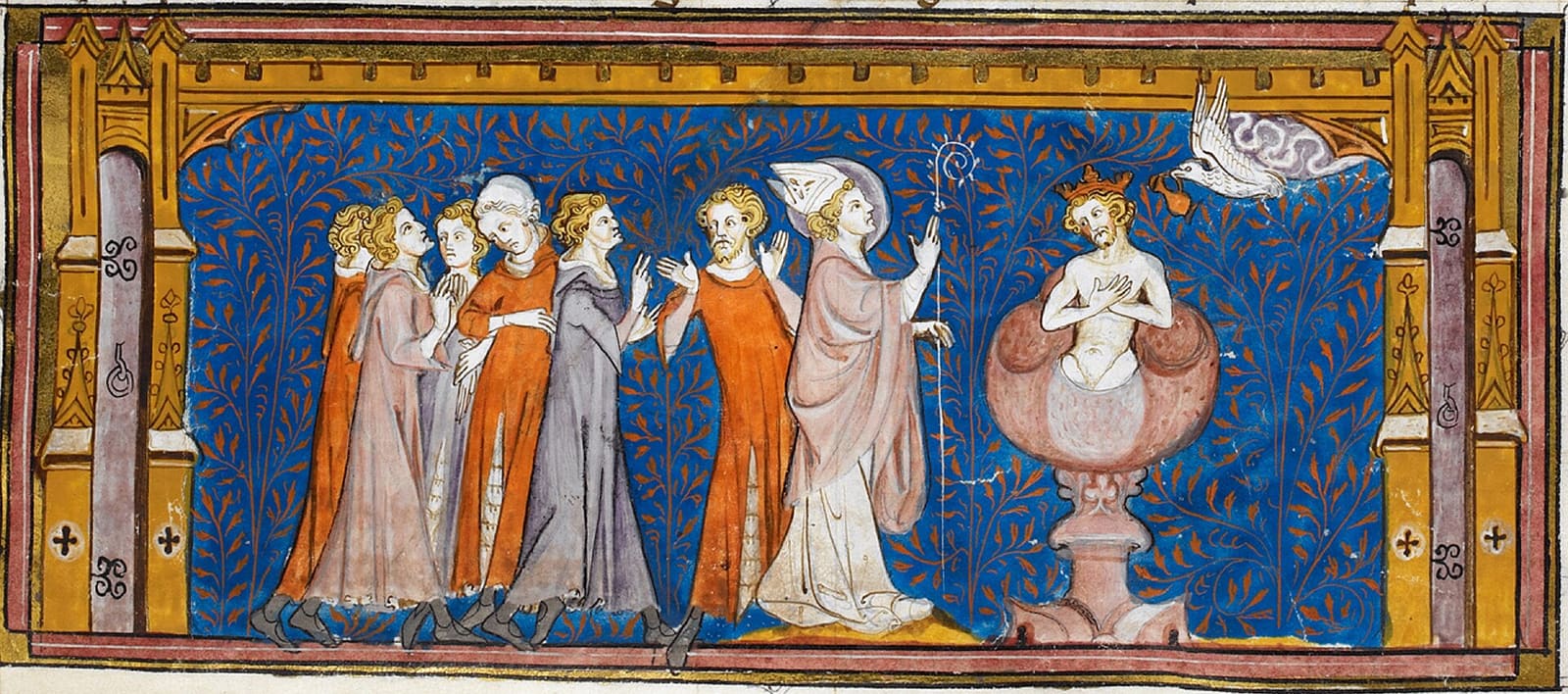
Remigius instructed Clovis in the faith. Around 496, possibly on Christmas Day, Clovis was baptized at Reims together with about three thousand of his warriors. Gregory of Tours records Remigius’s famous words as the king stepped into the font: bow your head humbly, adore what you have burned and burn what you have adored.
A later legend says that a dove brought from heaven a flask of holy oil, the Holy Ampulla, for the anointing. It was used for the coronation of French kings until the Revolution.
Why It Mattered
Clovis’s choice of Catholic rather than Arian Christianity linked the Franks to the Church of Rome and to the Gallo-Roman population. In time it shaped the Christian culture of France and much of Western Europe. For this reason France is often called the eldest daughter of the Church.
Remigius continued to evangelize, founding dioceses and caring for his people. He died around 533, at about ninety-six.
A Prayer for Conversion (Original Prayer)
St. Remigius, you led a king to Christ. Pray for husbands, wives and family members who do not yet believe. Give me patience and hope like St. Clotilde, and lead my loved ones to the waters of grace. Amen.
Continue Reading
Read about St. Monica, who prayed for her family, St. Denis, or St. Nicasius, an earlier bishop of Reims.
Frequently asked questions
When is the feast of St. Remigius?
October 1. In some places January 13, the anniversary of his death, is also kept.
What did St. Remigius say to Clovis at his baptism?
According to St. Gregory of Tours, he said, "Bow your head humbly, Sicambrian. Adore what you have burned, and burn what you have adored."
Why is France called the eldest daughter of the Church?
Because the Franks under Clovis were the first of the Germanic peoples to accept Catholic Christianity rather than Arianism.
Sources
- St. Gregory of Tours, History of the Franks II.31
- Hincmar of Reims, Life of St. Remigius (ninth century)
- Roman Martyrology, October 1