St. Francis of Assisi: Biography, Stigmata, Feast Day and the Peace Prayer
Quick answer
St. Francis of Assisi (around 1181–1226) was the son of a wealthy Italian merchant who gave up everything to live in poverty and preach the Gospel. He founded the Franciscans, helped St. Clare begin her order, and received the stigmata in 1224. His feast is October 4. The famous Peace Prayer, though beautiful, was not written by him.
Key takeaways
- Francis was born in Assisi around 1181 and spent a carefree youth before war, illness and grace changed him.
- He publicly renounced his inheritance before the bishop of Assisi and devoted himself to Lady Poverty.
- His way of life received the approval of Pope Innocent III around 1209.
- He received the stigmata at La Verna in 1224 and died on October 3, 1226.
- The Peace Prayer first appeared in a French magazine in 1912, and was later attached to his name.
He wanted to be a knight. Instead he became the poorest man in Italy and, for eight hundred years, one of the most loved. In 2026 the Church marks the eighth centenary of his death.
A Merchant’s Son
Francis was born in Assisi around 1181, the son of Pietro Bernardone, a prosperous cloth merchant, and his wife, Pica. He was cheerful, generous and popular, with money to spend and a taste for parties.
Dreaming of glory, he went to war against neighboring Perugia in 1202. He was captured and spent about a year as a prisoner. Illness followed. He began to lose interest in the life he had known.
“Rebuild My House”
One day, praying in the crumbling chapel of San Damiano, he heard Christ speak from the crucifix, telling him to repair His house, which was falling into ruin. Francis took the words literally. He sold cloth from his father’s shop to pay for the repairs.
His father was furious and took him before the bishop of Assisi. There, in front of the town, Francis handed back his money, took off his clothes, and declared that from then on he would say only “Our Father who art in heaven.”
Another turning point came when he overcame his horror of lepers and embraced one. He later wrote that what had seemed bitter to him was turned into sweetness.
The Little Brothers
Companions soon joined him. Around 1209, Francis went to Rome and received the approval of Pope Innocent III for his simple way of life based on the Gospel. They called themselves the Friars Minor, or Lesser Brothers.
In 1212 a young noblewoman of Assisi, St. Clare, left home to follow him and began the community that became the Poor Clares. Later, a third order opened his spirit to lay men and women.
Before the Sultan
In 1219, during the Fifth Crusade, Francis crossed the battle lines at Damietta in Egypt to speak with the Sultan, al-Malik al-Kamil. He went unarmed, hoping to preach Christ. The Sultan received him courteously and let him go in safety. It remains a striking moment of peaceful courage.
Greccio and La Verna
At Christmas in 1223, in the village of Greccio, Francis arranged a living Nativity scene with an ox and a donkey, so that people could see with their own eyes the poverty of the Child Jesus. Every Christmas crib owes something to him.
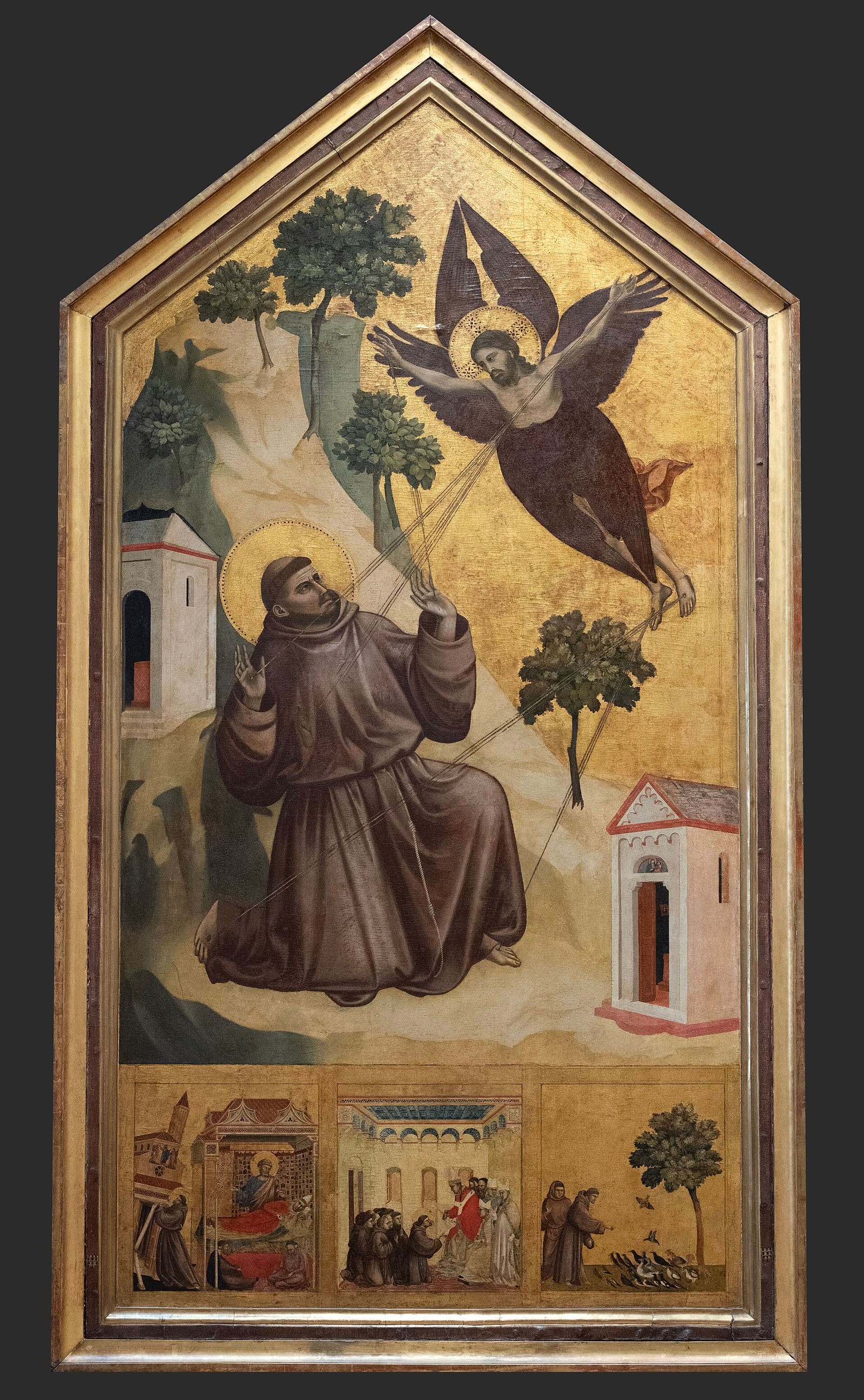
In September 1224, while praying on the mountain of La Verna, he received the wounds of Christ in his body. He is the first person known to have borne the stigmata.
Brother Sun and Sister Death
Nearly blind and in great pain, Francis composed the Canticle of the Creatures, praising God through Brother Sun, Sister Moon, Brother Fire and Sister Water. He added a final verse welcoming “Sister Death.”
He died at the Porziuncola on the evening of October 3, 1226. Pope Gregory IX canonized him less than two years later, on July 16, 1228.
The Peace Prayer
Many people know him best from a prayer he did not write. It first appeared, without an author’s name, in a small French Catholic magazine called La Clochette in December 1912. Its link to Francis came later, when it was printed on a holy card showing the saint. Yet it captures his spirit so well that it has become known around the world.
The Peace Prayer (Traditional, 1912)
Lord, make me an instrument of your peace. Where there is hatred, let me sow love; where there is injury, pardon; where there is doubt, faith; where there is despair, hope; where there is darkness, light; where there is sadness, joy. O Divine Master, grant that I may not so much seek to be consoled as to console; to be understood as to understand; to be loved as to love. For it is in giving that we receive, it is in pardoning that we are pardoned, and it is in dying that we are born to eternal life. Amen.
A Prayer in the Spirit of the Canticle (Original Prayer)
Most High, all-powerful, good Lord, I praise You for the sun and the moon, for wind, water and fire, and for this good earth that feeds us. Teach me to live simply and to love the poor, and to welcome Sister Death in peace when she comes. Amen.
Continue Reading
Read the life of Padre Pio, a Capuchin son of St. Francis who also bore the stigmata, or learn how to live like a Catholic saint.
Frequently asked questions
When is the feast day of St. Francis of Assisi?
October 4. He died on the evening of October 3, 1226, and many Franciscans keep a Transitus service that night.
What is St. Francis the patron saint of?
He is a patron of Italy. In 1979 St. John Paul II named him the patron of those who promote ecology, and he is also widely associated with animals.
Did St. Francis write the Prayer of St. Francis?
No. "Lord, make me an instrument of your peace" first appeared anonymously in the French magazine La Clochette in December 1912. It was attributed to Francis only later. It does reflect his spirit, and it is good to pray it.
Why do people bless animals on his feast?
Early stories about him describe his tender regard for all God's creatures, including preaching to the birds. Many parishes hold blessings of animals around October 4.
Sources
- Thomas of Celano, Lives of St. Francis
- St. Bonaventure, Major Life of St. Francis
- St. Francis of Assisi, Canticle of the Creatures
- Christian Renoux, research on the Peace Prayer, summarized at The Origin of the Peace Prayer of St. Francis
- Pope Francis, Encyclical Laudato Si' (2015)