St. Elizabeth of Hungary: Princess, Widow and Servant of the Poor
Quick answer
St. Elizabeth of Hungary (1207–1231) was a daughter of King Andrew II of Hungary, married at fourteen to Louis IV of Thuringia, in Germany. She and Louis loved each other deeply. She used her wealth to feed the hungry and care for the sick. After Louis died on crusade, she gave up court life, became a Franciscan tertiary, and spent her last years serving the poor in a hospital she founded at Marburg. She died at twenty-four. Her feast is November 17.
Key takeaways
- She was betrothed as a child and married Louis of Thuringia in 1221.
- Their marriage was a happy one, and they had three children.
- During a famine she distributed grain from the royal stores.
- She founded a hospital at Marburg and cared for patients with her own hands.
St. Elizabeth of Hungary lived only twenty-four years, but she packed into them a happy marriage, motherhood, widowhood and a life of heroic service to the poor. She is a saint for every stage of life.
A Royal Childhood
Elizabeth was born in 1207, the daughter of King Andrew II of Hungary. As was common for royal children, she was promised in marriage while still a small child, to Louis, son of the Landgrave of Thuringia in Germany, and was sent to grow up at his family’s castle, the Wartburg.
Some at court mocked her piety. But Louis loved and defended her.
A Loving Marriage
They married in 1221, when Elizabeth was fourteen and Louis twenty-one. Their marriage was deeply happy. Her handmaids later testified that she would hold her husband’s hand while she prayed at night. They had three children, a son and two daughters.
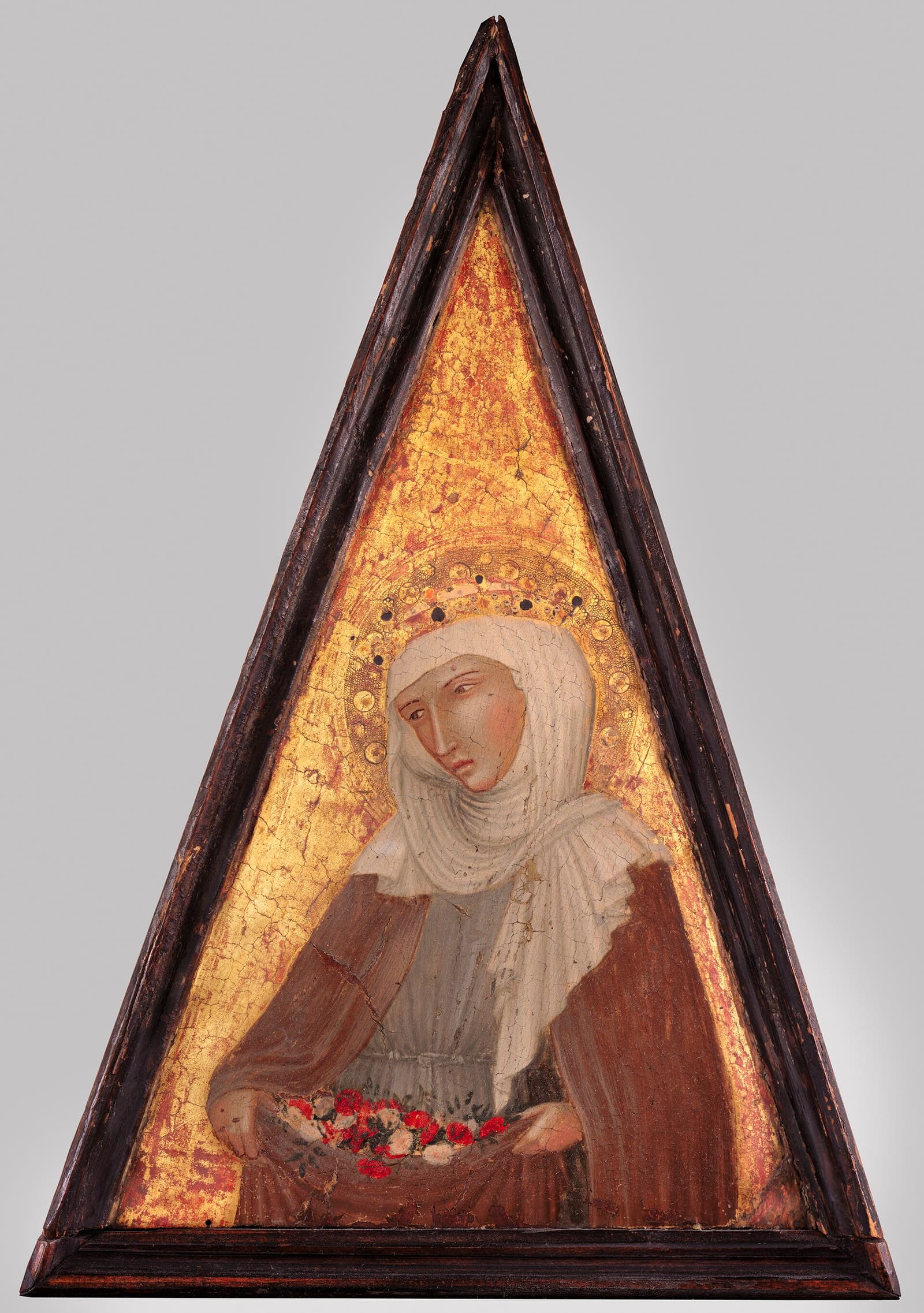
Louis supported her charity. During a famine in 1226, while he was away, Elizabeth opened the royal grain stores to the hungry and built a hospital below the castle, where she cared for the sick herself. A legend says that once, when she was carrying bread to the poor in her cloak, she was stopped and asked what she had. She opened her cloak and found it full of roses.
Widowhood
In 1227 Louis set out on crusade and died of fever in Italy. Elizabeth, only twenty, was heartbroken. She left the Wartburg with her children, and for a time endured poverty and rejection.
She then joined the Franciscan Third Order, inspired by St. Francis of Assisi, who had died the year before. Under the strict guidance of her confessor, Conrad of Marburg, she settled at Marburg and founded a hospital dedicated to St. Francis. There she nursed the sick, washed them, fed them, and lived in poverty.
Her Death
Worn out by work and penance, Elizabeth died on November 17, 1231, at twenty-four. So many miracles were reported at her tomb that she was canonized only four years later, in 1235.
What She Teaches
Elizabeth shows that wealth and position can be used for God, that a holy marriage is a path to sanctity, and that grief can open us to serve others.
A Prayer for Those Who Serve the Sick (Original Prayer)
St. Elizabeth, you loved your husband, your children and the poor. Bless all nurses, caregivers and those who feed the hungry. Help me use what I have for others, and find Christ in those who suffer. Amen.
Continue Reading
Read about St. Francis of Assisi, St. Vincent de Paul, or St. Louis IX.
Frequently asked questions
When is the feast of St. Elizabeth of Hungary?
November 17.
What is the miracle of the roses?
A popular legend says that when Elizabeth was secretly carrying bread to the poor, she was stopped and asked what was in her cloak. When she opened it, it was full of roses.
What is she the patron saint of?
Bakers, the Franciscan Third Order, hospitals, nurses, widows and Catholic charities.
Sources
- Conrad of Marburg, Letter to Pope Gregory IX on Elizabeth's life (1232)
- Testimony of Elizabeth's four handmaids (Dicta quatuor ancillarum)
- Pope Benedict XVI, General Audience on St. Elizabeth of Hungary (October 20, 2010)