The Magnificat: Mary's Song of Praise and What It Means
Quick answer
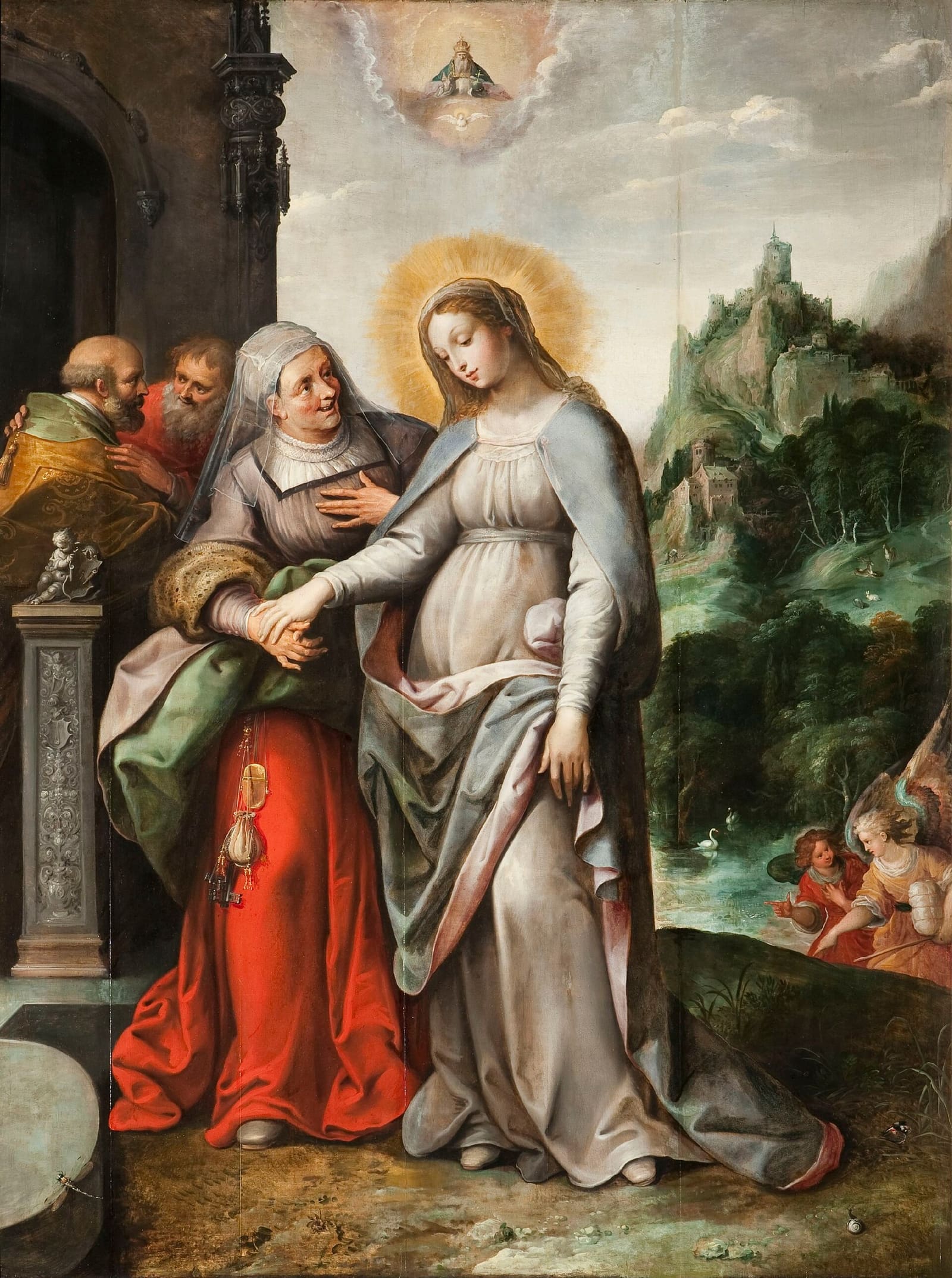
The Magnificat is the song of praise Mary sang when she visited her relative Elizabeth (Luke 1:46-55). It praises God who looks on the lowly, keeps His promises to Abraham, and lifts up the humble. The Church prays it every evening in Vespers, the Evening Prayer of the Liturgy of the Hours.
Key takeaways
- Mary sang it at the Visitation, after Elizabeth called her blessed.
- Its name comes from its first word in Latin, Magnificat, "magnifies."
- It echoes the song of Hannah in 1 Samuel 2 and many psalms.
- The Church sings it every day at Evening Prayer.
When Mary went in haste to visit Elizabeth, the older woman cried out, “Blessed art thou among women.” Mary’s answer was not about herself. It was a song about God. The Church has sung it every evening for centuries.
The Text of the Magnificat (Luke 1:46-55, Douay-Rheims)
My soul doth magnify the Lord. And my spirit hath rejoiced in God my Saviour. Because he hath regarded the humility of his handmaid; for behold from henceforth all generations shall call me blessed. Because he that is mighty, hath done great things to me; and holy is his name. And his mercy is from generation unto generations, to them that fear him. He hath shewed might in his arm: he hath scattered the proud in the conceit of their heart. He hath put down the mighty from their seat, and hath exalted the humble. He hath filled the hungry with good things; and the rich he hath sent empty away. He hath received Israel his servant, being mindful of his mercy: As he spoke to our fathers, to Abraham and to his seed for ever.
In the Liturgy of the Hours it ends with the Glory Be.
What It Means
“My soul doth magnify the Lord.” To magnify is to make great. Mary does not make God bigger, but her whole life lets His greatness be seen, the way a magnifying glass lets us see more clearly.
“He hath regarded the humility of his handmaid.” God chose a young woman from a small village. Mary sees her greatness entirely as His gift.
“All generations shall call me blessed.” Every time we pray the Hail Mary, we fulfill these words.
“His mercy is from generation unto generations.” What God did for Mary, He does for every generation that reveres Him.
“He hath put down the mighty … and hath exalted the humble.” Mary praises a God who turns the world’s values upside down. These lines have always encouraged care for the poor and the hungry.
“As he spoke to our fathers, to Abraham.” God keeps His promises. In Mary’s Son, the hope of Israel is fulfilled.
Rooted in the Old Testament
Mary’s song closely echoes the Song of Hannah, the mother of the prophet Samuel, who also praised God for lifting up the lowly (1 Samuel 2:1-10). Mary prays with the words of Scripture she knew by heart, and teaches us to do the same.
How to Pray It
- At Evening Prayer. The Magnificat is the high point of Vespers each day, sung while the altar may be incensed.
- As thanksgiving. After good news, a recovery or an answered prayer, pray it slowly as Mary did.
- After Holy Communion. Like Mary, we carry Christ within us.
- With the Rosary. It is a natural companion to the second Joyful Mystery, the Visitation.
A Short Prayer After the Magnificat (Original Prayer)
Holy Mary, teach me to praise God as you did, to see His gifts in my life, and to give thanks in every season. Amen.
Continue Reading
Read why Catholics pray to Mary, what the Church believes about Mary, or about St. John the Baptist.
Frequently asked questions
Where is the Magnificat in the Bible?
In the Gospel of Luke, chapter 1, verses 46 to 55.
When do Catholics pray the Magnificat?
Every evening in Vespers (Evening Prayer). Many people also pray it on Marian feasts, after Holy Communion, or as a prayer of thanksgiving.
Why is it called the Canticle of Mary?
A canticle is a song from Scripture outside the Book of Psalms. The Magnificat is Mary's own canticle.
Sources
- Gospel of Luke 1:39-56 (Douay-Rheims)
- 1 Samuel 2:1-10, the Song of Hannah (Douay-Rheims)
- Catechism of the Catholic Church, nos. 2097, 2619, 2675
- Pope St. John Paul II, Redemptoris Mater (1987), nos. 35–37