The Church of the Gesù in Rome: Mother Church of the Jesuits
Quick answer
The Church of the Gesù (Chiesa del Santissimo Nome di Gesù) is the mother church of the Society of Jesus in Rome. Begun in 1568 with money from Cardinal Alessandro Farnese and designed by Giacomo Barozzi da Vignola and Giacomo della Porta, it introduced a wide, single nave built for preaching that became a model for churches around the world. Inside are Baciccio's ceiling fresco The Triumph of the Name of Jesus, the altar and tomb of St. Ignatius by Andrea Pozzo, and a relic of the arm of St. Francis Xavier. Next door are the rooms where St. Ignatius lived and died.
Key takeaways
- The Gesù was begun in 1568, twelve years after St. Ignatius's death.
- Its single, wide nave without aisles was designed for preaching and became a model for Baroque churches.
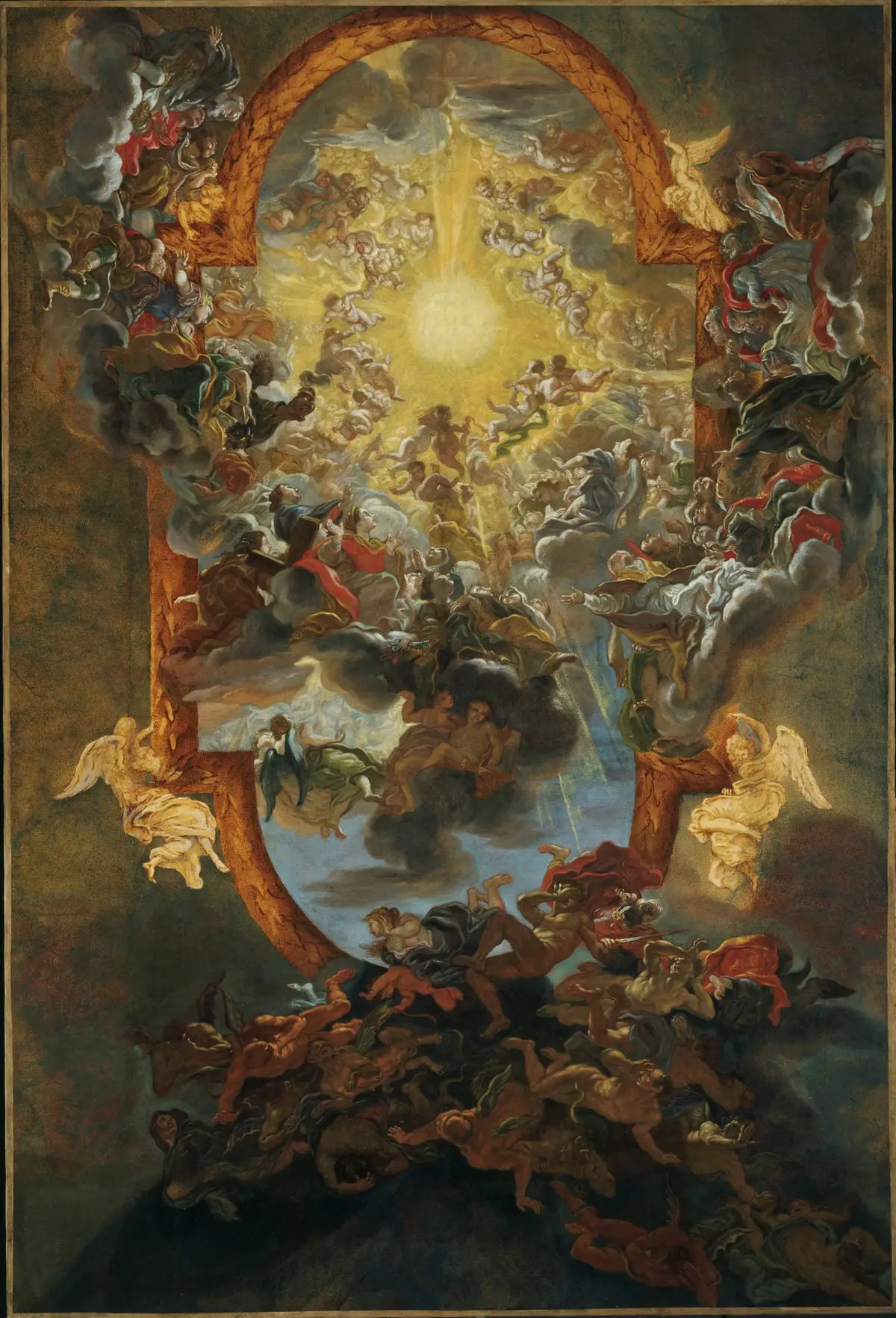
- Baciccio's ceiling, The Triumph of the Name of Jesus (1670s), seems to open into heaven.
- St. Ignatius is buried under Andrea Pozzo's lavish altar in the left transept.
- The rooms of St. Ignatius next to the church can be visited.
Michelangelo offered to design it for free. Caravaggio was so angry when he lost a commission there that the quarrel ended up in court. Bernini drew inspiration from its paintings and sermons. That is how art historian Gauvin Alexander Bailey opened his Company magazine article on the Church of the Gesù, the mother church of the Jesuits in Rome. For more than four centuries, it has been one of the most important churches in the Eternal City.
History
The Gesù, properly the Church of the Most Holy Name of Jesus, stands on Piazza del Gesù in the heart of Rome. St. Ignatius had served a small church on the site, Santa Maria della Strada, but he dreamed of a larger church for preaching. Work began only in 1568, twelve years after his death.
The money came from Cardinal Alessandro Farnese, the richest art patron of his day and grandson of Pope Paul III, who had approved the Society of Jesus in 1540. Farnese spent a fortune on the project and chose the architects: Giacomo Barozzi da Vignola designed the plan, and Giacomo della Porta completed the dome and the famous façade. The church was consecrated in 1584. Decorating it took more than a century.
The Gesù was surrounded by a network of Jesuit works: houses for former prostitutes, orphanages, schools and homes for the elderly. It was the center of an active Christian city.
A New Kind of Church
The Gesù’s design was revolutionary. Instead of a nave lined with columns and side aisles, it has a single, wide nave under a great barrel vault, with chapels along the sides. Everyone could see the altar and hear the preacher. Its façade, with two stories joined by scrolls, was copied across Europe and Latin America. Hundreds of Jesuit churches, from Mexico to Goa, follow its pattern.
What to See
The Ceiling: The Triumph of the Name of Jesus
In the 1670s the painter Giovanni Battista Gaulli, known as Baciccio, covered the nave ceiling with an astonishing fresco. The roof seems to burst open into a heaven of light, with the monogram IHS, the name of Jesus, blazing at the center. Painted figures and stucco angels spill over the frame, and the damned seem to tumble down into the church.
The Altar and Tomb of St. Ignatius
In the left transept is the altar of St. Ignatius, designed by the Jesuit brother Andrea Pozzo around 1700, glittering with lapis lazuli, gilded bronze and colored marbles. The saint’s remains lie beneath it in a gilded urn. Above, a large painting of Ignatius can be lowered by machinery to reveal a statue of the saint, a ceremony still performed at certain times.
The Arm of St. Francis Xavier
In the right transept, the altar of St. Francis Xavier holds a reliquary with the right arm of the great missionary, with which he baptized thousands in Asia. Read the life of St. Francis Xavier.
The Rooms of St. Ignatius
Next to the church are the Camerette, the rooms where St. Ignatius lived, wrote the Constitutions, governed the Society and died on July 31, 1556. A corridor painted by Andrea Pozzo uses perspective tricks that change as you walk.
Other Treasures
A painting in the church shows Pope Paul III approving the Society of Jesus in 1540. In a side chapel rest the remains of Fr. Pedro Arrupe, Superior General from 1965 to 1983, whose cause for beatification is open.
A Restored Masterpiece
Between 1993 and 1999 the Italian government restored the church’s frescoes, stuccoes and marbles, revealing colors hidden under centuries of grime. A French writer once compared the Gesù to a royal banquet hall. Its splendor was meant to lift hearts toward the glory of God, ad maiorem Dei gloriam.
Visiting the Gesù
The church is open daily and free to enter, a short walk from the Pantheon and Piazza Venezia. Nearby is the Church of Sant’Ignazio, with Andrea Pozzo’s famous painted “dome.” In the building beneath the Jesuit residence, the Jesuit Refugee Service runs the Centro Astalli for refugees.
Litany of the Holy Name (Excerpt)
Jesus, Son of the living God, have mercy on us. Jesus, splendor of the Father, have mercy on us. Jesus, brightness of eternal light, have mercy on us. Jesus, King of glory, have mercy on us. Jesus, Sun of justice, have mercy on us. Jesus, Son of the Virgin Mary, have mercy on us.
Continue Reading
Read the life of St. Ignatius of Loyola, discover Jesuit mission art, or read about lost masterpieces found in Jesuit houses.
Frequently asked questions
Where is St. Ignatius of Loyola buried?
In the Church of the Gesù in Rome, beneath the altar of St. Ignatius in the left transept, designed by the Jesuit brother Andrea Pozzo around 1700.
Is the arm of St. Francis Xavier in the Gesù?
Yes. A relic of the right arm of St. Francis Xavier, the arm with which he baptized thousands, is kept in a reliquary at the altar of St. Francis Xavier in the right transept. His body lies in Goa, India.
Can you visit the rooms of St. Ignatius?
Yes. The Camerette, the small rooms where Ignatius lived, worked and died in 1556, are next to the church and include a famous painted corridor by Andrea Pozzo.
Sources
- Gauvin Alexander Bailey, "Gesù," Company magazine (Spring 2001)
- Gauvin Alexander Bailey, Between Renaissance and Baroque, Jesuit Art in Rome 1565–1610 (University of Toronto Press, 2003)
- Chiesa del Gesù, official site