Lost Masterpieces Found in Jesuit Houses: Caravaggio's Taking of Christ and More
Quick answer
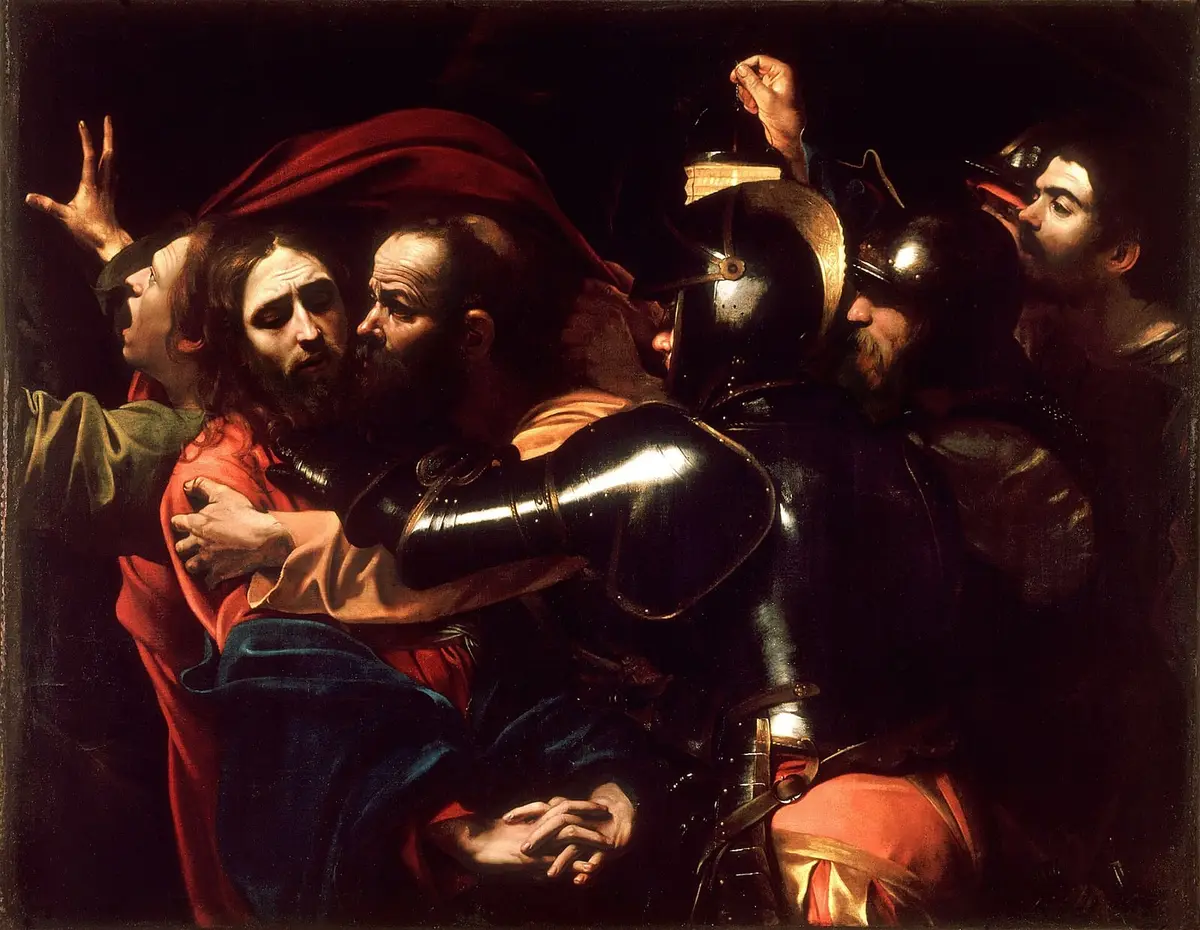
Several important works of art have been rediscovered in Jesuit houses. The most famous is Caravaggio's The Taking of Christ (1602), which had hung unrecognized for decades in the Jesuit residence on Leeson Street in Dublin until it was identified in 1990; the Jesuits lent it indefinitely to the National Gallery of Ireland. A Tintoretto was found at the Jesuit center in Wernersville, Pennsylvania, and in 2000 the Jesuits of Amsterdam found 75 early 17th-century copperplates by the Wierix family of engravers in a cardboard box.
Key takeaways
- Caravaggio painted The Taking of Christ in 1602 for a Roman patron.
- It was given to the Dublin Jesuits in the 1930s and recognized as a Caravaggio in 1990.
- The Jesuits lent it indefinitely to the National Gallery of Ireland.
- A Tintoretto was found at the Jesuit center in Wernersville, Pennsylvania.
- In 2000, 75 Wierix copperplates turned up in a box at De Krijtberg in Amsterdam.
Most religious houses have old paintings on the walls that nobody looks at twice. Occasionally one of them turns out to be a masterpiece. Company magazine once reported three such discoveries in Jesuit houses: “a Caravaggio in the Jesuit community of Dublin,” “a Tintoretto in the Jesuit community of Wernersville, Pennsylvania,” and a priceless box of copperplates in Amsterdam.
Caravaggio’s The Taking of Christ
The Painting
In 1602, the Italian painter Caravaggio painted The Taking of Christ for the Roman nobleman Ciriaco Mattei. It shows the moment of Judas’s kiss in the Garden of Gethsemane (Matthew 26:47–50). Judas presses his lips to Jesus’s cheek; Christ, hands clasped, lowers His eyes in sorrow; a soldier in black armor reaches for Him; a disciple flees, crying out. At the far right, a man holds up a lantern. Many believe it is a self-portrait of Caravaggio himself, the artist as a witness to the betrayal.
Lost for Two Centuries
The painting was sold and copied, and by the 19th century the original was thought lost. Copies hung in several collections. In the 1930s, a Dublin pediatrician, Dr. Marie Lea-Wilson, gave a painting of the subject to the Jesuits of Leeson Street in Dublin, in gratitude for their support after her husband, a police officer, was killed in 1920. It was believed to be a copy by a Dutch painter. For decades it hung in the Jesuits’ dining room.
The Discovery
In 1990, the Jesuits asked the National Gallery of Ireland to clean their paintings. Conservator Sergio Benedetti suspected at once that this was something special. Years of research, including the discovery of the Mattei family’s account books in an Italian archive, confirmed it: it was the lost Caravaggio. The story is told in Jonathan Harr’s book The Lost Painting.
The Jesuits could have sold it for a fortune. Instead they lent it indefinitely to the National Gallery of Ireland, where it was unveiled in 1993 and remains one of the gallery’s greatest treasures.
A Tintoretto in Pennsylvania
The second discovery was at the Jesuit center in Wernersville, Pennsylvania, a former novitiate and retreat house. A painting there was identified as the work of the Venetian master Tintoretto (1518–1594), whose dramatic religious paintings fill the churches of Venice.
The Wierix Copperplates of Amsterdam
The third find was quieter but just as remarkable. In the summer of 2000, the Jesuit house next to the church of St. Francis Xavier in Amsterdam, known as De Krijtberg, was vacated for renovation. The community’s oldest member produced a simple cardboard box he had kept in his room for over thirty years. Inside were 75 copperplates from the early 1600s, each wrapped in old paper, including theater programs from a girls’ school in Ghent from 1819 and an Amsterdam newspaper from 1839.
They were the work of Anton and Hieronymus Wierix and Hieronymus’s son-in-law Jan Baptist Barbé, members of a famous family of engravers in Antwerp. The plates, almost all in excellent condition, form one of the largest collections of Wierix plates in the world.
How did they get there? During the Dutch Republic, Catholics worshiped in hidden churches, and De Krijtberg had been one of the Jesuits’ secret “stations” since 1654. When the Society was suppressed in 1773, the former Jesuits in Amsterdam managed to stay put, while their brothers in the Southern Netherlands lost everything to the state. Probably a former Jesuit from Antwerp carried the plates north for safekeeping.
Pictures for Prayer
The Wierix engravings were devotional images: small prayer cards and illustrations for meditation, rooted in the late medieval Devotio Moderna. They show scenes from the life of Christ and the saints in tiny, exquisite detail, designed to help the faithful imagine Gospel scenes in prayer, exactly the kind of imaginative contemplation St. Ignatius taught in the Spiritual Exercises.
Why Sacred Art Matters
The Catechism teaches that “genuine sacred art draws man to adoration, to prayer, and to the love of God, Creator and Savior” (CCC 2502). These rediscovered works remind us that art made for prayer still has the power to move hearts centuries later. Read about the Church of the Gesù and Jesuit mission art.
Prayer Before the Betrayal of Christ (Original Prayer)
Lord Jesus, betrayed with a kiss, You went freely to Your Passion for love of us. When we are tempted to betray You, hold us fast in Your mercy. When others wound us, give us Your gentleness. May we never flee from You, but stay with You, in the garden and at the cross. Amen.
Continue Reading
Read about the Church of the Gesù, Jesuit mission art, or pray the Rosary for Friday, with the Sorrowful Mysteries.
Frequently asked questions
Where is Caravaggio's The Taking of Christ now?
In the National Gallery of Ireland in Dublin, on indefinite loan from the Jesuit community of Leeson Street, in gratitude to the late Dr. Marie Lea-Wilson, who gave it to them.
Who discovered the Caravaggio in Dublin?
Sergio Benedetti, a senior conservator at the National Gallery of Ireland, recognized it in 1990 when the Jesuits asked the gallery to clean their paintings.
What are Wierix engravings?
Prints by a family of engravers in Antwerp around 1600, famous for small, very detailed devotional images used as prayer cards and in books of meditation.
Sources
- "Lasting Impressions," Company magazine (Fall 2001)
- Jonathan Harr, The Lost Painting (Random House, 2005)
- National Gallery of Ireland, The Taking of Christ