Ignatian Spirituality: A Simple Guide to Praying Like St. Ignatius
Quick answer
Ignatian spirituality is the way of prayer and life taught by St. Ignatius of Loyola in his Spiritual Exercises. Its key practices are the daily Examen, discernment of spirits, imaginative contemplation of the Gospels and the effort to find God in all things. It aims at freedom from disordered attachments so that a person can love and serve God more generously in daily life.
Key takeaways
- It comes from the Spiritual Exercises, which St. Ignatius wrote from his own conversion experience.
- "Finding God in all things" means God can be met in work, family, study and nature.
- The daily Examen is a five-step review of the day with gratitude.
- Discernment means noticing consolation and desolation to recognize God's will.
- Imaginative prayer places you inside a Gospel scene with Jesus.
Some spiritualities are built for the cloister. Ignatian spirituality was built for the road. St. Ignatius of Loyola wanted people who could pray deeply and then go out into busy, complicated lives, finding God in classrooms, kitchens, offices and hospitals. Five centuries later, his way of prayer helps Catholics everywhere listen to God in the middle of daily life.
Where It Comes From
During his recovery from a war wound in 1521, St. Ignatius noticed something. When he daydreamed about knightly glory, he felt excited and then dry. When he imagined imitating the saints, the joy lasted. Over years of prayer at Manresa he wrote down what he learned. The result was the Spiritual Exercises, a handbook for those who guide others in prayer.
The Exercises begin with the Principle and Foundation: we are created to praise, reverence and serve God, and all other things are given to help us reach that end. We should use them insofar as they help and leave them insofar as they hinder (Spiritual Exercises 23).
The Four Weeks of the Exercises
The full Exercises last about thirty days, divided into four “weeks”:
- First Week: God’s love and our sin. We see ourselves as loved sinners.
- Second Week: the life of Christ. We ask to know Jesus more intimately, love Him more and follow Him more closely.
- Third Week: the Passion. We stay with Jesus in His suffering.
- Fourth Week: the Resurrection. We share His joy and end with the Contemplation to Attain Love.
Ignatius knew most people could not leave home for a month. His 19th annotation allows the Exercises to be made over many months, praying an hour a day with a director. This “retreat in daily life” is popular today.
Finding God in All Things
The phrase sums up the Jesuit outlook. God is not only in church. He is at work in creation, in other people and in the events of our day. A teacher grading papers, a nurse on night shift and a grandfather playing with his grandchildren can all meet God there.
The Daily Examen
Ignatius told his companions that if they had to skip some prayer, they should never skip the Examen. It takes about ten minutes, usually at night:
- Become aware of God’s presence. Ask the Holy Spirit for light.
- Give thanks. Recall the gifts of the day, large and small.
- Review the day. Walk through it hour by hour. Where did you feel close to God? Where did you drift away?
- Face your failings. Ask forgiveness for what went wrong.
- Look to tomorrow. Ask for grace for the day ahead.
The Examen is not a list of sins for confession, though it prepares well for it. It is mostly a prayer of gratitude.
Discernment of Spirits
Ignatius taught that inner movements of the heart can come from God or lead away from Him. He called the first consolation: an increase of faith, hope and love, peace, tears of joy, a pull toward God. He called the second desolation: darkness, turmoil, a pull toward low things, feeling “as if separated from our Creator” (Spiritual Exercises 317).
Some of his rules are simple and very practical:
- In desolation, never make a change. Keep the decisions you made in a time of peace.
- In consolation, prepare for desolation. Store up strength.
- The enemy loves secrecy. Speak to a wise director about your temptations.
Pope Francis, the first Jesuit pope, called discernment “a gift we must implore” and urged every Christian to practice it (Gaudete et Exsultate 166).
Imaginative Prayer
Ignatius invites us to enter a Gospel scene with all our senses. Picture the road to Emmaus. Feel the dust, hear the conversation, watch the stranger break bread. Then speak with Jesus “as one friend speaks to another” (Spiritual Exercises 54). This kind of meditation, which the Catechism describes as engaging “thought, imagination, emotion, and desire” (CCC 2708), helps the Gospel become personal.
The Magis and the Greater Glory of God
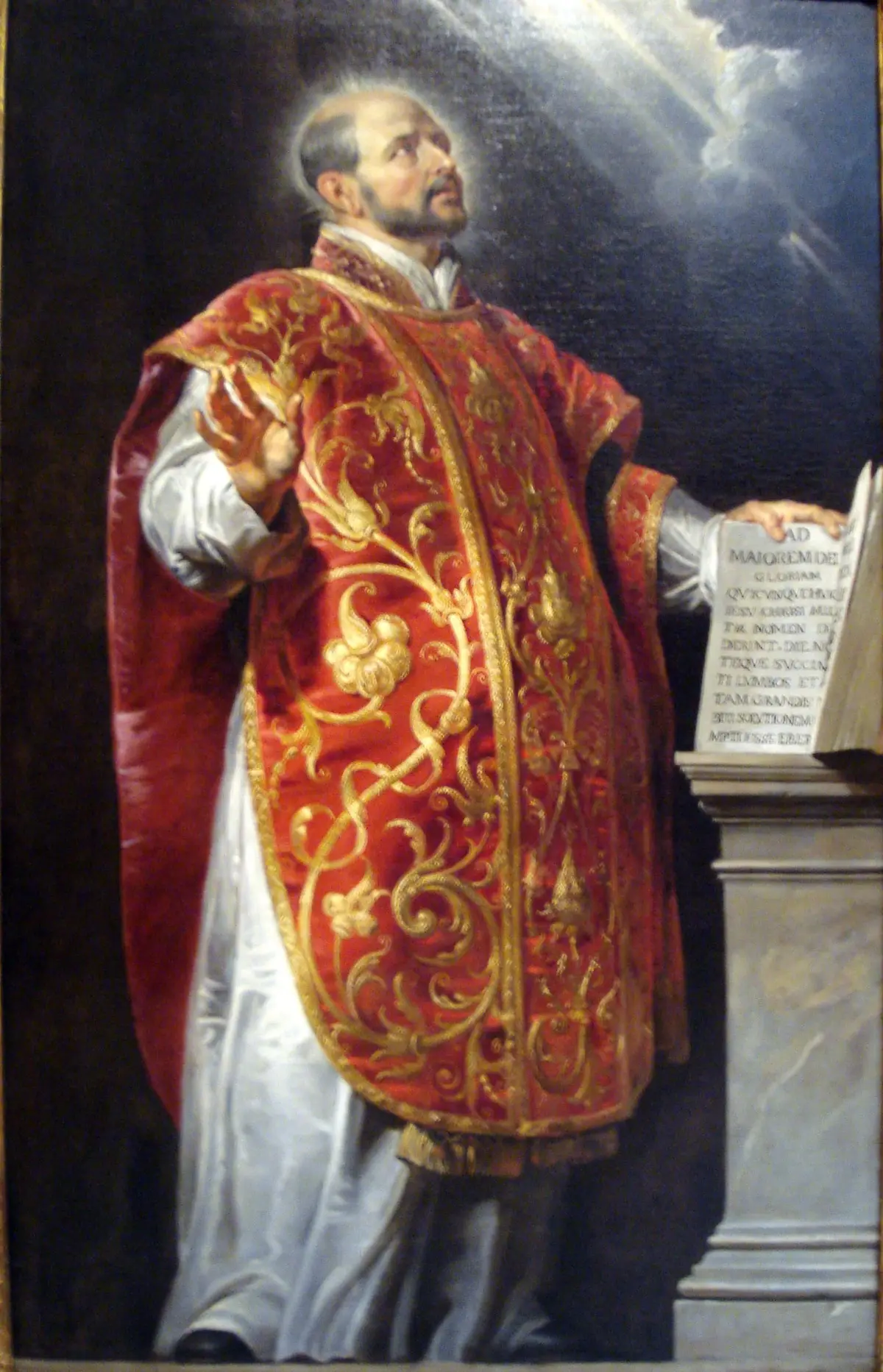
The Jesuit motto, Ad maiorem Dei gloriam, “for the greater glory of God,” expresses the magis, the “more.” It is not about doing more activities. It is about choosing, among good options, the one that gives greater glory to God and greater service to people.
How to Begin
- Pray the Examen each night for a month.
- Read a Gospel passage each morning and use your imagination.
- Look for an Ignatian retreat house or a trained spiritual director.
- Read a good introduction. See our Jesuit reading list.
Anima Christi
Soul of Christ, sanctify me. Body of Christ, save me. Blood of Christ, inebriate me. Water from the side of Christ, wash me. Passion of Christ, strengthen me. O good Jesus, hear me. Within your wounds hide me. Never let me be separated from you. From the evil one protect me. At the hour of my death call me and bid me come to you, that with your saints I may praise you for ever and ever. Amen.
Suscipe (Prayer of Self-Offering)
Take, Lord, and receive all my liberty, my memory, my understanding, and my entire will, all I have and call my own. You have given all to me. To you, Lord, I return it. Everything is yours; do with it what you will. Give me only your love and your grace. That is enough for me. Amen.
Continue Reading
Learn who the Jesuits are, read the life of St. Ignatius of Loyola, or pray the Rosary for today.
Frequently asked questions
What are the Spiritual Exercises?
A month-long program of prayer, meditation and contemplation written by St. Ignatius, divided into four "weeks." They can be made in a 30-day silent retreat or, as Ignatius allowed (Annotation 19), over several months in daily life with a spiritual director.
Do you have to be a Jesuit to practice Ignatian spirituality?
No. Ignatius first gave the Exercises to lay men and women. Today millions of Catholics and other Christians pray the Examen and make Ignatian retreats.
What is the difference between consolation and desolation?
Consolation is any movement of the soul that increases faith, hope and love and draws us to God. Desolation is darkness, restlessness or discouragement that pulls us away. Ignatius teaches never to make a major change in time of desolation.
Sources
- St. Ignatius of Loyola, The Spiritual Exercises, nos. 1, 23, 32, 43, 313–336
- St. Ignatius of Loyola, Autobiography (Reminiscences)
- Catechism of the Catholic Church, nos. 2705–2708 (meditation)
- Pope Francis, Gaudete et Exsultate (2018), nos. 166–175 (discernment)