Do Pets Go to Heaven? What the Catholic Church Really Teaches
Quick answer
The Catholic Church has no defined teaching on whether pets go to heaven. It teaches that only human beings have a spiritual, immortal soul (CCC 366), but also that God loves every creature (CCC 339, 2416) and will renew all creation (Romans 8:21, CCC 1047). So Catholics may hope, while trusting God with what He has not revealed.
Key takeaways
- The Church has never defined whether animals will be in heaven; it is an open question, not a doctrine.
- Only human beings have a spiritual, immortal soul created directly by God (CCC 362-366); animals have a real life, but not that kind of soul.
- God surrounds animals with His providential care, and by their existence they give Him glory (CCC 2416).
- Scripture and the Catechism teach that all of creation will be renewed in Christ (Romans 8:19-21, CCC 1046-1047), which leaves room for hope.
- The story that Pope Francis said "dogs go to heaven" was a media misreport, later corrected.
Do pets go to heaven? The honest Catholic answer is that the Church has never defined it. She teaches that only human beings have a spiritual, immortal soul, but she also teaches that God loves every creature He made and that He will renew the whole of creation in Christ. So Catholics are free to hope, and to leave the details to a God who is good.
If you are reading this because a dog, cat or other companion has just died, you are not foolish for asking. The question comes from love. Below you will find what the Church does teach, what she leaves open, what saints and theologians have said (clearly marked as their opinions), and a prayer of thanksgiving for a pet that has died.
What Does the Catholic Church Teach About Pets in Heaven?
There is no dogma, council or Catechism paragraph that says “animals go to heaven,” and none that says “animals do not go to heaven.” The question simply has not been settled. When the Church has not defined something, faithful Catholics may hold different opinions, as long as those opinions fit with what she does teach.
What she does teach can be gathered into three truths:
- Human beings are unique. Only we are made in God’s image with a spiritual soul that lives on after death (CCC 362-366).
- Animals are loved by God. They are His creatures, held in His care, and they give Him glory just by existing (CCC 339, 2416).
- Creation will be renewed. God will make “a new heaven and a new earth,” and the visible world itself will share in the glory of the risen Christ (CCC 1046-1047).
Each of these deserves a closer look, because together they shape a hope that is honest rather than sentimental.
Do Animals Have Souls? Human and Animal Souls Compared
Many people are surprised to learn that, in Catholic thought, animals do have a soul. In the classic sense of the word, the “soul” is simply the principle of life in a living thing: what makes a dog a living dog and not just a collection of matter. Plants have a life principle, animals have one, and so do we.
The difference lies in what kind of soul it is. The Catechism teaches that the human soul is spiritual. It is “created immediately by God,” it “does not perish when it separates from the body at death,” and it will be reunited with the body at the final resurrection (CCC 366). This spiritual soul is what makes us able to know truth, to choose freely, to love God, and to be responsible for our choices.
Here is a simple comparison:
| Human soul | Animal soul | |
|---|---|---|
| Gives life to the body | Yes | Yes |
| Senses, feelings, memory | Yes | Yes |
| Reason and free will | Yes | No |
| Created directly by God for each person | Yes (CCC 366) | Not taught |
| Lives on after death by its nature | Yes, it is immortal | Not taught |
| Made in God’s image, called to know and love Him | Yes (CCC 356-357) | No |
This does not make animals worthless or their feelings unreal. Anyone who has watched a dog greet its owner, or sat with an old cat purring in a lap, knows that animals experience real joy, fear, attachment and pain. The Church agrees: she forbids causing animals to suffer or die needlessly (CCC 2418). But their life is not the same as the spiritual, undying life of a human person.
So if the question is, “Does my dog have an immortal soul that goes to judgment, purgatory or heaven like mine?”, the Catholic answer is no. But that is not the end of the story.
God Loves Every Creature He Made
The first pages of Scripture tell us that God looked at the animals He had made “and God saw that it was good” (Genesis 1:25). The Catechism builds on this: “Each creature possesses its own particular goodness and perfection,” and each reflects “a ray of God’s infinite wisdom and goodness” (CCC 339).
The Catechism speaks very directly about animals: “Animals are God’s creatures. He surrounds them with his providential care. By their mere existence they bless him and give him glory. Thus men owe them kindness” (CCC 2416). It adds that we may love animals, but that we “should not direct to them the affection due only to persons” (CCC 2418).
Jesus Himself used animals to teach about the Father’s care. Not one sparrow falls to the ground without the Father knowing (Matthew 10:29). God feeds the birds of the air (Matthew 6:26). The psalmist praises the Lord who gives food to all living things and whose compassion is over all His works (Psalm 145:9).
When you loved your pet, you were sharing, in a small way, in God’s own delight in what He made. That love was not wasted.
The New Creation: Romans 8 and the Hope for All Creation
Christian hope is not only that our souls will go to heaven. It is also that God will raise our bodies and renew the whole universe. St. Paul writes that creation is waiting “with eager expectation” and hopes that “creation itself would be set free from slavery to corruption and share in the glorious freedom of the children of God” (Romans 8:19-21).
In the Book of Revelation, John sees “a new heaven and a new earth,” and hears the One on the throne say, “Behold, I make all things new” (Revelation 21:1-5). The prophet Isaiah, describing the peace of the Messiah’s kingdom, pictures the wolf as the guest of the lamb and a little child leading them (Isaiah 11:6).
The Catechism draws these passages together. It teaches that “the visible universe, then, is itself destined to be transformed,” so that the world, restored, will serve the just and share their glorification in the risen Jesus Christ (CCC 1047). It also notes that Scripture describes this renewal as a mystery; we do not know how it will happen (CCC 1048).
This is where many Catholics find room for hope. If God renews all creation and not only human souls, then animal life, in some form, may belong to that renewed world. The Church does not say how or whether individual animals, like your own dog or cat, will be there. But she does not forbid the hope.
What Saints and Theologians Have Said (Opinions, Not Doctrine)
Because the Church has not defined this question, thinkers have answered it differently. The views below are opinions, offered so you can see the range of faithful thought. None of them is binding.
St. Thomas Aquinas: a more cautious view
St. Thomas Aquinas, the great Dominican theologian of the 1200s, taught that an animal’s soul depends entirely on its body and does not survive death on its own. In writings gathered after his death, he also argued that animals would not be part of the renewed world, because in his view their purpose was to serve human life on earth, which will then be complete. Many Catholics still follow his reasoning closely.
St. Francis of Assisi: brother to all creatures
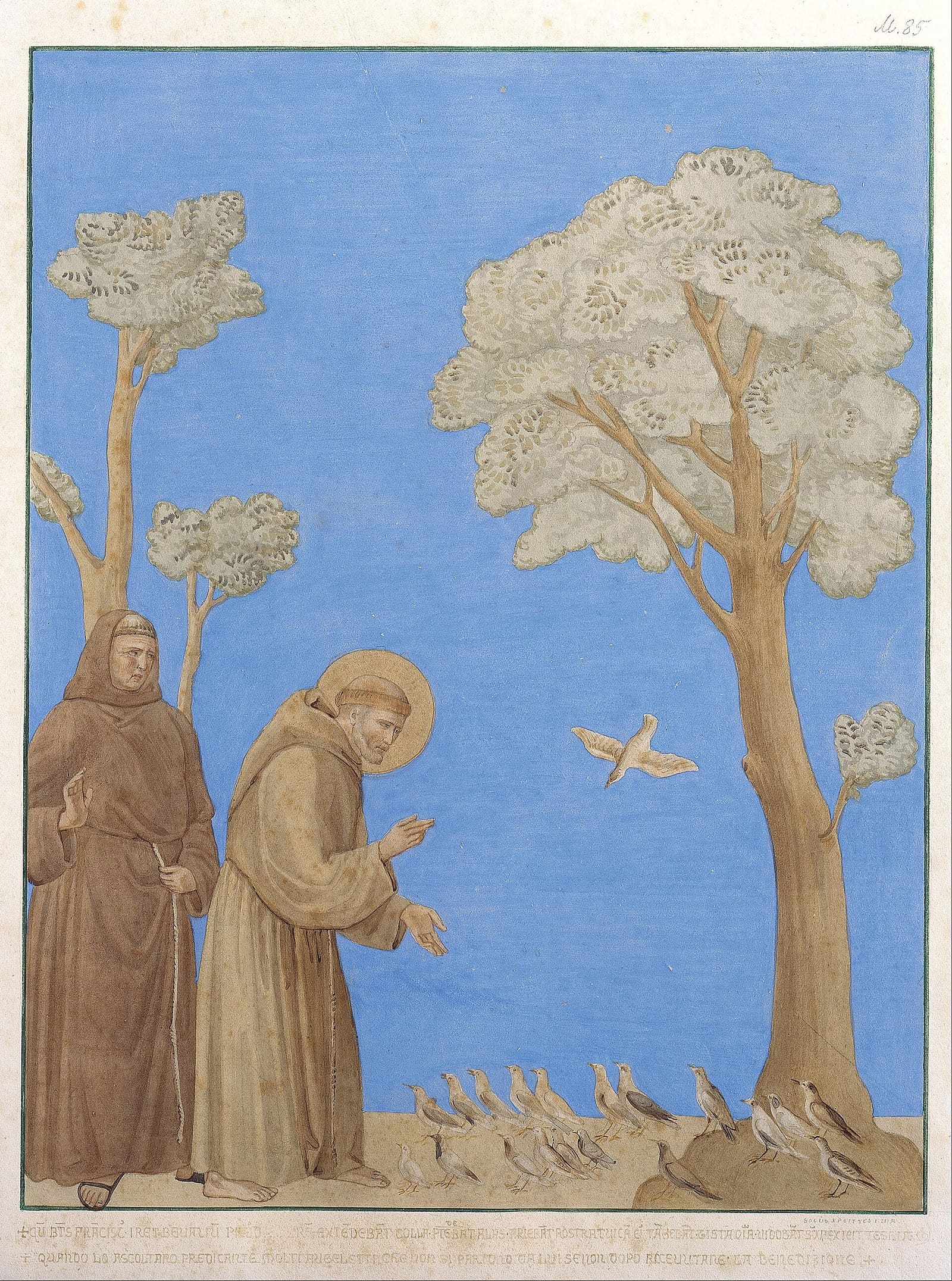
St. Francis of Assisi did not write a theology of animals in heaven, but his life shows a deep reverence for them. He called creatures his brothers and sisters, preached to the birds according to early accounts, and praised God through creation in his Canticle of the Creatures. The Catechism itself mentions him as an example of the gentleness owed to animals (CCC 2416). His spirit has encouraged many to believe that God’s love for animals is not merely temporary.
Pope Francis in Laudato Si’
In his 2015 encyclical Laudato Si’, Pope Francis wrote about the end of time in hopeful terms: “Eternal life will be a shared experience of awe, in which each creature, resplendently transfigured, will take its rightful place” (Laudato Si’ 243). He was speaking of creation as a whole, not specifically about pets. Still, his words show that hope for the renewal of all creatures sits comfortably within Catholic teaching.
Other Christian writers
Many modern writers, Catholic and not, have speculated that animals loved by human beings might share in heaven through that bond of love. The Anglican author C. S. Lewis explored this idea in The Problem of Pain, and later Catholic writers have offered similar thoughts. These are reflections, not teachings, but they show that the hope is an old and serious one.
Did Pope Francis Say Dogs Go to Heaven?
You may have seen a headline that Pope Francis comforted a grieving boy by telling him that his dog would be in heaven, or that “paradise is open to all God’s creatures.” That story spread widely in late 2014, but it was a misreport. Several major newspapers later issued corrections, because the Pope never said those words in the way reported.
It is worth knowing this, so that we do not build our hope on a quotation that was never said. Our hope rests on firmer ground: on God’s love for His creatures and His promise to make all things new.
Will I See My Pet in Heaven?
This is the question behind most searches, and it deserves a gentle, truthful answer.
No one can promise that you will see your pet in heaven, because God has not revealed it. But here is what the Church does promise:
- Heaven is perfect happiness. It is “the ultimate end and fulfillment of the deepest human longings, the state of supreme, definitive happiness” (CCC 1024). You can read more in our guide to what heaven is like according to the Catholic Church.
- Nothing will be missing. God “will wipe every tear from their eyes,” and there will be no more mourning or pain (Revelation 21:4).
- God is not less loving than we are. If you loved your pet, it is because God gave you that capacity. He knows your heart better than you do.
Many Catholics rest in this simple trust: if the presence of a beloved animal would add to the joy of heaven, God, who is infinitely generous, will not withhold it. And if heaven turns out to be different from what we imagine, it will be better, not worse. As St. Paul says, “What eye has not seen, and ear has not heard, and what has not entered the human heart, what God has prepared for those who love him” (1 Corinthians 2:9).
How Catholics Can Grieve a Pet
Grief for a pet is real grief. A dog who waited at the door for twelve years, or a cat who sat beside you through an illness, leaves a quiet emptiness that others may not fully understand. Here are a few gentle, Catholic ways to carry that sorrow:
- Thank God out loud. Name the good things: the walks, the companionship, the way they made you laugh. Gratitude turns grief toward God.
- Let yourself cry. Jesus wept at the tomb of His friend Lazarus (John 11:35). Tears are not a lack of faith.
- Bury or remember them with reverence. A simple burial in the garden, a small stone, or a photo near your prayer corner is fitting. (See our ideas for making a Catholic home altar.)
- Ask St. Francis to pray for you. Saints pray for us in every need, including sorrow.
- Keep a right order of love. Let your grief soften your heart toward other creatures and toward the people around you, not close it.
- Talk to someone. A friend, a family member or your parish priest can help, especially if the loss brings up older sorrows.
One note on prayer: the Church’s prayers for the dead, such as “Eternal rest grant unto them, O Lord,” are offered for human souls, who may need purification before seeing God (CCC 1030-1032). Animals do not face judgment or purgatory, so these prayers do not apply to them. Instead, we pray in thanksgiving for the gift of their life, and we pray for comfort in our own grief.
If your pet is still with you but unwell, you may find comfort in our prayers for a sick dog, the St. Roch prayer for dogs, or the St. Gertrude of Nivelles prayer for cats.
Prayers for a Pet That Died
These prayers are written for this article. Pray them slowly, alone or with your family, perhaps where your pet used to rest.
Prayer of Thanksgiving for a Pet That Has Died (Original Prayer)
Lord God, Creator of every living thing,
You looked on all You had made and saw that it was good.
I thank You for the gift of [name],
who shared my home and my days.
Thank You for the comfort, the loyalty and the joy
that came to me through this small creature of Yours.
I return [name] to You with a grateful heart.
I do not know all Your plans for the world You will make new,
but I know that You are good,
and that nothing You love is ever lost to You.
Help me to trust You with what I cannot see.
Through Christ our Lord.
Amen.
Prayer for a Grieving Heart After the Loss of a Pet (Original Prayer)
Lord Jesus, You wept for Your friend Lazarus,
and You know the sorrow of saying goodbye.
My home feels quiet, and my heart is heavy.
Comfort me in this loss.
Turn my tears into thanksgiving,
and my sadness into deeper love for You and for those around me.
When I miss my companion,
remind me that You hold all creation in Your hands
and that You will one day wipe every tear away.
Amen.
Prayer to St. Francis of Assisi for Comfort (Original Prayer)
St. Francis of Assisi,
you loved God’s creatures as your brothers and sisters,
and you praised the Lord through all that He had made.
Pray for me as I grieve the companion I have lost.
Help me to see in every creature a sign of God’s goodness,
and to treat all living things with gentleness.
Ask the Lord to give me peace,
and to lead me one day to the joy of heaven,
where all things will be made new.
Amen.
A Final Word of Hope
The Church does not hand us a guarantee about our pets, but she does not take away our hope either. She teaches that God made animals good, cares for them, and will renew all creation in His Son. For the rest, we are invited to do what every Christian does with the unknown: trust the Father. The love you felt for your companion came from Him, and He will not waste it.
For more on what the Church teaches about life after death, see our guide to Catholic beliefs on death and the afterlife.
Frequently asked questions
Do dogs go to heaven, according to the Catholic Church?
The Church has no official teaching on dogs or any other animal in heaven. It teaches that dogs do not have an immortal, spiritual soul like ours (CCC 366), yet God loves them and will renew all creation (CCC 1047). Some theologians have doubted that animals will be part of the new creation; others hope they will. A Catholic is free to hope and to leave the answer to God.
Will I see my pet in heaven?
No one can promise you that, because God has not revealed it. What the Church does promise is that heaven is perfect happiness with God, where every tear will be wiped away (Revelation 21:4). Nothing good that you lost will be missing from that joy. Many Catholics trust that if seeing a beloved pet would add to it, God will not withhold it.
Is it wrong to grieve so much for a pet?
No. Grief is the cost of love, and the love between a person and a faithful animal is a real good that God made possible. The Catechism says we may love animals, while keeping the affection due only to persons for people (CCC 2418). Let yourself grieve, thank God for the years you had, and talk to a friend or priest if the sorrow feels too heavy.
Can I have a Mass said for my pet that died?
Masses and prayers for the dead are offered for human souls, who may need purification before entering heaven (CCC 1030-1032). Animals do not need that purification, so a Mass is not offered for them. You can still bring your grief and your thanks to Mass, pray at home in thanksgiving for your pet, and ask St. Francis of Assisi to pray for you.
Sources
- Catechism of the Catholic Church 339, 362-366 (creatures; body and soul)
- Catechism of the Catholic Church 1046-1047 (the new heaven and new earth)
- Catechism of the Catholic Church 2415-2418 (respect for animals)
- Romans 8:19-21
- Revelation 21:1-5
- Pope Francis, Laudato Si' (2015), 243