St. Nicholas of Myra: The Real Saint Behind the Christmas Legend
Quick answer
St. Nicholas was bishop of Myra, in what is now Turkey, in the fourth century. Few historical details survive, but he has been loved for centuries for his generosity, especially the story of the gold he secretly gave so that three poor girls could marry. His relics are in Bari, Italy. His feast, December 6, falls in Advent, and his legend grew into Santa Claus.
Key takeaways
- He was bishop of Myra in Lycia, in present-day Turkey, and died around 343.
- The best-known story tells how he secretly gave gold to a poor father for his three daughters' dowries.
- His relics were brought to Bari, Italy, in 1087.
- The Dutch Sinterklaas, brought to America, became Santa Claus.
Long before reindeer and the North Pole, there was a bishop who gave in secret. St. Nicholas is one of the most popular saints in the world, in the East and the West alike.
What We Know
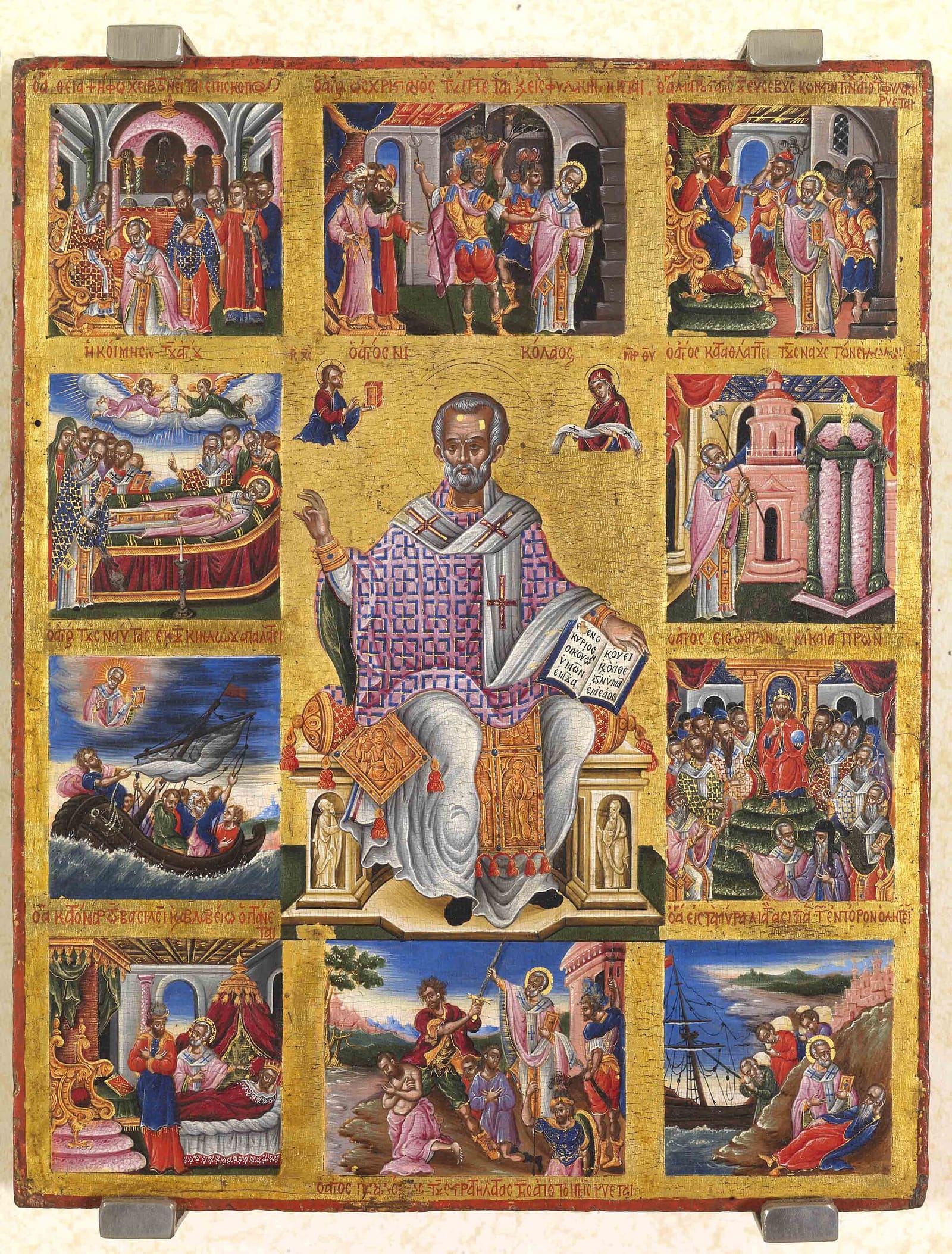
Nicholas was born in the third century in Patara, in Lycia, a region on the southern coast of present-day Turkey. He became bishop of the nearby city of Myra and died there, probably around 343. Tradition holds that he suffered imprisonment during the persecution under Emperor Diocletian, and some lists name him among the bishops at the Council of Nicaea in 325.
Beyond this, historians have little firm evidence. But the stories told about him from very early on show how deeply people loved him.
The Three Dowries
The most famous story is about a poor man with three daughters. Without dowries, they could not marry and faced a life of misery. Nicholas heard of it. One night he tossed a bag of gold through the man’s window, then did the same for the second daughter. On the third occasion the father kept watch and discovered who his benefactor was. Nicholas asked him to tell no one.
The story is the reason the saint is often shown with three golden balls, and why gifts are given in his name.
Protector of Sailors and Children
Other stories tell of Nicholas calming a storm at sea, saving three innocent men from execution, and feeding his city during a famine. Sailors in the Mediterranean prayed to him for centuries, and many harbor churches bear his name.
From Myra to Bari
In 1087, sailors from Bari, in southern Italy, carried his relics from Myra to their city, where the Basilica of St. Nicholas still holds them. Orthodox and Catholic pilgrims visit side by side.
How Nicholas Became Santa Claus
In the Netherlands, Sinterklaas arrives each year dressed as a bishop. Dutch settlers brought the custom to New York, and over time he became the American Santa Claus. Many Catholic families today keep December 6 as a way to recall the real saint behind the legend: a bishop whose joy was to give without being seen (Matthew 6:3-4).
A Prayer to St. Nicholas (Original Prayer)
St. Nicholas, friend of children and the poor, teach me to give quietly, without seeking thanks. Watch over our families this Advent, and help us prepare our hearts for Jesus. Amen.
Continue Reading
See when Advent starts, our Advent wreath prayers, or 10 simple ideas for a Catholic Christmas.
Frequently asked questions
When is the feast of St. Nicholas?
December 6.
What is St. Nicholas the patron saint of?
Children, sailors, travelers, the poor and unmarried people, among others. He is also a patron of Russia and Greece.
Why do children put out shoes on St. Nicholas Day?
In many countries children leave their shoes out on the night of December 5, and find them filled with small treats in the morning, a reminder of the saint's secret gifts.
Sources
- Roman Martyrology, December 6
- Butler's Lives of the Saints, December 6
- Basilica of St. Nicholas, Bari