Athanasius Kircher: The Jesuit Called the Last Renaissance Man
Quick answer
Athanasius Kircher (1602–1680) was a German Jesuit scholar who taught at the Roman College and wrote about forty books on an astonishing range of subjects, from magnetism, light and music to geology, medicine, China and Egyptian hieroglyphs. He climbed into Mount Vesuvius to study volcanoes, observed microorganisms with a microscope, invented machines and ran the Museum Kircherianum in Rome. Some of his theories were wrong, but his curiosity and his vast network of correspondents made him a center of 17th-century learning.
Key takeaways
- Kircher was born in Germany in 1602 and joined the Jesuits in 1618.
- He taught at the Roman College from 1634 until his death in 1680.
- He wrote about 40 books on science, music, languages, geology and China.
- His museum at the Roman College was one of the first public museums.
- His work on hieroglyphs was mistaken but helped spark the study of Coptic and Egypt.
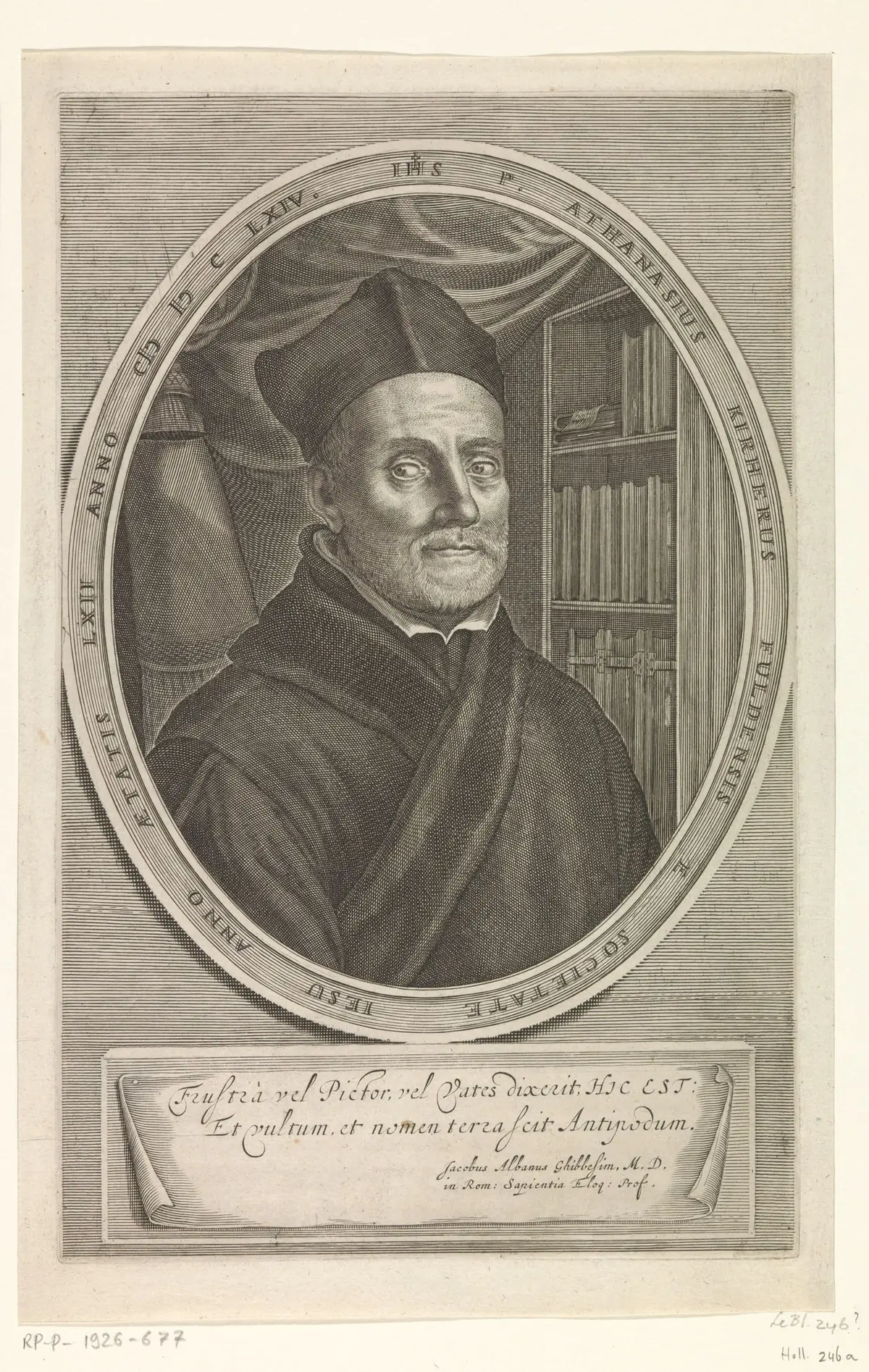
In the 1650s there was no internet, but there was Athanasius Kircher. From his rooms at the Jesuit Roman College, this German priest corresponded with missionaries, scholars and princes across the world, collected everything from Chinese manuscripts to Egyptian obelisks, and poured it all into some forty enormous books. A portrait made in his old age carried an inscription boasting that the farthest Antipodes knew his name and face. Modern historians have called him “the last man who knew everything.”
Early Life
Kircher was born in 1602 in Geisa, near Fulda in Germany, the youngest of nine children. He studied at the Jesuit college in Fulda and entered the Jesuit novitiate in Paderborn in 1618, the year the Thirty Years’ War began. The war forced him to flee more than once; once he narrowly escaped soldiers who wanted to hang him. He taught mathematics, philosophy and Oriental languages in Germany and France.
The Roman College
In 1634 Kircher was called to Rome, where he spent the rest of his life at the Roman College, the Jesuits’ great university. It was, in the words of a Jesuit historian quoted by Company magazine, a “clearinghouse of scientific information”: missionaries in Asia and the Americas sent back observations of eclipses, maps, plants, animals and reports of peoples and languages. Kircher gathered it all, compared it and published it.
A Universe of Interests
His books covered nearly every field:
- Magnetism (Magnes, 1641), studying magnets and even the “magnetism” of love and music.
- Light and optics (Ars Magna Lucis et Umbrae, 1646), describing the magic lantern, an early projector.
- Music (Musurgia Universalis, 1650), an encyclopedia of music theory and instruments, which also described music-making machines.
- Geology (Mundus Subterraneus, 1665). After the eruption of Vesuvius in 1630 he had himself lowered into its crater to observe the volcano. He imagined the earth full of fiery channels.
- Medicine. During the plague of 1656 in Rome he examined blood with a microscope and suggested that tiny “worms” spread disease, an early intuition of germs.
- China (China Illustrata, 1667), drawing on Jesuit missionaries’ reports, with images of the Nestorian Stele, the oldest Christian monument in China.
- Egypt (Oedipus Aegyptiacus, 1652–1654), his attempt to decode hieroglyphs.
He also engineered speaking tubes, sunflower clocks, automatons and a calculating box for teaching. Soon after his arrival in Rome, he commissioned a slate engraved with astronomical scales and charts so his students could plot the courses of the stars.
The Museum Kircherianum
Kircher’s collection of antiquities, scientific instruments, curiosities and natural specimens became the Museum Kircherianum at the Roman College. Visitors from all over Europe came to see it. It was one of the first museums open to the public. After 1870 its collections were scattered among several Italian museums.
Right and Wrong
Kircher made real mistakes. He believed hieroglyphs were symbolic and mystical, not phonetic, and his translations were fanciful. Champollion deciphered them only in 1822. Yet Kircher correctly argued that Coptic, the language of Egypt’s Christians, descended from ancient Egyptian, and his Coptic grammar helped Champollion’s generation.
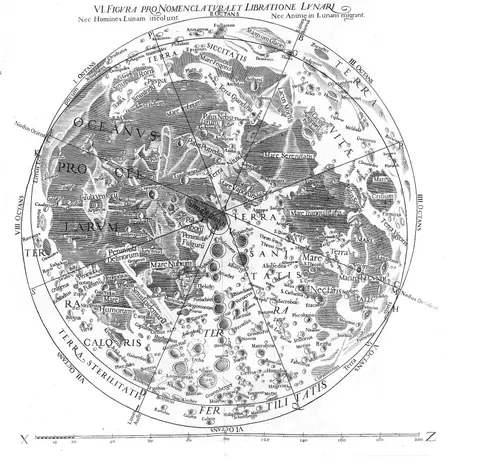
Above all, Kircher modeled a spirit of joyful curiosity. For him, every discovery revealed more of the wisdom of the Creator. A crater on the Moon is named after him.
Faith That Seeks Understanding
Kircher’s life illustrates the Jesuit ideal of finding God in all things. The Catechism teaches that the order and beauty of the world lead the mind to its Creator (CCC 32). Read about other Jesuit astronomers and the Gregorian calendar.
Prayer for Students and Scholars (Original Prayer)
God of wisdom, all truth comes from You. Bless all who study and search, who observe the heavens, the earth and the human heart. Give them curiosity, humility and patience, and let every discovery lead them to praise You, the Author of all wonders. Amen.
Continue Reading
Read about the Jesuit astronomers, the Ratio Studiorum, or Matteo Ricci, whose China mission Kircher described.
Frequently asked questions
What is Athanasius Kircher known for?
For the range of his learning. He wrote on magnetism (Magnes), light (Ars Magna Lucis et Umbrae), music (Musurgia Universalis), geology (Mundus Subterraneus), China (China Illustrata) and Egypt (Oedipus Aegyptiacus), and founded a famous museum.
Was Kircher right about hieroglyphs?
No. He thought hieroglyphs were mystical symbols rather than a writing system. They were deciphered by Champollion in 1822. But Kircher rightly saw that Coptic was descended from ancient Egyptian, and his Coptic grammar helped later scholars.
Sources
- "Renaissance Man," Company magazine (Winter 2001–2002)
- Paula Findlen, ed., Athanasius Kircher, The Last Man Who Knew Everything (Routledge, 2004)
- Joscelyn Godwin, Athanasius Kircher's Theatre of the World (2009)