St. Gertrude the Great: Life, Revelations, Herald of Divine Love and Feast Day
Quick answer
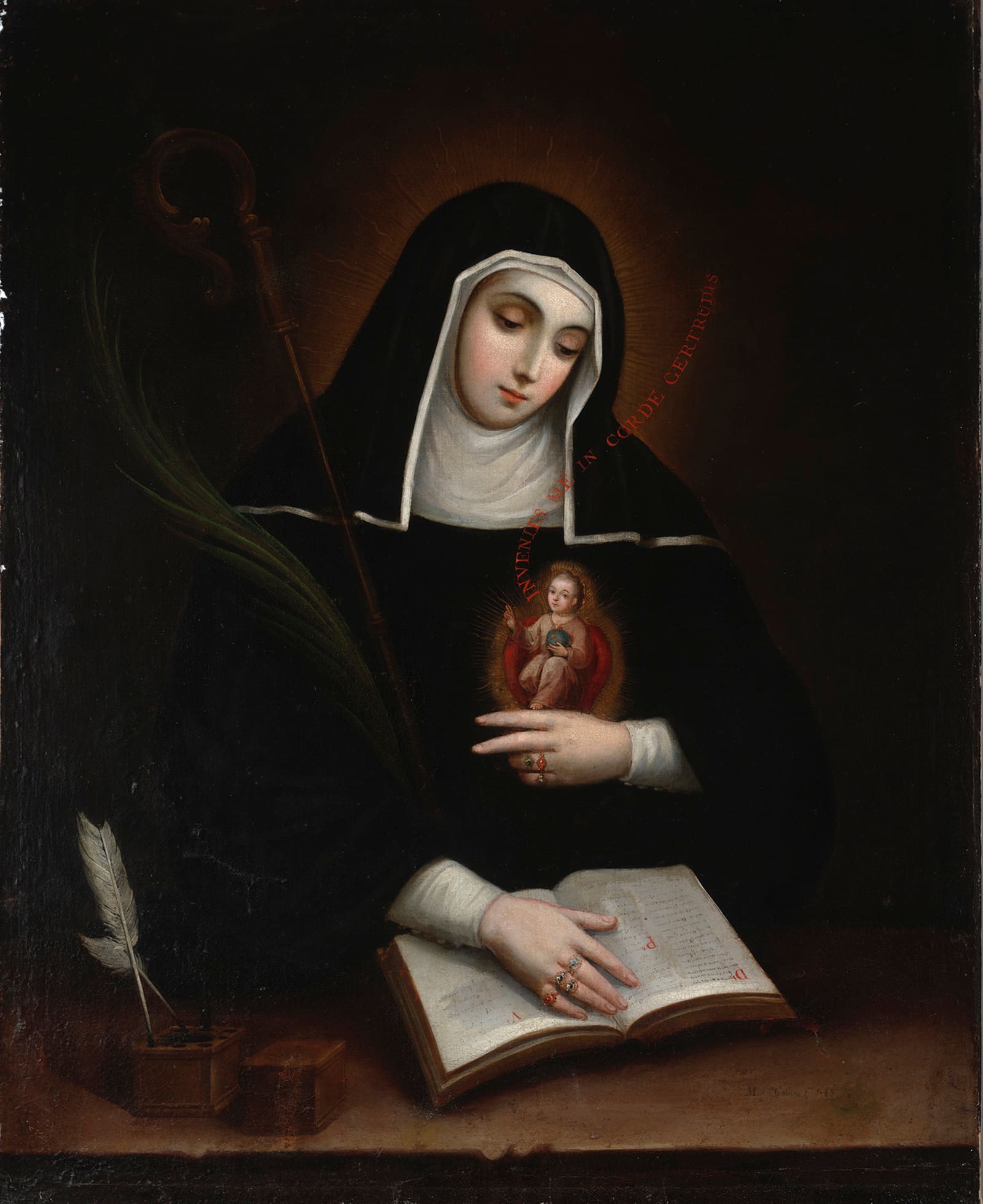
St. Gertrude the Great (1256–1301 or 1302) was a nun of Helfta in Germany and one of the great mystics of the Middle Ages. After a profound conversion in 1281, she wrote of her experience of the love of Christ, especially in The Herald of Divine Love. Her feast is November 16.
Key takeaways
- Gertrude was born on January 6, 1256, and entered the monastery of Helfta at the age of five.
- On January 27, 1281, she experienced a conversion that turned her from study for its own sake to a deep life of prayer.
- Her main works are The Herald of Divine Love and the Spiritual Exercises.
- Her writing is an early witness to devotion to the Heart of Jesus.
Pope Benedict XVI called St. Gertrude one of the most famous of the mystics, and the only German woman to be called “the Great.” Her message may be summed up in one line: the heart of a true Christian life is friendship with Jesus.
A Child of Helfta
Gertrude was born on January 6, 1256, the feast of the Epiphany. We know nothing of her parents or birthplace. In 1261, at the age of five, she was brought to the monastery of Helfta in Saxony, where she remained for the rest of her life.
Helfta was a remarkable place. Its abbess, Gertrude of Hackeborn, valued learning, and the community produced several gifted women writers, including St. Mechtilde of Hackeborn. The young Gertrude became an outstanding student, and she delighted in literature and the liberal arts.
Her Conversion
During Advent of 1280, she began to feel a disgust for her studies and a deep inner anxiety. Then, on January 27, 1281, toward the hour of Compline, she experienced the presence of Christ, and her anxiety lifted.
She later reproached herself for having cared more for learning than for God. From then on, she turned her gifts to Scripture, the Fathers and the liturgy, and she began to write for the good of others.
Her Writings
Gertrude wrote in Latin, with great poetic gifts. Her main surviving works are:
- The Herald of Divine Love, also known as The Revelations of St. Gertrude, in which she records her mystical experiences. Parts were compiled by her sisters.
- Spiritual Exercises, a series of prayers and meditations rooted in the liturgy.
Her Spirituality
Gertrude’s mysticism is deeply grounded in the prayer of the Church, in the Mass and the Divine Office. She speaks often of the Heart of Jesus, centuries before the devotion became widespread. The Catechism teaches that Jesus has loved each of us with a human heart (CCC 478).
Pope Benedict XVI pointed to several marks of her life: love of Sacred Scripture, love of the liturgy, profound faith and tender love of Mary. She remained very aware of her own faults and was very confident in God’s mercy.
She died at Helfta on November 17 in either 1301 or 1302, at about the age of 46.
A Prayer for the Souls in Purgatory
A short prayer for the dead is often linked with her name. Some leaflets say that it frees a fixed number of souls each time it is said. No such promise can be verified, and we should not treat prayer as a calculation. Nevertheless, the Church has always prayed for the dead (CCC 1030-1032), and we may say this prayer with confidence in God’s mercy.
Prayer for the Holy Souls (Attributed to St. Gertrude)
Eternal Father, I offer Thee the Most Precious Blood of Thy Divine Son, Jesus, in union with the Masses said throughout the world today, for all the holy souls in Purgatory, for sinners everywhere, for sinners in the universal Church, those in my own home and within my family. Amen.
A Prayer to St. Gertrude (Original Prayer)
St. Gertrude, friend of the Heart of Jesus, you learned that God is greater than all knowledge. Help me to love the Mass and the Scriptures, to trust in God’s mercy despite my faults, and to remember the faithful departed. Amen.
Continue Reading
Pray for the dead with our prayer for the souls in Purgatory, read about another great woman mystic, St. Bridget of Sweden, or see the prayer of St. Gertrude of Nivelles, the other St. Gertrude.
Frequently asked questions
When is the feast day of St. Gertrude the Great?
November 16.
Is St. Gertrude the Great the patron saint of cats?
No. That is a different saint, St. Gertrude of Nivelles, who lived in the seventh century.
Does the prayer of St. Gertrude really release 1,000 souls from Purgatory?
Devotional leaflets make this claim, and it cannot be verified. There is no approved promise of a fixed number. It is still a good prayer, and praying for the dead is a holy and traditional work of mercy.
Do Catholics have to believe her revelations?
No. They are private revelations. They do not belong to the deposit of faith, and Catholics may read them for their spiritual profit (CCC 67).
Sources
- Pope Benedict XVI, General Audience on St. Gertrude the Great (October 6, 2010)
- St. Gertrude the Great, The Herald of Divine Love
- Catechism of the Catholic Church 67, 478, 1030-1032