St. Genevieve: Patron Saint of Paris, Life, Feast Day and Prayer
Quick answer
St. Genevieve (around 422–512) was a consecrated virgin of Gaul who became the patron saint of Paris. She is remembered for urging the people of Paris to pray and not to flee when Attila the Hun approached in 451, and for bringing food to the city during a later siege. Her feast is January 3.
Key takeaways
- Genevieve was born at Nanterre, near Paris, around 422 and consecrated her life to God as a young girl.
- Tradition says St. Germanus of Auxerre noticed her holiness when she was a child.
- In 451 she encouraged Parisians to fast and pray as Attila's Huns approached, and the Huns turned away from the city.
- The great church that later became the Panthéon in Paris was built in her honor.
When an invading army threatened Paris, the men wanted to run. A woman told them to stay and pray. That woman is still honored as the protector of the city, fifteen centuries later.
A Child Set Apart
Genevieve was born around the year 422 at Nanterre, not far from Paris, at a time when Roman rule in Gaul was collapsing. The main source for her life was written not long after her death.
According to that account, St. Germanus, the bishop of Auxerre, passed through Nanterre on his way to Britain and noticed the young girl in the crowd. He spoke to her about giving her life to God, and she agreed gladly. Around the age of fifteen she received the veil of a consecrated virgin.
After her parents died she moved to Paris to live with her godmother. She lived simply, ate sparingly and prayed often. Some people were suspicious of her and spread rumors, and for a time she suffered from their hostility.
Facing Attila
In 451, Attila and his Huns swept into Gaul. The people of Paris panicked and prepared to flee. Genevieve urged them to stay, to fast and to pray. She gathered the women of the city to pray with her.
The Huns turned away from Paris and marched toward Orléans. Her reputation was never the same afterward. People who had distrusted her now honored her.
Bread for a Starving City
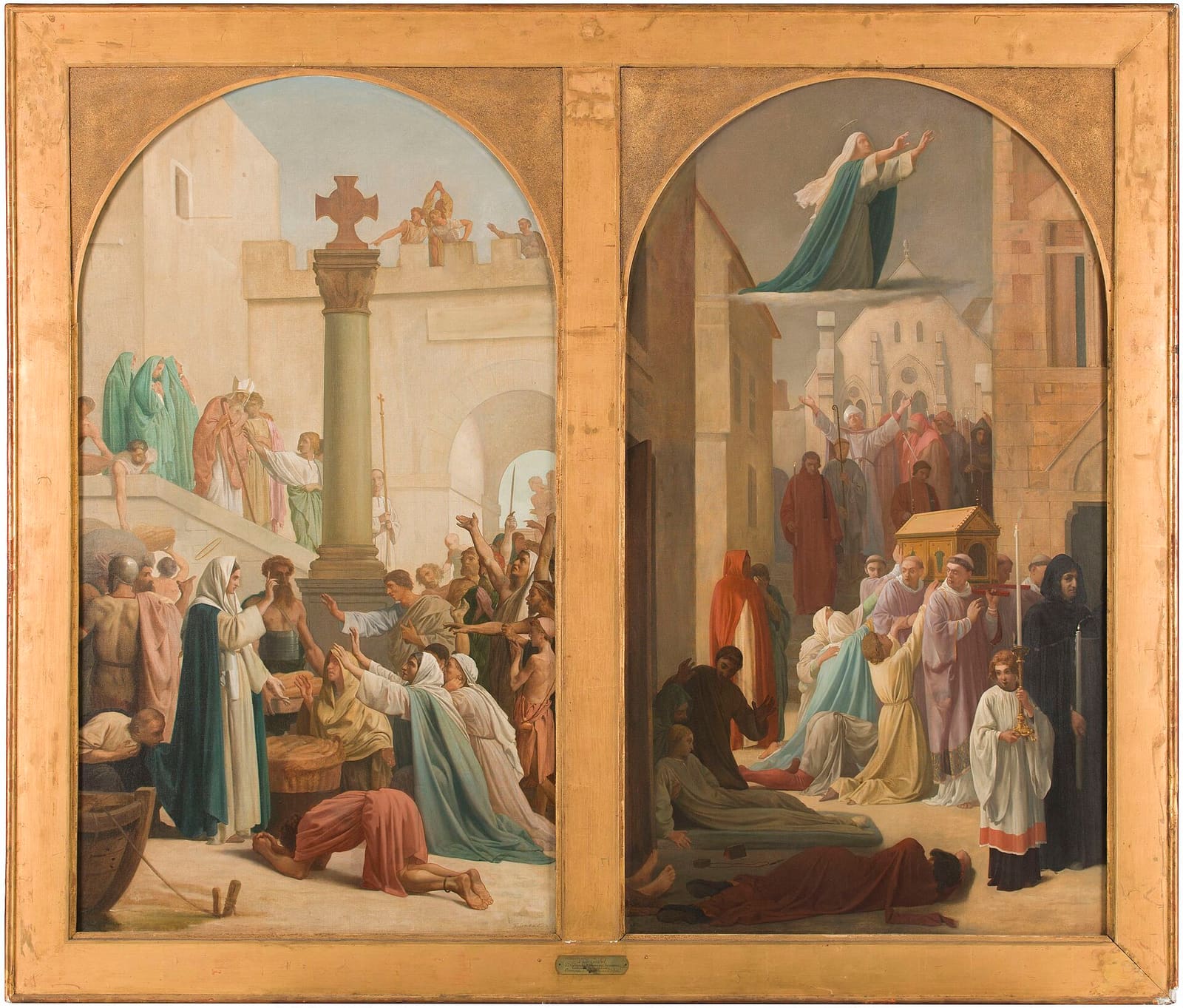
Later, when Frankish forces under Childeric besieged Paris and hunger set in, Genevieve led boats up the Seine to gather grain and bring it back to the city. She also pleaded with Childeric for the lives of prisoners, and his son Clovis, who became a Christian, respected her greatly.
Tradition credits her with encouraging the building of a church over the tomb of St. Denis, the first bishop of Paris.
She died around the year 512, and she was buried near the church that Clovis had built on the hill that is still called Montagne Sainte-Geneviève.
After Her Death
Parisians have turned to her in every kind of crisis. In 1129, a terrible epidemic known as the “burning sickness” is said to have ended after her relics were carried through the streets.
In the eighteenth century King Louis XV built a magnificent new church in her honor. During the French Revolution it was turned into a secular monument, the Panthéon, and her relics were burned. A small portion survives at the church of Saint-Étienne-du-Mont, where people still pray at her shrine.
A Prayer for Our Cities (Original Prayer)
St. Genevieve, courageous woman of prayer, you stood firm when others were afraid. Pray for our cities and our leaders. Give us faith in times of danger and generous hands for those who are hungry. Amen.
Continue Reading
Read about the pope who also faced Attila, St. Leo the Great, or learn why Catholics pray to the saints.
Frequently asked questions
When is the feast day of St. Genevieve?
January 3, the traditional date of her death.
What is St. Genevieve the patron saint of?
She is the patron saint of Paris. In France she is also the patroness of the Gendarmerie.
Did St. Genevieve really save Paris from Attila?
Attila's army did turn away and head for Orléans, and early tradition credits her prayers and courage. Historians cannot say exactly why he changed course.
Sources
- Life of St. Genevieve (Vita Genovefae, early sixth century)
- Catholic Answers Encyclopedia, Genevieve, Saint