The Ascension of Our Lord: Meaning, Scripture and the Golden Legend
Quick answer
The Ascension of Our Lord celebrates Jesus Christ returning in His glorified body to the Father, forty days after His Resurrection. The Church teaches that He has gone ahead of us as our Head and intercedes for us forever. It is kept on Ascension Thursday or, in most U.S. dioceses, on the following Sunday. In 2027 those dates are May 6 and May 9.
Key takeaways
- Scripture describes the Ascension in Acts 1:1-12, Luke 24:50-53 and Mark 16:19.
- Jesus ascended in His risen human body, and the Catechism teaches that He entered God's heavenly domain, from where He will come again.
- The Ascension gives us hope, because Christ our Head has gone before us, the members of His Body.
- The medieval Golden Legend explored the feast through seven questions, and quoted St. Leo the Great, St. Augustine and St. Ambrose.
- In most U.S. dioceses the solemnity moves to the following Sunday, and it remains a day of obligation.
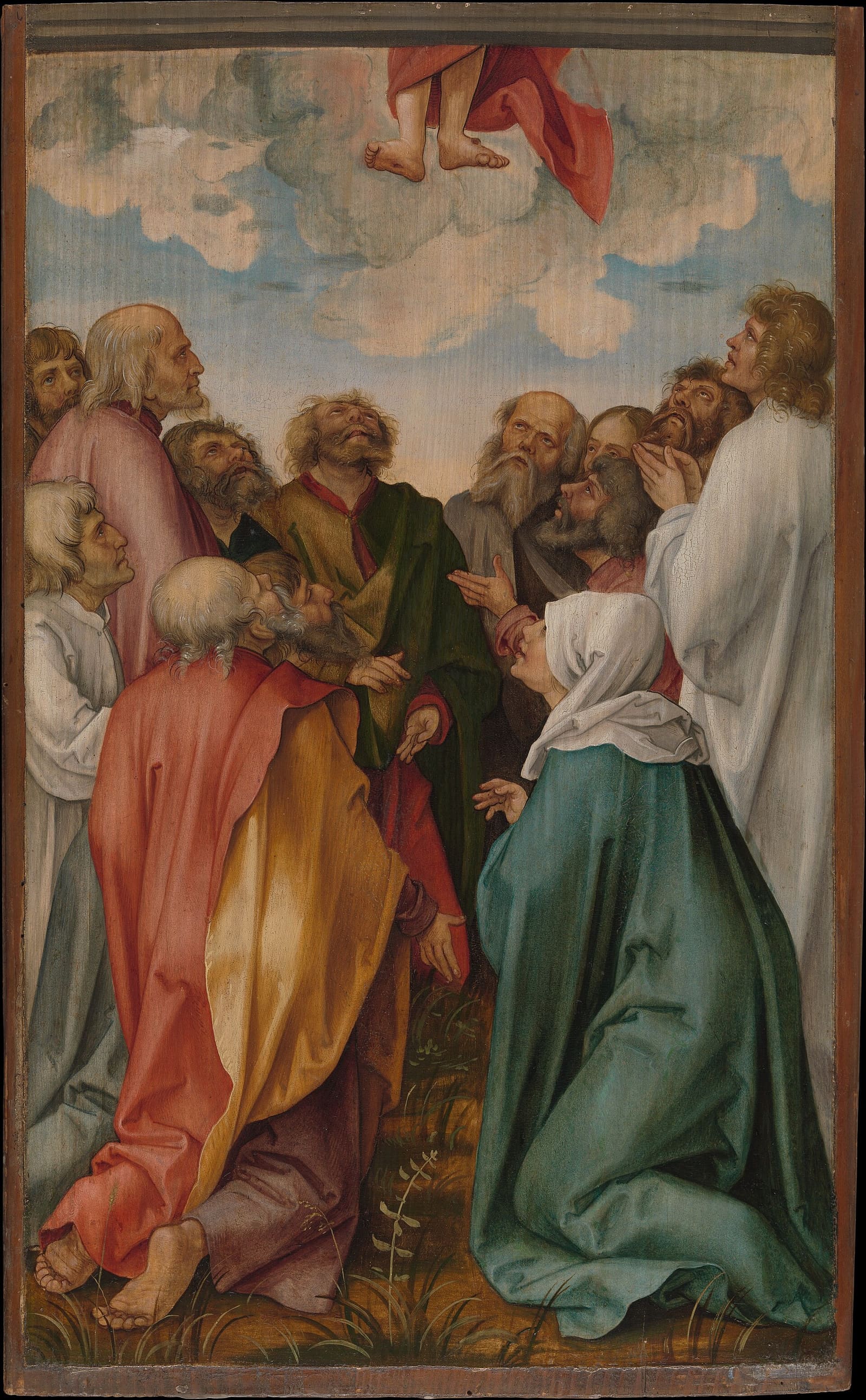
Forty days after He rose from the dead, Jesus led His disciples out to the Mount of Olives, blessed them, and was taken up from their sight. They might have been expected to go home broken-hearted. Instead, St. Luke tells us, they returned to Jerusalem “with great joy” (Luke 24:52).
Why such joy, at a farewell? That question is at the heart of this feast.
What Scripture Tells Us
St. Luke describes the event twice. At the end of his Gospel, he says that Jesus lifted up His hands, blessed the disciples, and “was carried up to heaven” (Luke 24:51). In the Acts of the Apostles he adds that a cloud received Him out of their sight, and that two men in white told the apostles He would return in the same way (Acts 1:9-11).
St. Mark adds that the Lord “sitteth on the right hand of God” (Mark 16:19). To sit at the right hand means to share in the Father’s glory and authority.
What the Church Teaches
The Catechism explains the Ascension in a few clear points (CCC 659-667):
- Jesus ascended in His risen body. His humanity has entered God’s heavenly domain, and it is from there that He will come again.
- He has gone ahead of us. Christ is the Head of the Church, and He precedes us so that we, the members of His Body, can live in hope of being with Him forever.
- He prays for us now. Having entered the sanctuary of heaven once and for all, He intercedes for us without ceasing (see Hebrews 7:25) and assures the outpouring of the Holy Spirit.
So the Ascension is not the story of Jesus leaving us behind. St. Leo the Great, whose sermons on this feast are still read today, put it this way: what was visible in our Savior has passed over into His mysteries (CCC 1115). We meet Him now in the sacraments.
The Ascension in the Golden Legend
The Golden Legend, compiled around 1260 by Blessed Jacobus de Voragine, was one of the most read books of the Middle Ages. Its chapter on the Ascension organizes the feast around seven questions.
- From where did He ascend? From the Mount of Olives by Bethany.
- Why did He wait forty days? To give certain proof of the Resurrection and to console His disciples. The author notes that Christ lay in the tomb for about forty hours, a time of sorrow, and remained on earth for forty days, a time of comfort.
- How did He ascend? By His own power, and openly, so that His disciples could be witnesses.
- Who went with Him? The author pictures the angels marveling and calling out, drawing on Isaiah 63: “Why then is thy apparel red?” The red garments are the wounds of the Passion, and the winepress is the Cross.
- By what merit? By His truth, meekness and justice.
- Where did He ascend? Above all the heavens, to the place of highest honor.
- Why did He ascend? The book lists the benefits to us, among them a greater love and knowledge of God, the merit of faith, the assurance of having an advocate with the Father, and a firmer hope.
The book also quotes a lovely image from St. Ambrose: Christ came into this world to make a great leap. From the Father to the Virgin’s womb, from the womb to the manger, from the Jordan to the Cross, from the Cross to the tomb, and from the tomb to heaven.
Readers should remember that the Golden Legend mixes solid tradition with medieval speculation, including ideas about the structure of the heavens. Its value is devotional. It shows how lovingly our ancestors in faith pondered this mystery.
When Is the Ascension Celebrated?
The Ascension falls forty days after Easter, always on a Thursday. Since canon law allows bishops’ conferences to transfer certain holy days to Sunday (can. 1246), most U.S. dioceses now celebrate it on the following Sunday. A handful of ecclesiastical provinces, mainly in the Northeast, keep the Thursday date. Your parish bulletin or diocesan website will confirm the local practice.
In 2027, Ascension Thursday is May 6, and the transferred celebration is on Sunday, May 9.
The First Novena
Before He ascended, Jesus told His disciples to wait for the Holy Spirit (Acts 1:4). They spent the days that followed in prayer with Mary and the other women (Acts 1:14). Pentecost came on the tenth day after the Ascension, and those nine days of prayer are the model for every Catholic novena.
A Prayer for Ascension Day (Original Prayer)
Lord Jesus Christ, You have gone before us into the glory of the Father. Lift up our hearts to where You are. Keep our feet on the road You walked, and our eyes on the home You have prepared. Send us Your Spirit, as You promised, and make us Your joyful witnesses. Amen.
Continue Reading
Learn more about what Catholics believe about Jesus and what the Church believes about Mary, or pray the Glorious Mysteries with our Rosary for today.
Frequently asked questions
When is the Ascension in 2027?
Ascension Thursday falls on May 6, 2027, forty days after Easter counting Easter Sunday as the first day. In most U.S. dioceses it is celebrated on Sunday, May 9, 2027. A few ecclesiastical provinces, mainly in the Northeast, keep it on Thursday, so check your diocese.
Is the Ascension a holy day of obligation?
Yes, in the United States it remains a day of obligation, whether it is kept on Thursday or moved to Sunday. Practice in other countries varies, so check with your bishops' conference.
Where did Jesus ascend from?
From the Mount of Olives, near Bethany, just outside Jerusalem (Luke 24:50; Acts 1:12).
What is the difference between the Ascension and the Assumption?
Jesus ascended by His own divine power. Mary was assumed, which means she was taken up body and soul into heaven by the power of God at the end of her earthly life.
What is the Golden Legend?
It is a very popular medieval collection of saints' lives and reflections on the Church's feasts, compiled around 1260 by Blessed Jacobus de Voragine. William Caxton printed an English version in 1483. It contains much that is legendary and should be read as devotional literature and not as history.
Sources
- Acts 1:1-12; Luke 24:50-53; Mark 16:19; Hebrews 7:25
- Catechism of the Catholic Church 659-667, 1115
- Jacobus de Voragine, The Golden Legend (William Caxton's English edition), The Ascension of Our Lord
- Code of Canon Law, can. 1246