Magis: The Jesuit Pilgrimage Before World Youth Day
Quick answer
Magis is a program of the Society of Jesus and the wider Ignatian family that brings young adults together before World Youth Day. Participants spend several days in small international groups on "experiments" modeled on the experiences of Jesuit novices, such as serving the poor, making a pilgrimage, or working in the arts, and then gather for prayer, reflection and celebration before joining the Pope. In 2005 thousands of young people took part in experiments in twelve European cities, met at Loreley on the Rhine and traveled by boat to World Youth Day in Cologne. The name comes from the Ignatian ideal of the magis, the "more," the greater glory of God.
Key takeaways
- Magis gathers young adults from Jesuit schools, parishes and communities before World Youth Day.
- Its "experiments" are modeled on the trials of Jesuit novices.
- In 2005 participants met at Loreley, Germany, before sailing up the Rhine to Cologne.
- Each day includes Ignatian reflection, such as the Examen, in small groups.
- Magis means "more" in Latin, recalling the Jesuit motto of the greater glory of God.
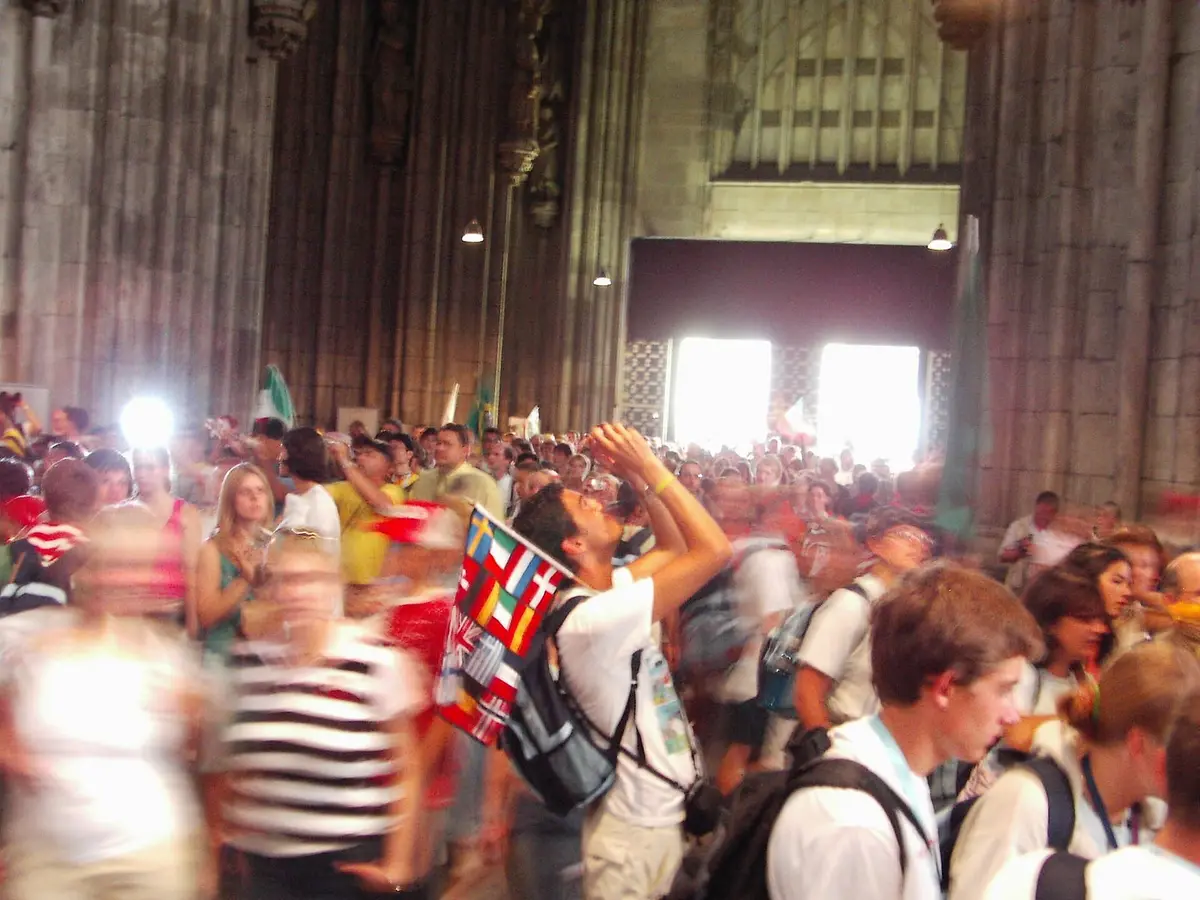
In August 2005, in a field above the Rhine River at Loreley, Germany, thousands of young people huddled in little blue tents in the pouring rain. The Spaniards sang into the night, the Australians carried a big stuffed kangaroo, and the Californians taught everyone the Hokey Pokey. In a circus tent, under fireworks, hundreds knelt in adoration of the Eucharist. As Company magazine reported, everyone called it the Jesuit Magis experience.
Pilgrims on Experiments
Magis is a program of the Society of Jesus and the wider Ignatian family that gathers young adults just before World Youth Day. Before meeting the Pope, participants spend about a week in small, mixed international groups on “experiments.”
The idea comes from Jesuit formation. Novices are sent into unfamiliar situations, a hospital, a pilgrimage on foot with no money, work with the poor, to learn about themselves, others and God. Magis experiments are similar:
- Social experiments: serving immigrants, the homeless or people with disabilities.
- Pilgrimage experiments: walking to shrines, sometimes begging for food along the way.
- Creative experiments: street theater, music, art and media.
- Spiritual experiments: retreats and prayer in monasteries or Jesuit houses.
Each evening the groups gather to share and reflect, often using the Examen.
Cologne 2005
In 2005, several thousand young people took part in experiments in twelve European cities, in about 100 international groups. They then met in Loreley for two days of rain, mud and joy before sailing by boat up the Rhine to Cologne, where Pope Benedict XVI arrived for World Youth Day. “They come asking, not demanding,” said Fr. Roger Dawson, a British Jesuit organizer. On display, he said, were “values of the kingdom, not of the market or the world.”
Magis has accompanied many World Youth Days since, gathering young people from Jesuit schools, universities, parishes and communities around the world.
The Meaning of Magis
Magis is Latin for “more.” St. Ignatius asked those who make the Spiritual Exercises to desire and choose “only that which is more conducive to the end for which we are created” (Spiritual Exercises 23). It is the spirit of the Jesuit motto, Ad maiorem Dei gloriam, for the greater glory of God. Magis does not mean doing more for its own sake, but seeking what gives God greater glory and serves others better.
Prayer of a Young Pilgrim (Original Prayer)
Lord Jesus, You called the first disciples to come and see. As I set out on this journey, open my eyes to see You in strangers, my hands to serve the poor, and my heart to hear Your call. Teach me to choose always what is more for Your glory. Amen.
Continue Reading
Learn about Ignatian spirituality, the Jesuit Volunteer Corps, or how to become a Jesuit.
Frequently asked questions
What does magis mean?
Magis is Latin for "more." In Ignatian spirituality it means always choosing what leads more to the glory of God and the good of others, as in the Jesuit motto Ad maiorem Dei gloriam, "for the greater glory of God."
Who can take part in Magis?
Young adults, usually between 18 and 30, who are connected with Jesuit or Ignatian institutions or communities, register through their country's Magis organizers before a World Youth Day.
Sources
- Julie Bourbon, "Magis," Company magazine (Fall 2005)
- St. Ignatius of Loyola, Spiritual Exercises, no. 23 (Principle and Foundation)