The Jesuit Missions of Chiquitos, Bolivia: Baroque Churches and Music in the Jungle
Quick answer
The Jesuit missions, or reductions, of Chiquitos were mission towns founded between 1691 and 1760 in the eastern lowlands of Bolivia, beginning with San Javier on December 31, 1691. Jesuits and the indigenous Chiquitano people built large wooden churches with painted façades and carved altars, and made the towns centers of Baroque music, with locally built instruments and choirs. The Jesuits were expelled in 1767, but six of the churches survive as a UNESCO World Heritage Site, and the region's music archive and festival still draw visitors from around the world.
Key takeaways
- Ten Chiquitos missions were founded between 1691 and 1760, the first being San Javier.
- The towns were self-governing indigenous communities organized around a central church.
- Swiss Jesuit Martin Schmid designed several churches and taught music and instrument-making.
- Six mission churches were declared a UNESCO World Heritage Site in 1990.
- Thousands of pages of mission music survive and are performed at a biennial festival.
“El camino es muy feo,” the road is very ugly. That was the refrain of the driver who took an art historian and his wife from Santa Cruz to the Chiquitos missions of Bolivia, as the visitor recalled in Company magazine. Few Jesuit missions in the world were as remote. And few repay the trip so richly: in the middle of the tropical plains rise enormous wooden churches painted with angels and flowers, where indigenous orchestras still play music written three centuries ago.
Founding the Missions (1691–1760)
The name Chiquitos, “little ones,” was given by a 16th-century Spanish explorer to the many peoples living east of Santa Cruz, between the Paraguay and Guapay rivers, reportedly because of the low doors of their houses.
After earlier attempts, Fr. José Francisco de Arce, a Jesuit from Tarija, led an expedition north of Santa Cruz when he heard that a smallpox epidemic had struck the region. On December 31, 1691, he founded the first mission, San Francisco Javier. Over the next seventy years the Jesuits and the local peoples founded ten towns:
- San Javier (1691)
- San Rafael (1696)
- San José (1698)
- San Juan Bautista (1699)
- Concepción (1709)
- San Miguel (1721)
- San Ignacio (1748)
- Santiago (1754)
- Santa Ana (1755)
- Santo Corazón (1760)
How the Reductions Worked
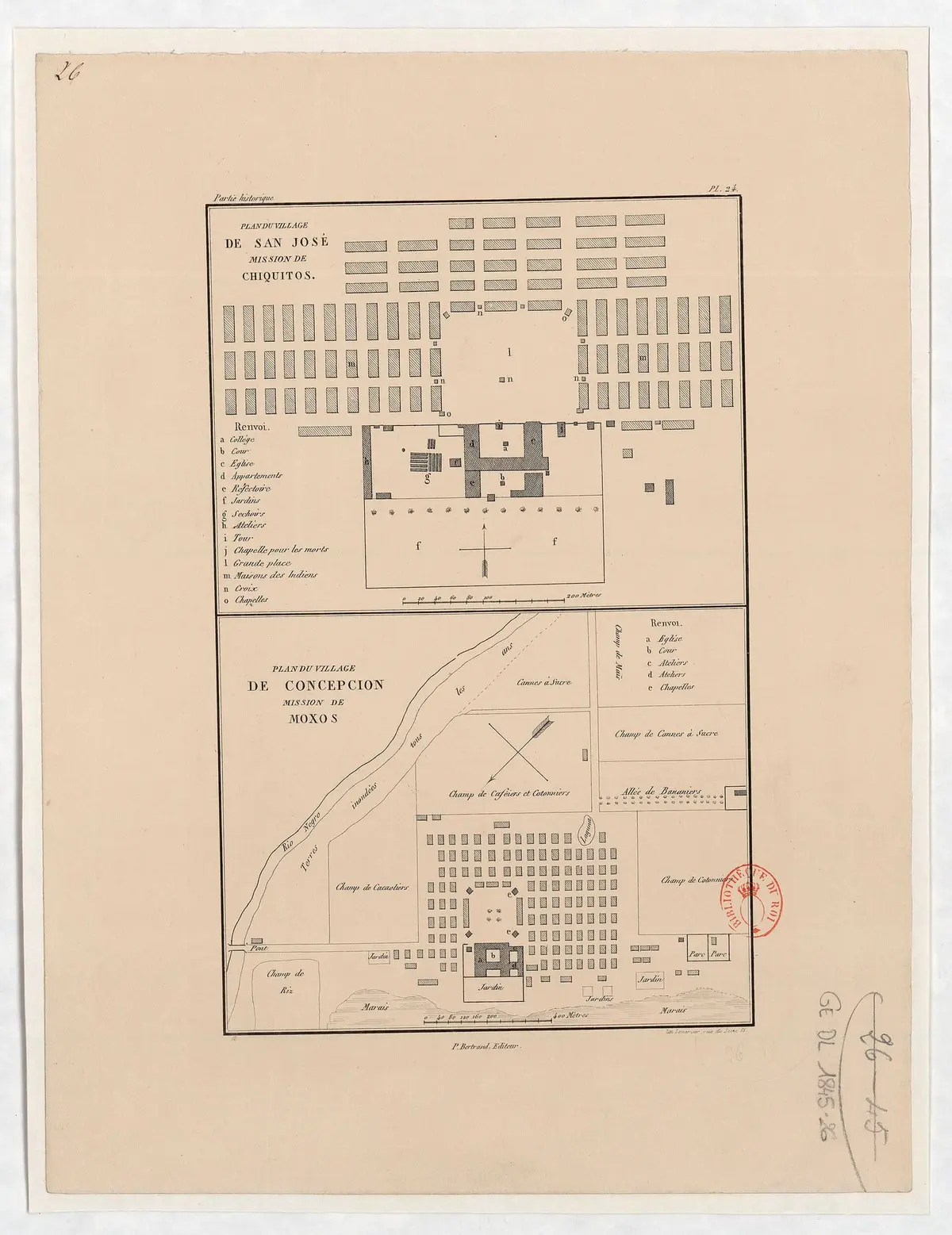
A reducción was a town where indigenous families gathered to live, pray and work together. Each was built around a great plaza with the church on one side, flanked by the priests’ residence, workshops and a school. The people elected their own cabildo, or council, and two or three Jesuits served as pastors.
The reductions protected the Chiquitano from the slave raiders who hunted indigenous people for plantations in Brazil. They also preserved native languages: the Jesuits learned the Chiquitano language and wrote grammars in it.
Churches of Wood and Color
The Chiquitos churches are unlike any in Europe. Built of local wood and adobe, with huge roofs supported on carved wooden columns and wide eaves that shade the walkways, they are covered inside and out with painted decoration: angels, flowers, saints and twisting columns. Their round “rose windows” over the main door became a trademark.
Many were designed by Fr. Martin Schmid (1694–1772), a Swiss Jesuit who arrived in 1730. He was architect, carpenter, composer and music teacher all at once. His churches at San Rafael, San Javier and Concepción, built in the mid-1700s, still stand. Santa Ana, the most remote, keeps more of its original colonial structure than any other.
From 1972, Swiss architect Hans Roth led a long restoration, training local craftsmen to repair the churches with the old methods. In 1990, UNESCO declared six of the churches, San Javier, Concepción, Santa Ana, San Miguel, San Rafael and San José, a World Heritage Site.
Missions in a Musical Key
Music was at the heart of mission life. Jesuits taught the Chiquitano to read music, to sing and to build violins, harps, organs and other instruments. Carvings of musician angels decorate the church of San Miguel. Choirs and orchestras accompanied daily Mass and great feasts, and indigenous musicians copied and composed music themselves.
Remarkably, much of this music survived. After the Jesuits left, local musicians kept copying the scores. In recent decades researchers catalogued thousands of pages of manuscripts at Concepción and in the Moxos region, including works by the Italian Jesuit composer Domenico Zipoli (1688–1726), who worked in Córdoba, Argentina. Since 1996 Bolivia has held a biennial International Festival of Baroque and American Renaissance Music “Misiones de Chiquitos,” in which local youth orchestras perform beside ensembles from around the world.
The Expulsion of 1767
In 1767 King Charles III expelled the Jesuits from all Spanish territories. The missionaries were marched away, and the missions passed to diocesan clergy and colonial administrators. Many declined. Yet the Chiquitano people treasured the churches, the feasts and the music, and passed them down for two centuries.
A Lasting Witness
The Chiquitos missions show the Jesuit conviction that the Gospel can take flesh in every culture, a theme the Jesuits’ General Congregation 34 called inculturation. They also show the beauty that grows when faith, art and the gifts of a people meet. Read about the neighboring Jesuit missions of Moxos and about Jesuit mission art around the world.
Prayer of Praise (Psalm 150:1, 3–6)
Praise the Lord! Praise God in his sanctuary; praise him with trumpet sound; praise him with lute and harp! Praise him with timbrel and dance; praise him with strings and pipe! Let everything that breathes praise the Lord! Praise the Lord!
Continue Reading
Read about the Jesuit missions of Moxos, the life of St. Francis Xavier, patron of the first Chiquitos mission, or who the Jesuits are.
Frequently asked questions
What is a Jesuit reduction?
A mission town (reducción in Spanish) in which indigenous people lived together under their own leaders with Jesuit missionaries, protected from enslavement by colonists. The best known are those of Paraguay, Argentina, Brazil and Bolivia.
Can you visit the Chiquitos missions?
Yes. The circuit of mission towns lies east of Santa Cruz de la Sierra in Bolivia. Roads are much better than they once were, and the restored churches of San Javier, Concepción, San Rafael, Santa Ana, San Miguel and San José are open to visitors.
What happened when the Jesuits were expelled?
In 1767 King Charles III expelled the Jesuits from the Spanish empire. Diocesan priests took over the missions, which slowly declined, but the Chiquitano people preserved the churches, the music and the faith.
Sources
- UNESCO World Heritage Centre, Jesuit Missions of the Chiquitos (1990)
- "Missions in a Musical Key: The Jesuit Reductions of Chiquitos, Bolivia," Company magazine (Winter 2002–2003)
- Gauvin Alexander Bailey, Art on the Jesuit Missions in Asia and Latin America, 1542–1773 (University of Toronto Press, 1999)