Father Eusebio Kino: The Padre on Horseback of Arizona and Sonora
Quick answer
Fr. Eusebio Francisco Kino (1645–1711) was an Italian-born Jesuit who spent 24 years as a missionary in the Pimería Alta, today northern Sonora in Mexico and southern Arizona. Riding thousands of miles on horseback, he founded more than twenty missions, including San Xavier del Bac near Tucson, introduced cattle and new crops, defended the O'odham people from forced labor, and mapped the region, showing that Baja California is a peninsula. Pope Francis declared him Venerable in 2020.
Key takeaways
- Kino was born in 1645 in Segno, in the Italian Tyrol, and became a Jesuit in 1665.
- From 1687 to 1711 he served the O'odham peoples of the Pimería Alta.
- He founded more than twenty missions, including San Xavier del Bac near Tucson.
- His maps showed that California is a peninsula, not an island.
- He was declared Venerable by Pope Francis in 2020.
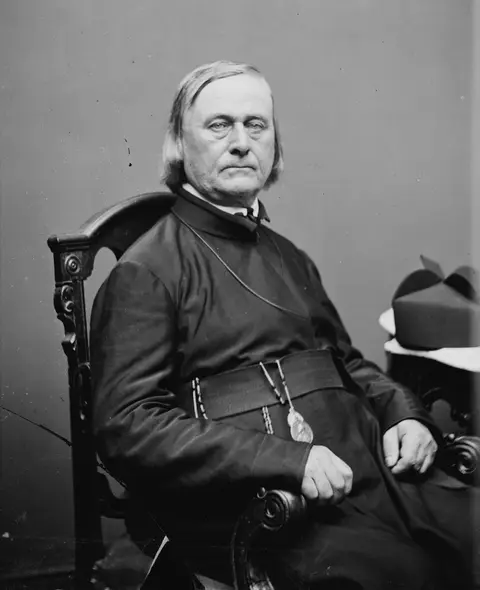
In the U.S. Capitol’s National Statuary Hall, each state honors two of its great citizens. Arizona chose a Jesuit priest on horseback: Fr. Eusebio Francisco Kino. Missionary, explorer, mapmaker, astronomer and rancher, he spent the last twenty-four years of his life crossing the deserts of what is now Sonora and Arizona, and his cause for canonization is now open.
From the Alps to Mexico
Eusebio Chini (later spelled Kino in Spanish) was born on August 10, 1645, in Segno, a village in the Italian Tyrol. As a young man he fell gravely ill and promised St. Francis Xavier that if he recovered he would become a missionary like him. He entered the Jesuits in 1665, adding “Francisco” to his name in gratitude.
Kino studied mathematics and astronomy in Germany and hoped to go to China. Instead, in a drawing of lots, he was assigned to New Spain. He arrived in Mexico in 1681, where he published a scientific treatise on the great comet of 1680.
The Pimería Alta
After a failed expedition to Baja California, Kino was sent in 1687 to the Pimería Alta, the land of the O’odham (Pima) peoples, today northern Sonora and southern Arizona. On March 13, 1687, he founded his headquarters, the mission of Nuestra Señora de los Dolores.
For the next 24 years he rode an estimated tens of thousands of miles, often more than thirty miles a day, visiting villages, baptizing, teaching and founding missions. He established more than twenty missions and visitas, among them San Xavier del Bac near Tucson, Tumacácori and Guevavi in Arizona, and Caborca and San Ignacio in Sonora. The present white church of San Xavier, called the “White Dove of the Desert,” was built later, in the 1780s and 1790s, on the site he chose.
Rancher and Protector
Kino was practical. He brought cattle, horses, sheep and wheat and taught new methods of farming, laying the foundation of the region’s ranching economy. He also defended the O’odham against Spanish settlers who wanted to force them into labor in the mines, insisting that converts be free.
California Is Not an Island
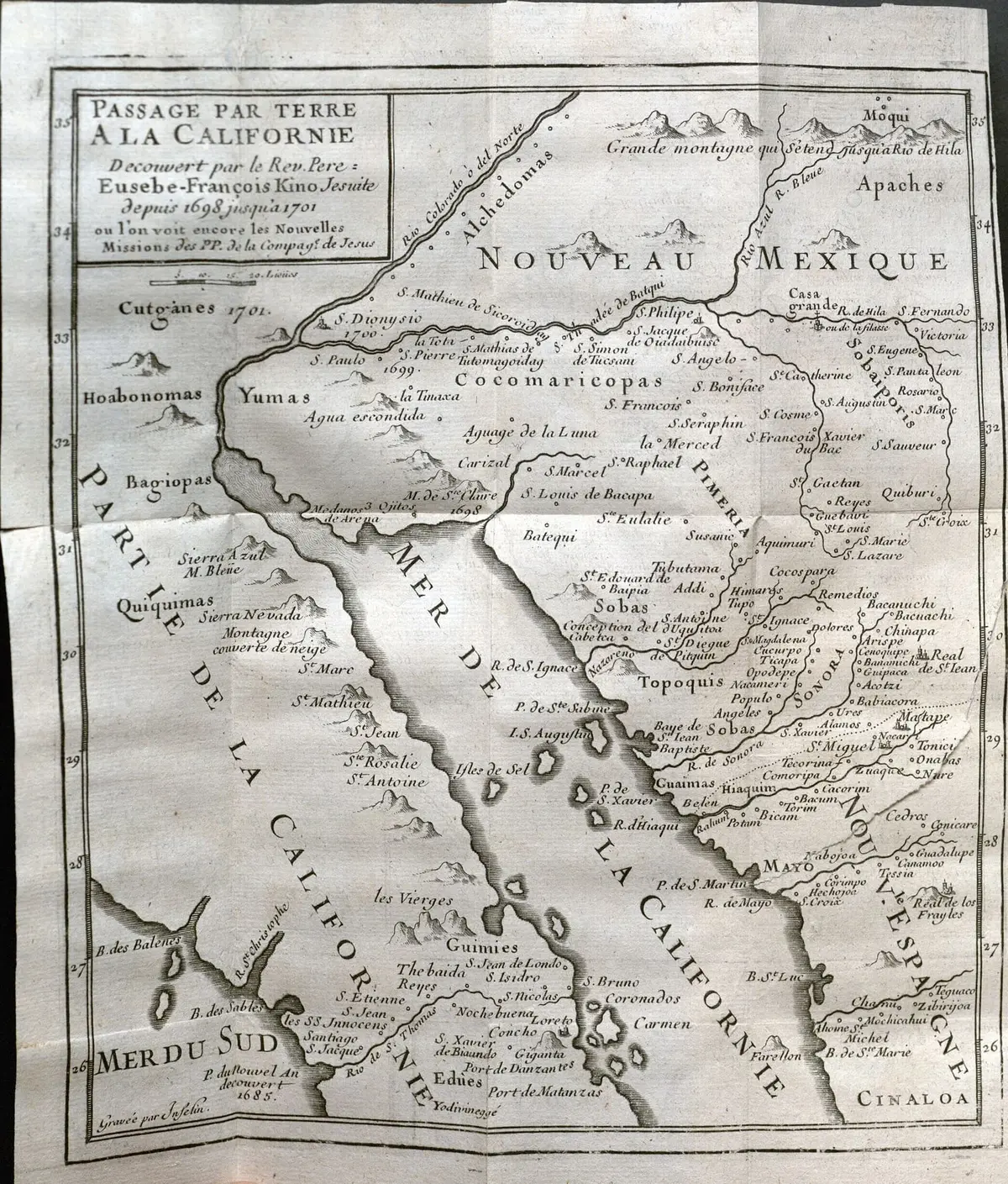
European maps of the time showed California as an island. Through expeditions to the Colorado River and the head of the Gulf of California between 1698 and 1702, Kino showed that Baja California is a peninsula connected to the mainland. His map of 1701 was copied across Europe for decades.
Death and Legacy
Kino died on March 15, 1711, in Magdalena, Sonora, having gone there to dedicate a new chapel to St. Francis Xavier. A fellow Jesuit wrote that he died as he had lived, with great humility and poverty, on a bed of calfskins with a saddle for a pillow. In 1966 archaeologists found his remains, which now rest in a memorial in the town, renamed Magdalena de Kino.
Arizona placed his statue in the U.S. Capitol in 1965. On July 10, 2020, Pope Francis declared him Venerable, recognizing his heroic virtue.
A Model for Today
Kino lived the Jesuit ideal of being a “contemplative in action.” He prayed long hours, celebrated Mass wherever he traveled, and gave himself completely to the people entrusted to him. He shows that holiness and hard, practical work go together.
Prayer for the Canonization of Fr. Kino (Original Prayer)
Lord God, You called Your servant Eusebio Kino to carry the Gospel across deserts and mountains and to love the peoples of the Pimería Alta as a father. If it be Your will, glorify him among Your saints. By his example, make us generous missionaries in our own homes and communities. Amen.
Continue Reading
Read about the Jesuits in the United States, the life of St. Francis Xavier, Kino’s patron, or the Jesuit astronomers.
Frequently asked questions
Why is Father Kino called the Padre on Horseback?
Because he traveled tens of thousands of miles on horseback across deserts and mountains to visit his missions and explore. Historian Herbert Bolton used the phrase as the title of a 1932 biography.
Where is Father Kino buried?
In Magdalena de Kino, Sonora, Mexico, where he died on March 15, 1711. His remains were found by archaeologists in 1966 and can be seen in a memorial on the town plaza.
Is Father Kino a saint?
Not yet. His cause for canonization is open, and on July 10, 2020, Pope Francis declared that he lived the virtues to a heroic degree, giving him the title Venerable.
Sources
- Herbert E. Bolton, Rim of Christendom (1936) and The Padre on Horseback (1932)
- Charles W. Polzer, SJ, Kino, A Legacy (1998)
- "Padre on Horseback," Company magazine (Summer 2002)
- Dicastery for the Causes of Saints, decree on the heroic virtues of Eusebio Francisco Chini (2020)