The Book of Judith: Faith and Courage of a Widow Who Saved Her People
Quick answer
The Book of Judith is one of the deuterocanonical books of the Old Testament. When the Assyrian general Holofernes besieges the Jewish town of Bethulia, its leaders plan to surrender in five days. Judith, a devout and wise widow, rebukes them for putting God to the test, prays, and goes into the enemy camp. She beheads Holofernes as he lies drunk, and the Assyrian army flees. The book is a story of faith and God's power working through the weak. The Church applies its praise of Judith to the Virgin Mary.
Key takeaways
- Judith was a widow known for prayer, fasting and fear of the Lord.
- She told the elders not to set deadlines for God.
- Her victory over Holofernes shows that God saves through the humble.
- The words "Thou art the glory of Jerusalem" are used in Marian liturgy.
The Book of Judith is a dramatic story of a woman who refused to give up hope when the men around her had lost their nerve. It is a reminder that God often works through those the world overlooks.
A Town Under Siege
The general Holofernes, commanding a vast Assyrian army, sweeps through the nations and besieges the small Jewish town of Bethulia, which guards the approach to Jerusalem. He cuts off the water supply. The people, dying of thirst, beg their leaders to surrender. The elder Ozias promises that if God does not help them within five days, they will hand over the town.
Judith Speaks
In Bethulia lived Judith, a widow of three years. She was beautiful and wealthy, but she lived simply, fasting and praying, and “she was greatly renowned among all, because she feared the Lord very much” (Judith 8:8, Douay-Rheims).
She called the elders and rebuked them. Who were they to put God to the test and set Him a deadline? They should pray and wait for His help, remembering how He had tested their ancestors (Judith 8:11-27).
Then she said she would do something herself, and asked them not to question her about it.
Into the Enemy Camp
Judith put on sackcloth and ashes and prayed, asking God to strengthen her hand. Then she dressed in her finest clothes and went with her maid to the Assyrian camp. She told Holofernes she had come to help him. He was taken with her beauty and her words.
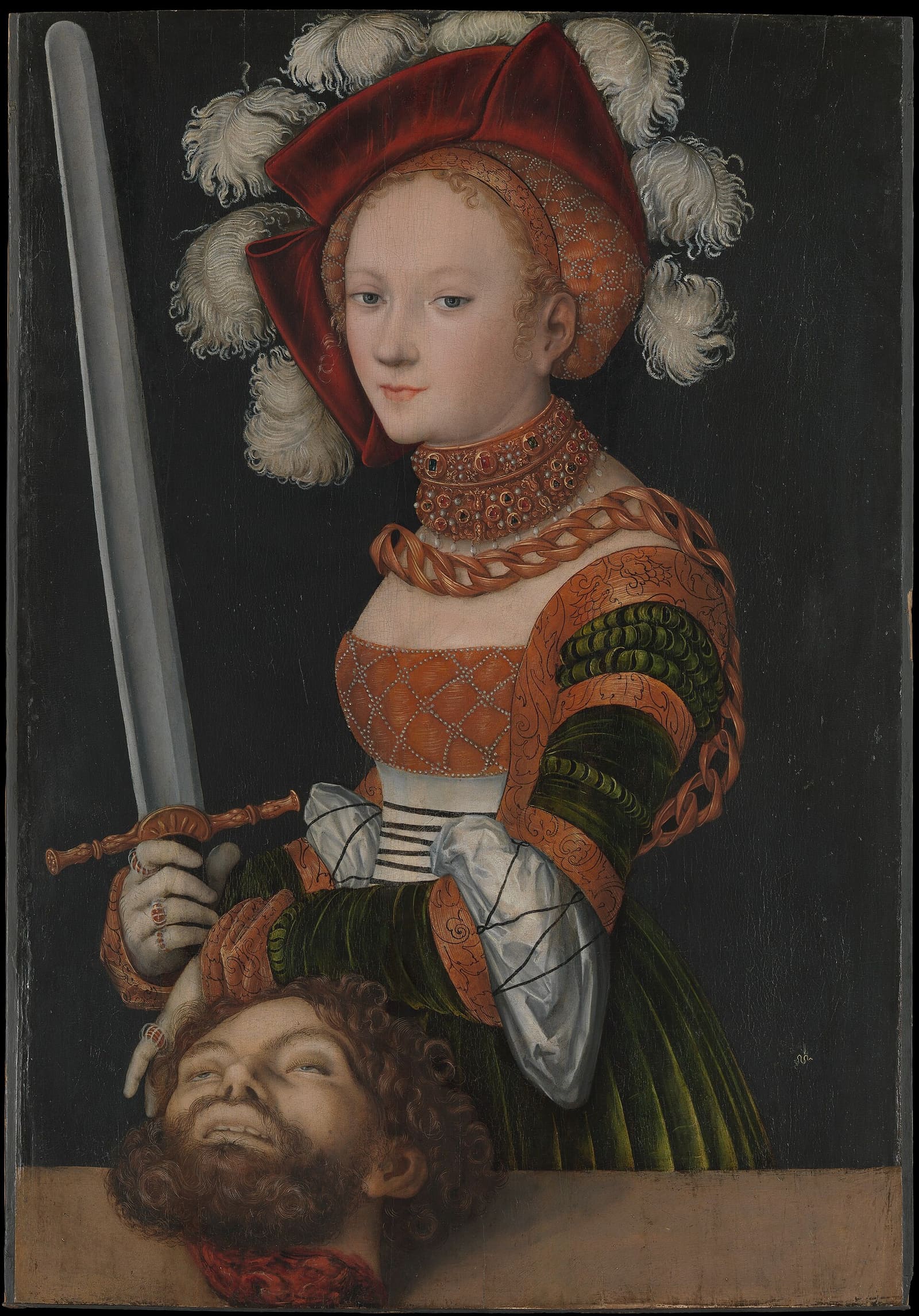
On the fourth day, Holofernes held a banquet, hoping to seduce her. He drank so much wine that he fell into a stupor. Left alone with him, Judith prayed again, took his sword, and cut off his head. She and her maid returned to Bethulia with it.
Victory
When the Assyrians discovered their general dead, panic spread, and they fled. The people of Israel pursued them. The high priest and elders came from Jerusalem to praise Judith:
Thou art the glory of Jerusalem, thou art the joy of Israel, thou art the honour of our people. (Judith 15:10, Douay-Rheims)
Judith sang a hymn of thanksgiving to God. She lived the rest of her life as a widow, freed her maid, and was mourned by all Israel when she died at 105.
What It Teaches
- Trust God, and do not set conditions for Him.
- God saves through the weak. A widow defeats a general.
- Prayer comes before action. Judith prays before every step.
Judith and Mary
The early Church saw in Judith a figure of the Virgin Mary. As Judith struck the head of the enemy, Mary is the woman whose Son crushes the serpent’s head (Genesis 3:15). The praise “Thou art the glory of Jerusalem” is sung in the liturgy of the Immaculate Conception.
A Prayer for Trust in God (Original Prayer)
Lord, when I am tempted to lose hope, give me the faith of Judith. Help me pray first, trust Your timing, and act with courage when You call. Amen.
Continue Reading
Read about the Book of Tobit, the Feast of the Immaculate Conception, or our guide to the Catholic Bible.
Frequently asked questions
Is the Book of Judith history?
Many scholars see Judith as an inspired story using historical names freely to teach a lesson, rather than a strict historical record. The Church accepts it as Scripture, whatever its literary form.
Why isn't Judith in Protestant Bibles?
Like Tobit, it was in the Greek Septuagint but not in the later Hebrew canon. The Church has always accepted it, and the Council of Trent confirmed it.
How is Judith connected to Mary?
The Church sees Judith as a figure of Mary, who crushes the head of the serpent. Words of praise for Judith (Judith 15:9-10) are sung on Marian feasts.
Sources
- The Book of Judith (Douay-Rheims)
- Council of Trent, Session IV (1546)
- Genesis 3:15 (Douay-Rheims)