4 Sentence Prayer of Daniel: Full Text and Daniel 9 Explained (2026)
Quick answer
The 4 sentence prayer of Daniel is a short prayer of praise to the living God, King of Kings, that echoes the Book of Daniel but is not a direct Bible quotation. The great prayer of Daniel in Scripture is Daniel 9:4-19, a humble confession of sin and a plea for God's mercy on His people, ending: "O Lord, hear; O Lord, forgive."
Key takeaways
- The popular 4 sentence prayer of Daniel summarizes Daniel's praise of God but is not a direct quotation from Scripture.
- Daniel's great prayer in the Bible is Daniel 9:4-19: praise, confession of sin, trust in God's mercy and intercession for his people.
- Daniel prayed three times a day, even when it led him to the lions' den (Daniel 6).
- The Church reads part of Daniel's prayer at Mass on the Monday of the second week of Lent.
- Prayer is not a formula for guaranteed results; Daniel teaches faithfulness and trust in God's mercy.
The “4 sentence prayer of Daniel” is a short prayer of praise to the living God, King of Kings. It is popular in devotional circles and echoes the words of the prophet Daniel, but it is not a quotation from the Bible. The great prayer of Daniel in Scripture is found in Daniel 9:4-19: a humble confession of sin and a plea for God’s mercy on His people.
Both can help you pray. (Quotations below are from the RSV and follow its verse numbers; some Catholic Bibles number a few verses one higher.) Below you will find the popular short form, the Scripture prayer of Daniel 9 explained step by step, and how Catholics can make Daniel’s way of praying their own. These are prayers of trust, not formulas that guarantee a result.

What Is the 4 Sentence Prayer of Daniel?
This is the short prayer many people know as the 4-sentence prayer of Daniel:
The 4 Sentence Prayer of Daniel
Praise God, who is God.
Praise God, the living God.
Praise God, ruler of the Kingdom of Heaven.
God, who made the Nations, Praise God, King of Kings.
Amen.
Each line echoes praise found in the Book of Daniel. After God revealed the king’s dream to him, Daniel blessed God: “Blessed be the name of God for ever and ever, to whom belong wisdom and might” (Daniel 2:20, RSV). King Nebuchadnezzar later praised the Most High, “whose dominion is an everlasting dominion” (Daniel 4:34), and King Darius proclaimed that the God of Daniel “is the living God” (Daniel 6:26).
So the short form is a faithful summary of Daniel’s praise, even though these exact four sentences do not appear in Scripture. It is a good prayer to begin the day or to calm the heart in a hard moment: before you ask God for anything, you remember who He is.
The Prayer of Daniel in Daniel 9:4-19
The longest prayer of Daniel in the Bible comes in chapter 9. Daniel was an old man in Babylon, far from Jerusalem. Reading the prophet Jeremiah, he understood that the exile would last seventy years (Daniel 9:2; Jeremiah 29:10). So he turned to God “with prayer and supplications, with fasting and sackcloth and ashes” (Daniel 9:3, RSV).
You can read the whole prayer in Daniel chapter 9. It moves in four steps.
- Praise of God’s faithfulness (9:4). Daniel begins by calling God “the great and terrible God, who keepest covenant and steadfast love with those who love him and keep his commandments” (RSV).
- Honest confession of sin (9:5-14). “We have sinned and done wrong and acted wickedly and rebelled” (9:5, RSV). Daniel does not blame others. He says “we”, counting himself among the sinners.
- Trust in God’s mercy (9:9, 9:15-18). “To the Lord our God belong mercy and forgiveness” (9:9, RSV). Daniel asks for help “not … on the ground of our righteousness, but on the ground of thy great mercy” (9:18, RSV).
- Intercession for his people (9:16-19). He prays for Jerusalem and the whole people, ending with a cry from the heart:
The Closing Plea of Daniel’s Prayer (Daniel 9:19)
O Lord, hear;
O Lord, forgive;
O Lord, give heed and act;
delay not, for thy own sake, O my God,
because thy city and thy people are called by thy name.
Amen.
God answered while Daniel was still praying: the angel Gabriel came to give him understanding (Daniel 9:20-23). Gabriel is the same messenger who would later bring the good news to Mary. The Church still reads part of this prayer (Daniel 9:4b-10) at Mass on the Monday of the second week of Lent.
What Daniel’s Prayer Teaches Us
The Catechism teaches that “the first movement of the prayer of petition is asking forgiveness” (CCC 2631). Daniel shows exactly this. Before he asks for anything, he confesses the sins of his people and his own. That is why his prayer fits so well with an examination of conscience before going to Confession.
Daniel also shows the power of intercession: praying for others, as Abraham and Moses did before him (CCC 2634-2636). He carries his whole nation to God. We can do the same for our families, our parish and our country.
Finally, Daniel prays from Scripture. He reads Jeremiah and turns what he reads into prayer. This is the heart of lectio divina, the prayerful reading of God’s word. Like the psalms for forgiveness, Daniel 9 gives us words when our own words run out.
Who Was the Prophet Daniel?
Daniel was a young Jewish man taken to Babylon in the exile under King Nebuchadnezzar, around the beginning of the 6th century B.C. (Daniel 1:1-6). His companions were Hananiah, Mishael and Azariah, renamed Shadrach, Meshach and Abednego. It was these three friends who were thrown into the fiery furnace and saved by God (Daniel 3).
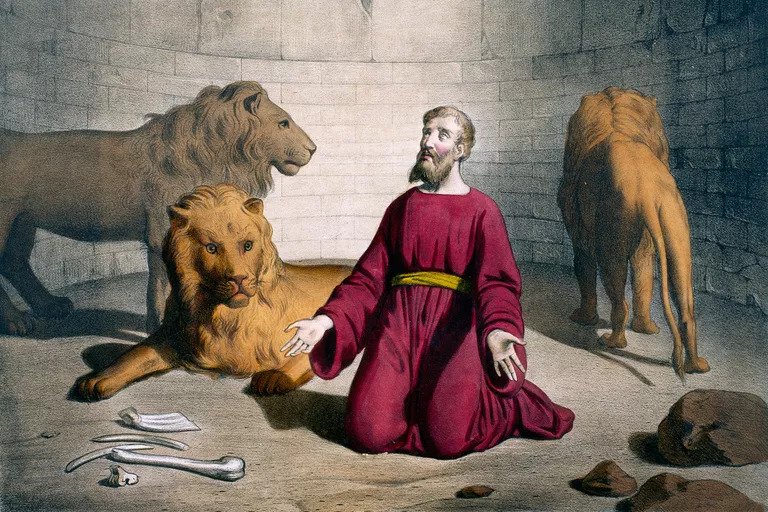
Daniel himself faced the lions alone. When King Darius forbade prayer to anyone but the king, Daniel kept praying. Three times a day he knelt in his upper room, with the windows open toward Jerusalem, and gave thanks to God as he always had (Daniel 6:10). He was thrown into the lions’ den, and God sent His angel to shut the lions’ mouths (Daniel 6:22).

Daniel in the lions’ den
The lesson is not that prayer keeps every danger away. It is that Daniel’s faithfulness in daily prayer gave him the strength to stay faithful when it cost him everything. The Book of Daniel is also where Scripture names the archangel Michael, “the great prince” who protects God’s people (Daniel 10:13; 12:1). You can read more about St. Michael in the Bible.
The Catholic Bible keeps the full Book of Daniel, including the Prayer of Azariah and the Song of the Three Young Men in chapter 3 and the stories of Susanna and of Bel and the Dragon in chapters 13-14. The Song of the Three (“Bless the Lord, all you works of the Lord”) is prayed in the Liturgy of the Hours at Sunday Morning Prayer.
Prayer Is a Conversation With God
It’s been said that prayer is a conversation between the Creator and the creature. God speaks, and we listen. This reflection puts it into simple words:
Reflection: He Speaks
He speaks, and we respond.
He speaks, and we obey.
He speaks, and we rejoice.
He speaks, and we are changed.
He speaks, and we are healed.
He speaks, and we are made whole.
He speaks, and we are blessed.
He speaks, and we are set free.
He speaks, and we are merciful.
He speaks, and we are patient.
He speaks, and we are compassionate.
He speaks, and we are obedient.
Amen.
When to Say the Prayer of Daniel
Daniel’s example suggests some simple times to pray with him:
- In times of distress, when a family member or friend is sick or grieving, or when you feel far from home.
- Three times a day, as Daniel did: morning, midday and evening. The short form takes less than a minute.
- Before Confession, praying Daniel 9:4-19 slowly as an examination of conscience.
- For your country and the Church, when you are troubled by the state of the world. Daniel prayed for a whole people, not just himself.
- During Lent, when the Church itself reads his prayer.
A Daily Prayer in the Spirit of Daniel (Original Prayer)
Great and faithful God,
you keep your covenant with those who love you.
I have sinned, and I am not worthy to ask,
yet I come before you trusting in your great mercy.
Hear my prayer for my family, my parish and my country.
Give me Daniel’s courage to pray every day,
in good times and in danger,
and to stay faithful to you whatever comes.
O Lord, hear; O Lord, forgive.
Through Christ our Lord.
Amen.
Prayer for the Intercession of the Prophet Daniel (Original Prayer)
Holy prophet Daniel,
you prayed with faith in a foreign land
and did not fear the lions.
Pray for me, that I may be faithful in prayer
and humble in confessing my sins.
Ask the Lord to strengthen all who suffer for their faith.
Amen.
Other Old and Powerful Prayers
The Prayer of Daniel is one of the oldest prayers in Scripture. Another ancient prayer of the Church, prayed for more than 1,600 years, is the Nicene Creed. If you would like to read Daniel in the setting of the whole Bible story, try reading the Catholic Bible in chronological order.
Frequently asked questions
Is the 4 sentence prayer of Daniel in the Bible?
Not word for word. The four lines are a popular devotional summary of praise found in the Book of Daniel, such as "Blessed be the name of God for ever and ever" (Daniel 2:20) and the confession that He is "the living God" (Daniel 6:26). The prayer of Daniel that Scripture records in full is Daniel 9:4-19.
What is the prayer of Daniel 9 about?
In Daniel 9:4-19 the prophet praises God's faithfulness, confesses the sins of his people, appeals to God's mercy rather than to their own righteousness, and asks God to restore Jerusalem. It ends with the plea, "O Lord, hear; O Lord, forgive; O Lord, give heed and act." The angel Gabriel then comes with God's answer.
How many times a day did Daniel pray?
Daniel prayed three times a day. Even after King Darius forbade prayer to anyone but the king, Daniel went to his upper room, knelt with the windows open toward Jerusalem, and prayed and gave thanks to God as he always had (Daniel 6:10). Many Catholics imitate this with morning, midday and evening prayer.
Is the prayer of Daniel a miracle prayer?
No prayer works like a formula. The prayer of Daniel is a beautiful Scripture prayer of praise, repentance and trust, and God hears every sincere prayer. But the Church teaches us to pray with humility, leaving the answer to God's wisdom and love, as Daniel did when he relied on God's mercy and not on his own merits.
Sources
- Book of Daniel, chapters 2, 3, 6 and 9 (NABRE)
- Jeremiah 29:10
- Catechism of the Catholic Church, nos. 2631, 2634-2636